Introduction
Walk into a luxury wedding ballroom glowing in soft amber uplighting, a festival stage exploding with synchronized beams, or a corporate launch illuminated in brand colors, and one thing becomes immediately clear: professional LED lighting has become the heartbeat of modern event production. Lighting no longer serves only to make performers visible. It creates emotion, guides attention, defines space, and transforms ordinary venues into immersive experiences people remember long after the event ends.
The shift toward professional color changing LED lights has accelerated because event producers demand flexibility, efficiency, and reliability. Today’s RGB event lights can instantly switch from elegant candlelight tones for speeches to energetic concert scenes during entertainment segments. High-end LED fixtures consume dramatically less power than legacy discharge systems while producing brighter outputs and richer color palettes.
Modern event environments rely heavily on intelligent lighting networks controlled through DMX systems and wireless protocols. Professional fixtures can now synchronize with music, video content, pyrotechnics, and stage automation to create fully integrated productions. The result is a level of creative control that was unimaginable only a decade ago.
This guide explains everything event planners, AV professionals, rental companies, DJs, and venue owners need to know about selecting the best LED lighting for events, from fixture types and control systems to deployment strategies and maintenance considerations.
Looking to upgrade your space with smarter lighting? Explore our guide to Color Changing LED Lights to learn how these versatile lighting solutions can transform homes, gaming setups, events, and commercial spaces. Discover how different color modes, control options, and lighting effects help create the perfect atmosphere for any environment.
What Is Professional LED Lighting?
Definition
Professional LED lighting refers to commercial-grade lighting fixtures designed specifically for entertainment, architectural, theatrical, and live event environments. Unlike consumer products, these systems are engineered for continuous operation, transportation, rapid installation, and precise color reproduction.
Professional fixtures use advanced drivers, thermal management systems, optical components, and intelligent control electronics. They are designed to operate reliably during concerts, weddings, television broadcasts, exhibitions, and festivals where failure is simply not an option.
How Professional RGB LED Lighting Works
Professional RGB fixtures mix red, green, and blue emitters to create millions of color combinations. More advanced fixtures include additional emitters such as white, amber, lime, or ultraviolet to improve color rendering and produce more natural whites and pastel shades.
Every color parameter can be controlled through DMX channels. A moving head fixture may use more than 20 individual channels controlling pan, tilt, color mixing, gobos, zoom, dimming, and strobe effects simultaneously.
Why Professionals Prefer LED Fixtures
Professionals prefer LEDs because they reduce heat output, lower electricity consumption, minimize maintenance requirements, and provide instant color changes without replacing gels or filters.
Modern fixtures also provide exceptional longevity. Premium entertainment fixtures commonly deliver between 50,000 and 100,000 operational hours depending on thermal management and maintenance practices. The lighting industry generally measures lifespan using the L70 standard, representing the point where fixtures retain 70% of their original brightness output rather than completely failing.
Commercial vs Consumer LED Lighting
Consumer fixtures prioritize affordability and simplicity. Commercial fixtures prioritize output consistency, optical quality, durability, and network integration.
A consumer fixture might advertise color changing capability but offer limited brightness and poor color consistency. Professional fixtures deliver calibrated output, precise dimming curves, flicker-free camera performance, and compatibility with industry-standard control systems.
Types of Professional Color Changing LED Lights
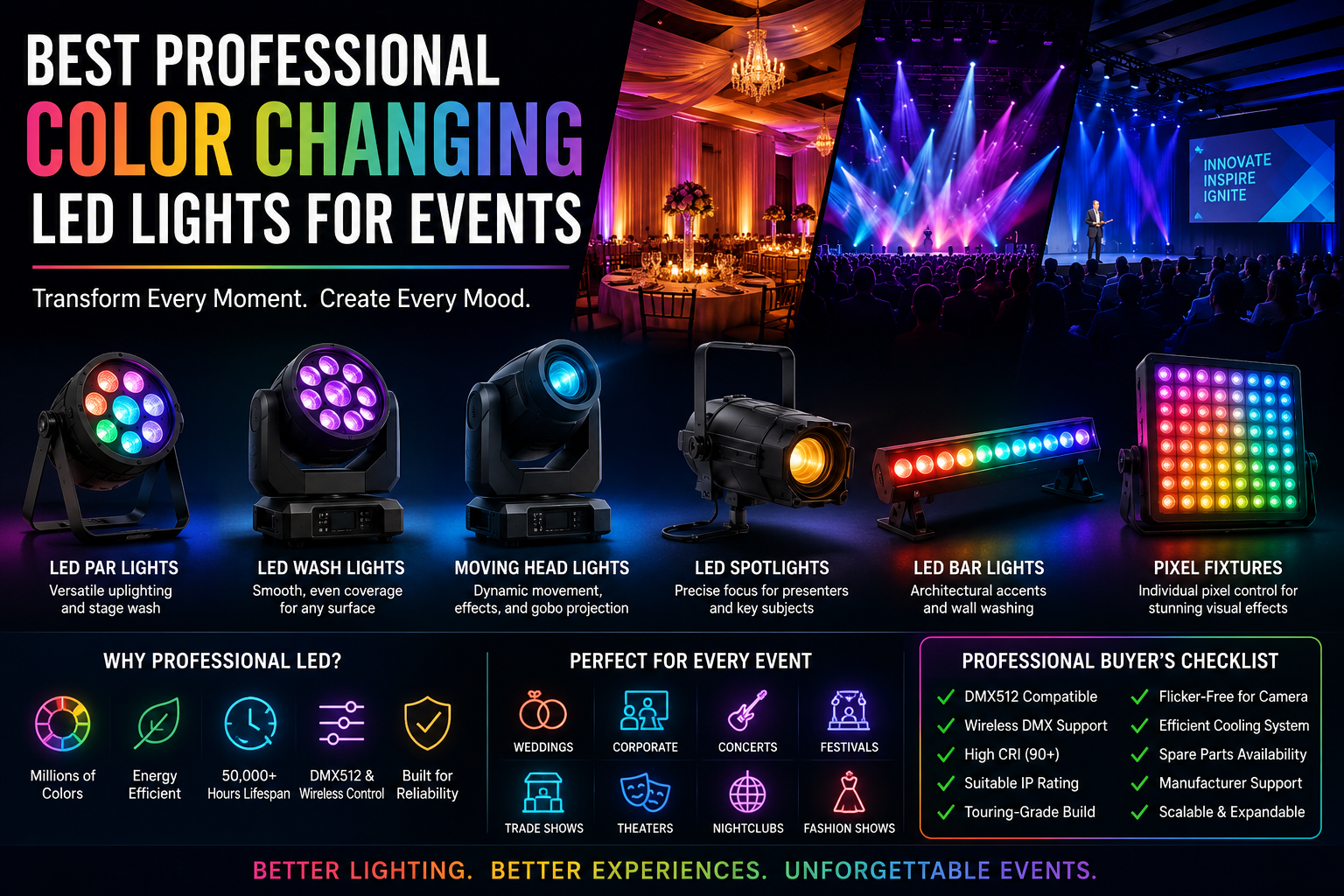
LED PAR Lights
LED PAR fixtures remain the workhorse of event production. Their versatility allows them to serve as uplights, stage washes, wall washers, and architectural accent lights.
Wedding designers frequently use LED PAR fixtures to transform ballrooms with warm amber, blush pink, and royal blue tones. Corporate productions use them to reinforce branding colors, while theaters depend on them for scenic illumination.
LED Wash Lights
Wash fixtures provide broad, even illumination across large surfaces. These fixtures are ideal for stages, projection backdrops, and building facades.
Large wash lights often include motorized zoom systems allowing designers to switch from narrow beams to wide floods instantly. This flexibility reduces fixture counts and simplifies rigging plans.
Moving Head LED Lights
Moving heads dominate concerts, festivals, and large-scale productions. Their ability to pan, tilt, zoom, change colors, and project gobos creates the visual energy audiences expect from modern entertainment lighting.
Moving head fixtures are available in beam, spot, wash, and hybrid variants. Concert productions often combine all four fixture types to maximize visual complexity.
LED Spotlights
Spot fixtures excel at keynote presentations, product launches, and theatrical productions where audience attention must be directed toward speakers or performers.
A well-positioned spotlight creates hierarchy within a visual environment. It tells audiences exactly where to look without requiring verbal direction.
LED Bar Lights
LED bars have become increasingly popular because of their ability to create seamless wall washing and architectural effects. They are particularly effective for trade exhibitions and fashion shows where visual symmetry matters.
Pixel Mapping Fixtures
Pixel fixtures represent the frontier of modern event production. Each LED can be individually controlled, enabling animated effects, video playback, and synchronized visual patterns.
Major touring productions frequently integrate pixel systems with video walls to create immersive environments that blur the boundary between lighting and media.
Fixture Comparison Table
| Fixture Type | Best Use | Beam Type | Mobility | Typical Application |
| LED PAR | Uplighting | Wide | Static | Weddings |
| Wash Light | Background coverage | Wide | Static | Corporate events |
| Moving Head | Dynamic effects | Variable | Motorized | Concerts |
| Spotlight | Presenter focus | Narrow | Static | Conferences |
| LED Bar | Wall washing | Linear | Static | Exhibitions |
| Pixel Fixture | Creative visuals | Programmable | Variable | Festivals |
Choosing Professional LED Lighting for Different Events
Different events require dramatically different design philosophies.
Weddings prioritize elegance, warmth, and atmosphere. Soft uplighting, dance floor effects, and subtle room transformations create emotional resonance without overwhelming guests.
Corporate events emphasize branding consistency and visual professionalism. Lighting often reinforces company colors while supporting camera coverage for hybrid broadcasts.
Concerts require movement, intensity, and synchronization. Designers use moving heads, strobes, blinders, and pixel fixtures to build excitement and support musical dynamics.
Festivals introduce environmental challenges including weather resistance, massive throw distances, and extensive control networks.
Trade shows require high visibility and product illumination. Fixtures must attract attention without causing glare or visual fatigue.
Fashion shows depend heavily on high CRI lighting that accurately reproduces fabric colors and skin tones.
Nightclubs emphasize movement and rhythm. Fast beam effects and synchronized color changes dominate these environments.
Theaters prioritize storytelling. Every lighting cue supports narrative structure and emotional pacing.
RGB vs RGBW vs RGBA vs RGBAL LED Fixtures
| Feature | RGB | RGBW | RGBA | RGBAL |
| Color Accuracy | Good | Better | Excellent | Outstanding |
| White Light Quality | Limited | Strong | Strong | Exceptional |
| Pastel Colors | Weak | Good | Excellent | Outstanding |
| Brightness | High | Higher | Higher | Highest |
| Professional Applications | Basic events | Weddings | Corporate | Broadcast |
RGB fixtures remain suitable for entry-level applications. RGBW systems dominate wedding and event markets because dedicated white emitters improve skin tones and decor presentation.
RGBA systems introduce amber emitters that dramatically improve warm color reproduction. RGBAL fixtures add lime emitters, creating smoother color transitions and improved broadcast performance.
Essential Features to Look For
A professional buyer should evaluate far more than wattage alone.
DMX512 compatibility remains essential because virtually every professional lighting environment depends on standardized control protocols. DMX512 continues to dominate entertainment lighting and allows up to 512 channels within a single universe.
Wireless DMX reduces installation time and cable complexity in historic venues and temporary event spaces.
High CRI ratings improve camera performance and skin tone reproduction.
Color mixing quality determines whether transitions appear smooth or uneven.
Dimming performance affects theatrical fades and cinematic transitions.
Strobe functionality supports concerts and dance environments.
Beam angle selection influences coverage efficiency and fixture counts.
IP ratings determine environmental suitability for outdoor productions.
Cooling systems protect drivers and LEDs from thermal degradation.
Build quality determines long-term ownership costs and resale value.
Professional Lighting Control Systems
Lighting hardware is only half the equation. Control infrastructure determines whether fixtures become tools or merely expensive decorations.
DMX controllers remain the foundation of smaller productions. Larger productions rely on dedicated lighting consoles capable of programming thousands of parameters simultaneously.
Wireless systems increasingly dominate temporary events because they reduce setup times and eliminate cable runs across guest areas.
App-based control platforms have opened professional lighting to smaller production companies and mobile DJs.
Scene programming allows designers to store complete looks and recall them instantly during shows. This capability enables synchronized cue execution across lighting, audio, and video systems.
How Many LED Fixtures Do You Need?
Small Events (50–100 Guests)
Typical configurations include:
- 8–12 LED uplights
- 2 moving heads
- 2 wash fixtures
- 1 controller
Medium Events (100–300 Guests)
Recommended systems include:
- 16–24 uplights
- 6 moving heads
- 4 wash fixtures
- 2 spot fixtures
Large Events (300–1,000+ Guests)
Professional productions commonly deploy:
- 40+ uplights
- 12–24 moving heads
- 8 wash fixtures
- Pixel fixtures
- Multiple DMX universes
Event Fixture Planning Table
| Event Size | Uplights | Moving Heads | Wash Lights | Controllers |
| Small | 8-12 | 2 | 2 | 1 |
| Medium | 16-24 | 6 | 4 | 1-2 |
| Large | 40+ | 12-24 | 8+ | Multiple |
Common Mistakes When Buying Professional LED Lighting
The most expensive mistake is buying consumer equipment for commercial work.
Ignoring DMX compatibility creates expansion limitations. Choosing incorrect beam angles often doubles fixture counts unnecessarily. Underestimating brightness requirements results in washed-out stages and poor camera images.
Another common error involves overlooking venue dimensions. Ceiling heights, throw distances, and surface reflectivity dramatically affect performance.
Purchasing incompatible control systems can create operational nightmares during installation windows where every minute matters.
Installation and Setup Tips
Professional installations begin with fixture placement and power planning.
Cables should follow predictable routes and remain physically separated from audience pathways. Power distribution should account for startup currents and future expansion requirements.
DMX addressing should be documented carefully. Incorrect addressing remains one of the most common causes of troubleshooting delays.
Safety rigging procedures should always include secondary safety bonds for overhead fixtures.
Every system should undergo a complete rehearsal before doors open.
Maintenance and Long-Term Care
Professional fixtures represent significant investments and require preventative maintenance.
Lenses should be cleaned regularly because dust accumulation reduces output dramatically. Cooling fans require inspection and replacement schedules.
Firmware updates often improve functionality and compatibility with newer control platforms.
Transport cases reduce vibration damage during touring operations.
Routine inspections identify connector wear before failures occur during shows.
Premium fixtures frequently achieve 50,000 operational hours or more when maintained correctly, while lower-cost fixtures may experience failures much earlier because of thermal stress and inferior drivers.
Professional Buyer’s Checklist
- DMX512 compatible
- Wireless DMX support
- Minimum CRI of 90
- Suitable IP rating
- Touring-grade housing
- Flicker-free camera mode
- Quality cooling system
- Spare parts availability
- Manufacturer support network
- Expandable control ecosystem
Conclusion
The best professional LED lighting systems do more than illuminate spaces. They shape emotions, direct attention, strengthen branding, and create unforgettable audience experiences.
Successful lighting investments balance fixture quality, control flexibility, maintenance requirements, and future scalability. Weddings require elegance, concerts demand energy, and corporate productions prioritize precision, but every environment benefits from reliable professional lighting systems built for commercial operation.
The event industry continues moving toward smarter fixtures, wireless networks, and increasingly immersive visual environments. Organizations investing in high-quality professional color changing LED lights position themselves to deliver exceptional experiences while reducing energy consumption and long-term operating costs.
FAQs
What is professional LED lighting?
Professional LED lighting refers to commercial-grade fixtures designed for entertainment, stage, broadcast, and event environments.
What are the best LED lights for events?
The best combination usually includes LED PAR fixtures, wash lights, and moving heads.
Are LED PAR lights good for weddings?
Yes. They remain the most popular choice for wedding uplighting and room transformation.
What is DMX lighting?
DMX512 is the entertainment industry’s standard communication protocol used to control lighting fixtures and effects equipment.
How many LED lights are needed for an event?
Requirements depend on venue size, ceiling height, and production goals.
What is the difference between RGB and RGBW?
RGBW fixtures include a dedicated white emitter that improves natural white light quality.
Are moving head lights worth it?
Absolutely. They provide unmatched versatility for concerts and dynamic productions.
Can professional LED lights be controlled wirelessly?
Yes. Wireless DMX solutions are increasingly common in event environments.
What IP rating is best for outdoor events?
IP65 or higher is recommended for outdoor installations.
How long do professional LED fixtures last?
High-quality fixtures commonly achieve between 50,000 and 100,000 operating hours under proper maintenance conditions.
What is the best lighting for concerts?
Moving heads, wash fixtures, blinders, and pixel fixtures create the greatest flexibility.
Do professional LED lights consume a lot of electricity?
No. LEDs are dramatically more efficient than traditional discharge technologies.