Introduction
Finding where to buy professional beam lights is not as simple as choosing the brightest fixture or the lowest price. In professional event production, the supplier behind the product often determines whether your lighting investment becomes a long-term asset or a recurring maintenance headache. A high-quality beam light backed by poor support can create expensive downtime during concerts, corporate events, and venue operations.
Today’s market offers countless options for sourcing professional stage lighting, from global manufacturers and regional distributors to online B2B marketplaces and specialized stage lighting dealers. Each channel comes with advantages and trade-offs. The challenge for buyers is understanding which source best matches their operational requirements, budget, and support expectations.
Whether you’re building a rental inventory, upgrading a nightclub installation, managing a concert venue, or importing fixtures for distribution, supplier selection deserves the same attention as fixture selection. This guide complements the pillar resource “Beam Lights: Complete Guide to Stage, DJ & Event Lighting“ and focuses specifically on procurement, supplier evaluation, and purchasing strategies.
Recent industry supplier data shows that leading manufacturers increasingly emphasize OEM capabilities, DMX512 compatibility, global certifications, and after-sales support as key differentiators in the professional lighting market. Many established manufacturers now support customers across more than 100 countries while offering customized solutions and spare parts programs.
What Are Professional Beam Lights?
Professional beam lights are specialized fixtures designed to produce concentrated, high-intensity light beams that remain visible over long distances. Unlike wash fixtures that spread illumination across broad areas, a beam light creates a narrow shaft of light that cuts through haze, fog, and atmospheric effects.
Modern moving head lighting systems combine advanced optics, LED technology, precision motors, and DMX512 control protocols. These fixtures allow lighting designers to create dynamic aerial effects, synchronized movement patterns, and dramatic visual moments during performances.
Common applications include:
- Concert lighting
- Touring productions
- Corporate events
- Wedding productions
- Nightclubs
- Television studios
- Festivals
- Permanent venue installations
Examples of professional fixtures include the 295W Beam Moving Head Light, commonly used by rental companies and concert organizers, and the 380W Beam Moving Head Light, which is better suited for large-scale outdoor productions and stadium environments.
Professional beam lighting systems are typically integrated with a lighting console, truss system, DMX networking infrastructure, and broader event production lighting ecosystems. The result is a highly coordinated visual experience that transforms an ordinary stage into an immersive performance environment.
Where Can You Buy Professional Beam Lights?
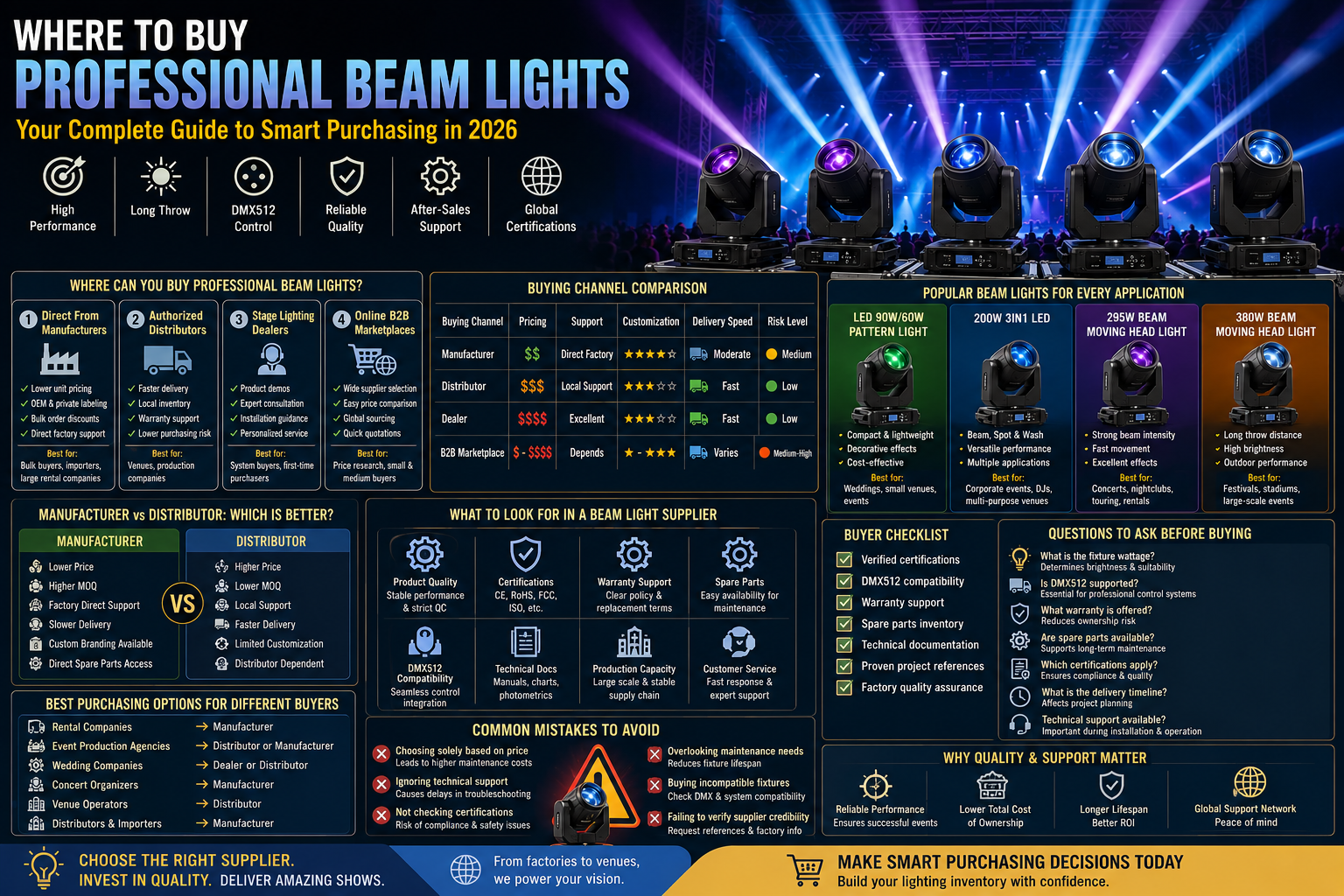
Direct From Manufacturers
Buying directly from a beam light manufacturer is one of the most common strategies for large-scale buyers.
Advantages
- Lower unit pricing
- Direct factory communication
- OEM manufacturing options
- Private labeling opportunities
- Better access to technical specifications
- Bulk order discounts
Disadvantages
- Higher minimum order quantities (MOQs)
- Longer shipping times
- Import responsibilities
- International warranty considerations
Many manufacturers now offer complete product portfolios including moving head fixtures, beam lights, wash lights, spotlights, and DMX control systems. Several leading factories also provide CE-certified products, OEM services, and large-scale production capabilities.
Authorized Distributors
Authorized distributors bridge the gap between manufacturers and end users.
Advantages
- Faster delivery
- Local inventory
- Easier warranty processing
- Regional technical support
- Lower purchasing risk
Disadvantages
- Higher prices
- Limited customization options
Distributors are often the preferred option for venue operators and production companies requiring immediate access to equipment.
Stage Lighting Dealers
Specialized stage lighting dealers focus on consultation and system design.
Advantages
- Product demonstrations
- Technical recommendations
- Installation guidance
- Personalized support
Disadvantages
- Smaller inventory
- Limited brand availability
Dealers are particularly valuable for buyers building complete lighting systems rather than purchasing individual fixtures.
Online B2B Marketplaces
Global sourcing platforms have transformed how companies buy beam lights.
Advantages
- Large supplier selection
- Easy price comparison
- International sourcing opportunities
- Quick quotation requests
Disadvantages
- Difficult supplier verification
- Quality inconsistencies
- Communication challenges
Buying Channel Comparison
| Buying Channel | Pricing | Support | Customization | Delivery Speed | Risk Level |
| Manufacturer | Lowest | Direct Factory | Excellent | Moderate | Medium |
| Distributor | Moderate | Local | Limited | Fast | Low |
| Dealer | Higher | Excellent | Limited | Fast | Low |
| B2B Marketplace | Varies | Depends | Varies | Varies | Medium-High |
Manufacturer vs Distributor: Which Is Better?
| Factor | Manufacturer | Distributor |
| Price | Lower | Higher |
| MOQ | Usually Higher | Usually Lower |
| Support | Factory Direct | Local Support |
| Delivery Speed | Slower | Faster |
| Custom Branding | Available | Limited |
| Spare Parts Access | Direct Access | Distributor Dependent |
Choose a manufacturer when:
- Buying wholesale quantities
- Importing products
- Requiring OEM branding
- Building rental inventories
Choose a distributor when:
- Fast deployment is critical
- Local warranty support is important
- Smaller quantities are needed
- Technical assistance is required immediately
What to Look for in a Beam Light Supplier
A professional stage lighting supplier should be evaluated using multiple criteria rather than pricing alone.
Product Quality
Ask about testing procedures, optical systems, cooling design, and quality assurance programs. Reputable suppliers typically perform extensive testing before shipment and maintain documented quality control processes.
Warranty Support
Look for suppliers offering clear warranty terms, replacement policies, and technical support channels.
Spare Parts Availability
Availability of motors, power supplies, lenses, and control boards can significantly reduce downtime.
Technical Documentation
Request:
- User manuals
- DMX channel charts
- Photometric data
- Lux output reports
- Beam angle specifications
Certifications
Verify certifications such as:
- CE
- RoHS
- FCC
- ISO quality management standards
Industry-leading manufacturers frequently highlight these certifications as evidence of compliance and reliability.
Production Capacity
Large-scale manufacturers often maintain significant annual production capacity and dedicated R&D teams, ensuring stable supply chains.
Customer Service
Evaluate response times, technical expertise, and communication quality before placing large orders.
Buyer Checklist
✅ Verified certifications
✅ Spare parts inventory
✅ Warranty support
✅ DMX512 compatibility
✅ Technical documentation
✅ Proven project references
✅ Factory quality assurance process
Questions to Ask Before Buying Beam Lights
| Question | Why It Matters |
| What is the fixture wattage? | Determines brightness and application suitability |
| Is DMX512 supported? | Essential for professional control systems |
| What warranty is offered? | Reduces ownership risk |
| Are spare parts available? | Supports long-term maintenance |
| Which certifications apply? | Ensures compliance and quality |
| Delivery timeline? | Affects project planning |
| Technical support available? | Important during installation and operation |
Best Purchasing Options for Different Buyers
| Buyer Type | Recommended Channel |
| Rental Companies | Manufacturer |
| Event Production Agencies | Distributor or Manufacturer |
| Wedding Companies | Dealer or Distributor |
| Concert Organizers | Manufacturer |
| Venue Operators | Distributor |
| Distributors & Importers | Manufacturer |
Rental companies often benefit from direct factory relationships because volume purchasing reduces costs. Venue operators, meanwhile, frequently prioritize local service and rapid support.
How to Compare Beam Light Suppliers
Product Portfolio
A strong supplier should offer beam, wash, spot, and hybrid fixtures alongside accessories.
Product Consistency
Consistency matters more than peak performance. Every fixture should deliver similar output and color characteristics.
Factory Experience
Manufacturers with 15–20+ years of experience often have stronger quality systems and broader engineering expertise.
Customization Capabilities
OEM manufacturing can be valuable for distributors and large rental businesses.
Logistics Support
Evaluate shipping methods, export experience, and packaging standards.
Long-Term Partnership Potential
A supplier relationship should support future growth, inventory expansion, and evolving technology requirements.
Common Mistakes When Buying Professional Beam Lights
Many buyers focus exclusively on fixture pricing while overlooking critical operational factors.
Choosing Solely Based on Price
Low-cost fixtures often generate higher ownership costs through maintenance and replacement needs.
Ignoring Technical Support
Technical support becomes crucial during system integration and troubleshooting.
Not Checking Certifications
Certification verification protects against compliance and safety issues.
Overlooking Maintenance Requirements
Complex moving head fixtures require regular servicing.
Buying Incompatible Fixtures
Always confirm compatibility with existing lighting consoles, DMX infrastructure, and event production systems.
Failing to Verify Supplier Credibility
Request references, project portfolios, certifications, and factory information before committing to major purchases.
How to Choose the Right Beam Light for Your Application
Small Venues
The LED 90W/60W Pattern Light is often sufficient for wedding stages, banquet halls, and decorative applications where extreme brightness is unnecessary.
Multi-Purpose Events
The 200W 3in1 LED offers flexibility for DJs, corporate productions, and mixed-use event environments requiring multiple lighting effects from a single fixture.
Professional Concerts
The 295W Beam Moving Head Light delivers the intensity, beam projection, and movement capabilities commonly required for touring productions and professional concert lighting.
Large Festivals
For stadiums and outdoor events, the 380W Beam Moving Head Light provides the output necessary to compete with ambient light and cover large performance spaces effectively.
Selecting the correct fixture depends on beam angle, lux output, throw distance, venue size, and integration requirements rather than simply choosing the highest wattage available.
Final Thoughts
Successful beam light procurement involves much more than comparing product specifications. The strongest purchasing decisions combine technical evaluation, supplier assessment, certification verification, and long-term support planning.
Whether you purchase directly from a beam light manufacturer, partner with a moving head beam light supplier, or work through a local distributor, your goal should be long-term reliability and operational efficiency.
Conclusion
The answer to where to buy professional beam lights depends on your business model, budget, and operational requirements. Manufacturers typically offer the best pricing and customization opportunities, while distributors and dealers provide convenience, local support, and faster delivery.
The most successful buyers evaluate suppliers using objective criteria such as quality assurance, certifications, production capacity, spare parts support, and customer service. Taking time to assess these factors helps avoid costly mistakes and ensures your investment delivers value for years to come.
10 FAQs
1. Where can I buy professional beam lights?
You can buy them directly from manufacturers, authorized distributors, stage lighting dealers, or online B2B sourcing platforms.
2. Should I buy beam lights directly from a manufacturer?
Yes, if you need bulk quantities, OEM branding, or lower pricing.
3. What should I look for in a beam light supplier?
Focus on certifications, warranty support, spare parts availability, and technical expertise.
4. Are wholesale beam lights worth buying?
They can significantly reduce per-unit costs for rental companies and distributors.
5. How do I choose a reliable lighting manufacturer?
Verify certifications, production capacity, quality control processes, and customer references.
6. What is DMX512?
DMX512 is the industry-standard protocol used to control professional lighting fixtures.
7. What wattage beam light is best for concerts?
295W and above are commonly used for professional concert applications.
8. Why are certifications important?
They help ensure product safety, reliability, and regulatory compliance.
9. Do manufacturers provide spare parts?
Most professional manufacturers offer replacement parts and technical support programs.
10. What is the difference between beam, spot, and wash lights?
Beam lights create narrow shafts of light, spot lights project patterns, and wash lights provide broad illumination.
Where can I buy professional beam lights?
Professional beam lights can be purchased from manufacturers, authorized distributors, stage lighting dealers, and online B2B marketplaces. Manufacturers offer lower pricing and customization, while distributors provide faster delivery and local support.
What should I look for in a beam light supplier?
Look for certifications, DMX512 compatibility, warranty support, spare parts availability, production capacity, technical documentation, and proven project experience.