Introduction
Professional beam lighting systems have become an essential part of modern event production. From concerts and nightclubs to weddings and corporate events, intelligent fixtures create dramatic aerial effects and dynamic movement that transform ordinary stages into immersive experiences.
Understanding the technical side of beam lights is just as important as selecting the fixtures themselves. Proper installation, programming, maintenance, and power distribution directly influence reliability, safety, and visual performance. Even high-end fixtures can fail prematurely when cooling systems are ignored or electrical loads are improperly planned.
DMX control gives lighting technicians precise command over movement, colors, gobos, prism effects, and dimming. According to current industry references, DMX512 remains the dominant communication protocol for professional stage lighting and supports up to 512 channels per universe. Reliable addressing and cabling practices are essential to avoid communication issues. Recent technical guides continue to recommend proper termination and dedicated lighting circuits for dependable operation.
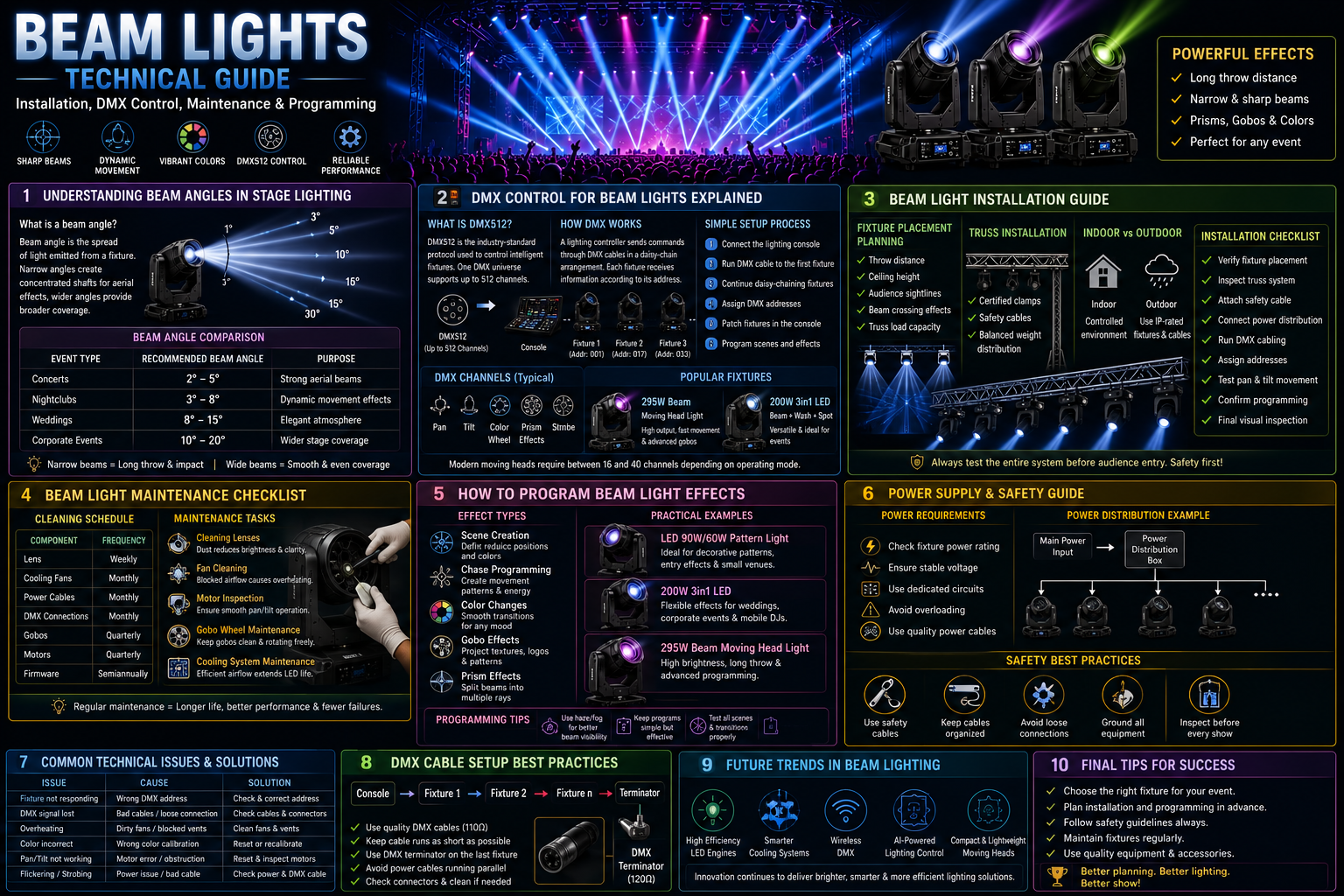
Complete Guide to Stage, DJ & Event Lighting explores how powerful beam lights transform stages, events, and live performances with sharp beams and dynamic effects. Discover different types, key features, and practical tips to select the ideal beam lighting solution for professional setups.
Understanding Beam Angles in Stage Lighting
What is a beam angle in stage lighting?
A beam angle is the spread of light emitted from a fixture. Narrow beam angles create concentrated shafts for aerial effects, while wider beam angles provide broader coverage suitable for wash and ambient lighting.
Beam Angle Comparison
| Event Type | Recommended Beam Angle | Purpose |
| Concerts | 2°–5° | Strong aerial beams |
| Nightclubs | 3°–8° | Dynamic movement effects |
| Weddings | 8°–15° | Elegant atmosphere |
| Corporate Events | 10°–20° | Wider stage coverage |
Narrow beam fixtures produce highly concentrated light columns that work exceptionally well in haze-filled environments. Concert lighting designers often prefer these narrow beams because they create sharp visual lines visible even at long throw distances.
Wider beam angles distribute light over larger areas. Wedding stage lighting and banquet events benefit from softer effects that avoid overwhelming the audience. Choosing the right beam angle ultimately depends on venue size, ceiling height, and desired visual impact.
DMX Control for Beam Lights Explained
What Is DMX512?
DMX512 is the industry-standard communication protocol used for controlling intelligent fixtures. It transmits digital commands between a lighting console and beam lights. One DMX universe supports up to 512 control channels.
How DMX Works
A lighting controller sends commands through DMX cables connected in a daisy-chain arrangement. Each fixture receives information according to its assigned address.
Simple Setup Process
- Connect the lighting console.
- Run DMX cable to the first fixture.
- Continue daisy-chaining fixtures.
- Assign DMX addresses.
- Patch fixtures inside the console.
- Program scenes and effects.
Practical Example
295W Beam Moving Head Light
Professional concert systems commonly use this fixture because it provides strong output, fast pan and tilt motors, and sophisticated gobo effects.
200W 3in1 LED
This versatile fixture combines beam, wash, and spot functions. It is ideal for event companies seeking flexible programming options.
DMX Channels
Typical channel assignments include:
- Pan
- Tilt
- Color wheel
- Gobos
- Prism effects
- Focus
- Dimmer
- Strobe
Modern moving heads frequently require between 16 and 40 channels depending on operating mode.
Beam Light Installation Guide
Professional installation begins long before fixtures are hung on the truss.
Fixture Placement Planning
Lighting designers evaluate:
- Throw distance
- Ceiling height
- Audience sightlines
- Beam crossing effects
- Truss load capacity
Truss Installation
Fixtures should always be mounted with:
- Certified clamps
- Safety cables
- Balanced weight distribution
Indoor vs Outdoor Installations
Indoor venues offer controlled environments, whereas outdoor festivals require weather protection and IP-rated connections.
Installation Checklist
✓ Verify fixture placement
✓ Inspect truss system
✓ Attach safety cable
✓ Connect power distribution
✓ Run DMX cabling
✓ Assign addresses
✓ Test pan and tilt movement
✓ Confirm programming
✓ Perform final visual inspection
Technicians should always conduct full system tests before audience entry. Improper rigging remains one of the leading causes of fixture damage and safety incidents.
Beam Light Maintenance Checklist
Routine maintenance significantly extends fixture lifespan.
Cleaning Schedule
| Component | Frequency |
| Lens | Weekly |
| Cooling Fans | Monthly |
| Power Cables | Monthly |
| DMX Connections | Monthly |
| Gobos | Quarterly |
| Motors | Quarterly |
| Firmware | Semiannually |
Maintenance Tasks
Cleaning Lenses
Dust accumulation reduces brightness and beam clarity.
Fan Cleaning
Blocked airflow causes overheating and shortens LED life.
Motor Inspection
Pan and tilt motors should operate smoothly without unusual noise.
Gobo Wheel Maintenance
Gobo mechanisms must rotate freely and remain free from debris.
Cooling System Maintenance
Efficient thermal management plays a major role in fixture longevity. Modern LED fixtures rely heavily on cooling fans and airflow design.
How to Program Beam Light Effects
Programming converts raw hardware into a visual experience.
Scene Creation
Scenes define static positions and colors.
Chase Programming
Chases create sequential movement patterns that add energy to performances.
Color Changes
Smooth color transitions are essential in wedding productions and theatrical presentations.
Gobo Effects
Gobos project textures, logos, and patterns onto stages and walls.
Prism Effects
Prisms split beams into multiple rays, creating spectacular aerial effects.
Practical Examples
LED 90W/60W Pattern Light
Ideal for beginners learning DMX programming and decorative applications. Its lower power consumption makes it perfect for smaller venues.
200W 3in1 LED
Supports beam, wash, and spot effects, providing exceptional flexibility for rental companies.
Music Synchronization
Programming movement sequences around BPM and musical phrases helps produce professional-looking shows.
Power Requirements for Beam Lights
Power planning prevents circuit failures and unexpected shutdowns.
Current industry guides emphasize using maximum fixture consumption instead of LED wattage alone because motors, fans, and electronics also contribute to total load. Additional safety margins of 20–30% are recommended.
Power Comparison Table
| Fixture Type | Approximate Power Consumption |
| LED 90W/60W Pattern Light | 60–90W |
| 200W 3in1 LED | 200–250W |
| 295W Beam Moving Head Light | 300–350W |
| 380W Beam Moving Head Light | 400–450W |
Voltage Requirements
Most professional fixtures support:
- 100V–240V AC
- 50Hz/60Hz operation
Surge Protection
Surge protectors and circuit protection devices help safeguard expensive equipment.
Backup Power
Large productions frequently incorporate:
- UPS systems
- Generators
- Redundant power feeds
Common Technical Problems & Troubleshooting
No DMX Signal
Checklist:
✓ Verify addresses
✓ Inspect cable polarity
✓ Check termination
✓ Confirm controller output
Fixture Not Powering On
✓ Inspect fuse
✓ Test power cable
✓ Verify voltage
Overheating
✓ Clean cooling fans
✓ Improve airflow
✓ Reduce ambient temperature
Pan/Tilt Errors
✓ Reset fixture
✓ Inspect motor assembly
✓ Update firmware
Color Wheel Malfunctions
✓ Clean internal components
✓ Replace damaged parts
Beam Alignment Problems
✓ Recalibrate fixture
✓ Verify optical components
Communication problems are frequently caused by addressing mistakes or cable issues rather than fixture failures. Experienced technicians usually troubleshoot the control network first. Community discussions and professional practice consistently support this approach.
Best Practices for Professional Beam Light Operation
Successful lighting systems combine technology, maintenance, and planning.
Professional recommendations include:
- Use certified truss systems.
- Always install safety cables.
- Clean fixtures regularly.
- Protect equipment during transport.
- Balance electrical loads.
- Maintain backup components.
- Store fixtures in road cases.
- Train technicians on programming and maintenance.
Rental companies operating 295W Beam Moving Head Lights and 380W Beam Moving Head Lights often prioritize preventive maintenance because downtime directly affects profitability.
Efficient operation also involves careful power distribution and proper transportation methods. Beam fixtures represent significant investments, and proactive care ensures maximum return on that investment.
Final Thoughts
DMX control remains the backbone of professional beam lighting systems. Understanding installation procedures, addressing methods, maintenance routines, programming strategies, and power requirements enables technicians to achieve reliable performance in concerts, weddings, festivals, and corporate productions.
Whether deploying entry-level LED 90W/60W Pattern Lights or high-output 380W Beam Moving Head Lights, success depends on combining sound engineering practices with creative lighting design.
FAQs
What is DMX control in stage lighting?
DMX control is a digital communication protocol used to control lighting fixtures and effects.
How do you install a beam light?
Mount the fixture securely, attach a safety cable, connect power, wire DMX, assign addresses, and test operation.
How often should beam lights be maintained?
Basic cleaning should be weekly, with detailed inspections monthly and quarterly.
How do you program moving head beam lights?
Using a lighting console, create scenes, chases, movement effects, and synchronize them with music.
How much power does a beam light use?
Depending on the model, consumption typically ranges from 60W to 450W.
What beam angle is best for stage lighting?
Concerts usually favor narrow 2°–5° beams, while weddings benefit from wider angles.
Why is my beam light not responding to DMX?
Incorrect addressing or faulty cables are the most common causes.
What is a lighting console?
A lighting console is the controller used to program and operate fixtures.
What are gobos?
Gobos are patterned discs used to project shapes and textures.
What are prism effects?
Prisms split one beam into multiple beams for dramatic aerial visuals.