Introduction
Choosing the right stage lighting fixture can completely transform the atmosphere of an event. Whether you’re designing a nightclub, preparing for a wedding, organizing a concert, or managing a rental inventory, understanding the differences between fixtures is essential. Each type of professional lighting equipment serves a unique purpose, and selecting the wrong fixture can lead to disappointing results and unnecessary costs.
Modern event production relies heavily on four popular categories: beam lights, wash lights, spot lights, and LED Par lights. While they are all part of intelligent lighting systems, their beam angle, throw distance, lux output, and creative capabilities differ significantly.
Complete Guide to Stage, DJ & Event Lighting explains how beam lights enhance concerts, DJ shows, and professional events with powerful effects and dynamic lighting. Explore types, features, applications, and expert tips to choose the right beam light setup for any event.
Beam Light vs Wash Light
What Is a Beam Light?
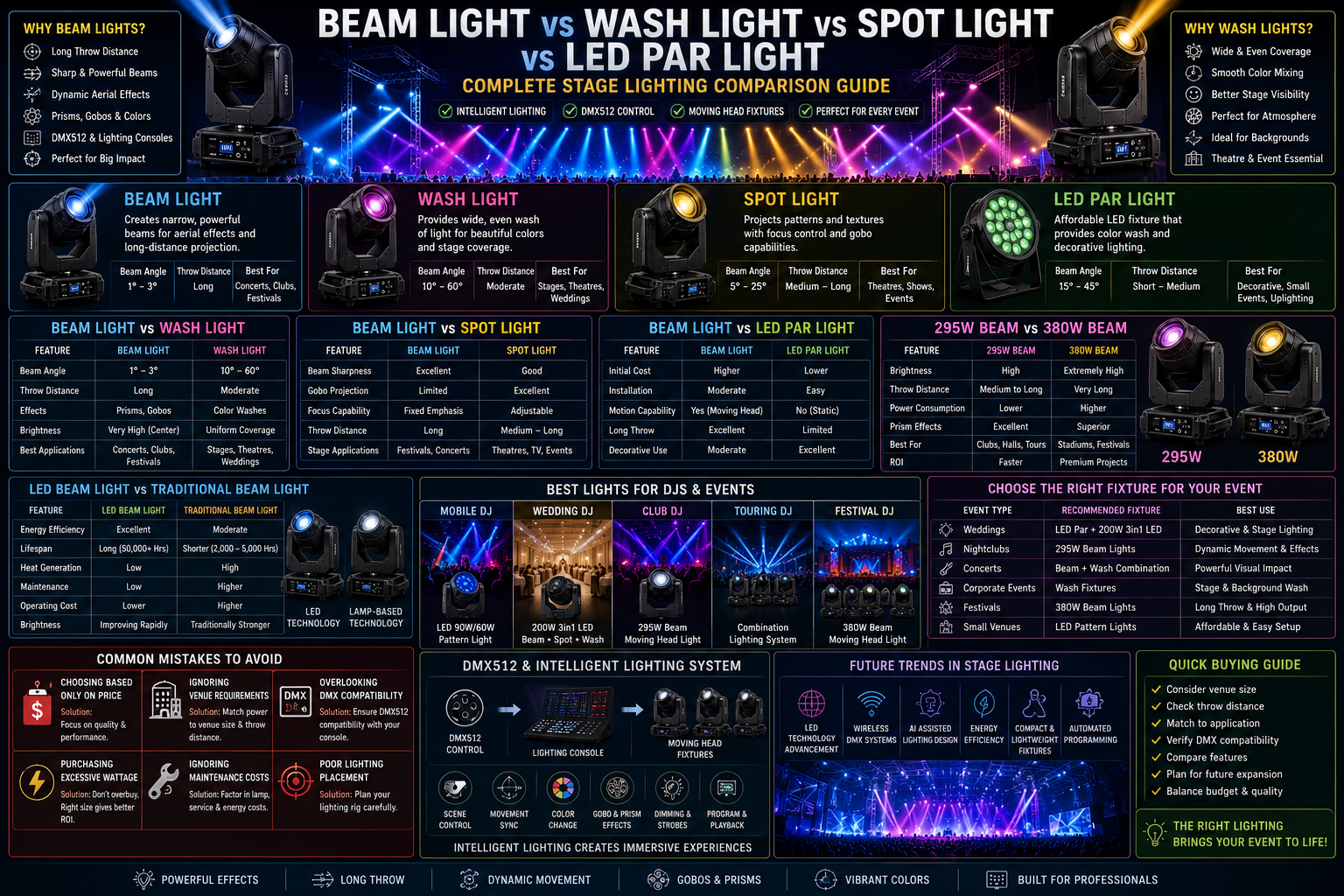
A beam light is designed to create extremely narrow and powerful shafts of light. These moving head fixtures typically produce beam angles between 1° and 3°, making them ideal for aerial effects and long-distance projection. Beam lights are widely used in concert lighting, festivals, and nightclubs where dramatic visual impact is essential. Many professional fixtures incorporate gobos and prism effects controlled through DMX512 and lighting consoles.
What Is a Wash Light?
Wash lights focus on broad and even illumination. Instead of producing sharp beams, they create smooth color coverage across stages and backgrounds. They are widely used in theatre productions, corporate events, and wedding stage lighting where atmosphere and visibility are more important than aerial effects. Modern LED wash fixtures provide excellent color mixing and smooth dimming performance.
Key Differences
| Feature | Beam Light | Wash Light |
| Beam Angle | 1°–3° | 10°–60° |
| Throw Distance | Long | Moderate |
| Effects | Prisms, gobos | Color washes |
| Brightness | Very high center intensity | Uniform coverage |
| Best Applications | Concerts, clubs | Stages, theatres |
Beam lights dominate high-energy productions, while wash fixtures create mood and atmosphere. Most professional stage designs combine both fixture types for balanced visual results.
Beam Light vs Spot Light
Beam Light Characteristics
Beam fixtures excel at creating concentrated shafts visible through haze. Their narrow optics make them ideal for dramatic effects, synchronized lighting programming, and concert stages.
Spot Light Characteristics
Spot fixtures are more versatile. Unlike beam fixtures, spot lights can project gobos, create textured effects, and focus images with greater precision. They are frequently used in theatres and television productions.
Performance Comparison
| Feature | Beam Light | Spot Light |
| Beam Sharpness | Excellent | Good |
| Gobo Projection | Limited | Excellent |
| Focus Capability | Fixed emphasis | Adjustable |
| Throw Distance | Long | Medium to Long |
| Stage Applications | Festivals | Theatres |
A beam spotlight delivers unmatched aerial effects, whereas spot lights provide greater creative flexibility. Lighting designers often install both within truss systems to achieve dynamic stage design.
Beam Light vs LED Par Light
Beam Light Advantages
Beam lights deliver impressive long-range projection and are perfect for large venues. Their intensity remains visible even in smoke and haze, making them ideal for concerts and festivals.
LED Par Light Advantages
LED Par lights offer affordability, simplicity, and efficient color washes. They are commonly used for wedding stage lighting, corporate events, and smaller venues where extensive moving head lighting is unnecessary.
Cost Comparison
| Feature | Beam Light | LED Par Light |
| Initial Cost | Higher | Lower |
| Installation Complexity | Moderate | Easy |
| Motion Capability | Yes | Usually No |
| Long Throw | Excellent | Limited |
| Decorative Use | Moderate | Excellent |
The LED 90W/60W Pattern Light is particularly suitable for decorative projections and entry-level installations. For smaller event lighting setups, it provides excellent value while complementing larger intelligent lighting systems.
Beam 295W vs Beam 380W
Choosing between a 295W Beam Moving Head Light and a 380W Beam Moving Head Light often depends on venue size and throw distance requirements.
Detailed Comparison
| Feature | 295W Beam | 380W Beam |
| Brightness | High | Extremely High |
| Throw Distance | Medium to Long | Very Long |
| Power Consumption | Lower | Higher |
| Prism Effects | Excellent | Superior |
| Venue Size | Clubs and halls | Stadiums and festivals |
| ROI | Faster | Premium projects |
The 295W Beam Moving Head Light is ideal for clubs, medium-sized venues, touring productions, and concert stages. It provides excellent performance without excessive power consumption.
Meanwhile, the 380W Beam Moving Head Light is designed for large-scale applications where long-distance projection and maximum intensity are critical. Festival organizers and stadium productions often choose these fixtures because they maintain visibility across massive spaces.
LED Beam Light vs Traditional Beam Light
LED Technology
LED technology has transformed the lighting industry. LED beam lights provide lower operating costs, minimal heat generation, and significantly longer lifespan. Maintenance requirements are also reduced.
Traditional Lamp-Based Technology
Traditional discharge lamps remain popular because of their extremely high intensity and established performance. However, replacement lamps and heat management increase ownership costs.
Comparison Table
| Feature | LED Beam Light | Traditional Beam Light |
| Energy Efficiency | Excellent | Moderate |
| Lifespan | Long | Shorter |
| Heat Generation | Low | High |
| Maintenance | Low | Higher |
| Operating Cost | Lower | Higher |
| Brightness | Improving rapidly | Traditionally stronger |
Industry trends indicate that LED technology will continue dominating future intelligent lighting solutions due to efficiency and sustainability benefits.
Which Stage Light Is Best for DJs?
Different DJs require different lighting setups.
Mobile DJs
Mobility and affordability matter most. The LED 90W/60W Pattern Light provides decorative effects with minimal setup requirements.
Wedding DJs
Versatility becomes essential. The 200W 3in1 LED combines beam, spot, and wash functionality, making it perfect for varying event themes.
Club DJs
Professional beam lights such as the 295W Beam Moving Head Light provide energetic and dynamic effects synchronized through DMX lighting systems.
Festival DJs
Large-scale performances benefit from the superior output of 380W Beam Moving Head Lights.
Recommendation Table
| DJ Type | Recommended Fixture |
| Mobile DJ | LED 90W/60W Pattern Light |
| Wedding DJ | 200W 3in1 LED |
| Club DJ | 295W Beam Moving Head Light |
| Touring DJ | Combination System |
| Festival DJ | 380W Beam Moving Head Light |
Choosing the Right Fixture Based on Your Event
| Event Type | Recommended Fixture |
| Weddings | LED Par + 200W 3in1 LED |
| Nightclubs | 295W Beam Lights |
| Concerts | Beam + Wash Combination |
| Corporate Events | Wash Fixtures |
| Festivals | 380W Beam Lights |
| Small Venues | LED Pattern Lights |
Before purchasing, consider:
- Venue size.
- Ceiling height.
- Audience capacity.
- Budget.
- Desired lighting effects.
- DMX compatibility.
- Future expansion plans.
Professional lighting systems work much like an orchestra. Each fixture plays a specific role, and harmony comes from combining them correctly.
Common Mistakes When Comparing Stage Lights
Choosing Based Only on Price
Lower prices often mean reduced performance and shorter lifespan. A cheap fixture may become more expensive in the long run.
Ignoring Venue Requirements
Buying excessive wattage for a small venue wastes money and energy. Likewise, underpowered fixtures struggle in large spaces.
Overlooking DMX Compatibility
DMX512 communication is essential for intelligent lighting. Ensuring compatibility with your lighting console simplifies programming and synchronization.
Purchasing Excessive Wattage
Bigger isn’t always better. Matching lux output and beam angle to application requirements delivers better ROI.
Ignoring Maintenance Costs
Lamp replacements, cooling systems, and energy consumption all contribute to total ownership cost.
Final Thoughts
Comparing beam lights, wash lights, spot lights, and LED Par lights reveals one important truth: there is no universal solution. Each fixture excels in specific situations.
Beam lights deliver spectacular aerial effects. Wash fixtures provide atmosphere and color coverage. Spot lights bring creativity through gobos and focus capabilities. LED Par lights remain practical and economical for many event lighting applications.
Professional event production companies rarely rely on a single fixture type. Instead, they combine moving head fixtures, intelligent lighting systems, DMX control, and lighting programming to achieve stunning visual experiences.
Readers interested in expanding their knowledge should also explore:
- Beam Lights: Complete Guide to Stage, DJ & Event Lighting
- Moving Head Beam Lights
- Beam Light Buying Guide
- Stage Lighting Applications
- DMX Control for Beam Lights
Comparing specifications carefully and discussing project requirements with experienced lighting professionals can help buyers maximize both performance and budget.
What is the difference between a beam light and a wash light?
A beam light creates narrow, high-intensity shafts for dramatic effects, while a wash light provides wide and even illumination for atmosphere and stage coverage.
Is a beam light better than a spot light?
Not necessarily. Beam lights excel in aerial effects, whereas spot lights offer superior gobo projection and focus control.
Can LED Par lights replace beam lights?
No. LED Par lights are excellent for color washes and decoration, but they cannot replicate long-distance beam effects.
Should I choose a 295W or 380W beam light?
295W models are suitable for clubs and medium venues. 380W fixtures are better for festivals and stadium applications.
Are LED beam lights better than traditional beam lights?
LED beam lights offer lower maintenance and operating costs, while traditional beam lights still provide exceptional brightness.
FAQs
What is the best stage light for DJs?
The best choice depends on venue size and event type. Hybrid fixtures are highly versatile.
What does DMX512 do?
DMX512 enables communication between fixtures and lighting consoles.
What are moving head fixtures?
They are intelligent lighting devices capable of pan and tilt movement.
Why are beam lights popular in concerts?
Because they create dramatic aerial effects visible through haze.
Are wash lights necessary?
Yes. They provide the foundation for color and atmosphere.
What are gobos?
Gobos are patterns projected through spot fixtures.
What are prism effects?
Prisms split beams into multiple rays for enhanced visual impact.
Can one fixture perform beam, spot, and wash functions?
Yes. Hybrid fixtures like the 200W 3in1 LED combine these capabilities.
Which light is best for weddings?
LED Par lights and hybrid fixtures work exceptionally well.
Are 380W beam lights worth it?
For festivals and large venues, absolutely.