Professional stage productions are about far more than performers and lighting fixtures. The atmosphere surrounding the stage plays an equally important role in creating memorable visual experiences. This is why the best theatrical fog machines have become essential equipment for theaters, concerts, television studios, theme parks, churches, and large-scale live events.
A well-designed stage fog machine transforms ordinary lighting into dramatic visual effects by making beams, colors, and movement visible throughout the performance space. Whether producing subtle atmospheric haze for a theatrical drama or powerful bursts of fog for a concert finale, selecting the right machine directly impacts the audience’s experience.
Today’s professional fog machines offer advanced heating technology, DMX control, wireless operation, adjustable output, and reliable continuous performance. However, with so many models available including haze machines, low fog machines, vertical fog machines, and high-output units choosing the right equipment can be challenging.
This comprehensive guide explains everything buyers need to know before investing in a professional fog machine, helping production companies, venue operators, lighting designers, and AV integrators make informed purchasing decisions.
Why Fog Machines Are Essential for Stage Performances
Lighting designers often say that audiences do not actually “see” light—they see what light reflects from. Without atmospheric effects, even expensive moving lights and laser systems cannot achieve their full visual impact.
Professional theatrical fog machines create the perfect medium for lighting beams, adding depth, texture, and dimension that dramatically enhance every performance.
Enhancing Stage Lighting Effects
One of the biggest advantages of using a stage fog machine is improved beam visibility. Fog particles scatter light, allowing audiences to clearly see beams from:
- Moving head lights
- Beam lights
- Spotlights
- Wash fixtures
- LED PAR lights
- Laser systems
- Follow spots
This transforms simple lighting cues into immersive visual effects.
Expert Tip: Even a moderate amount of haze can make lighting appear significantly brighter without increasing fixture power consumption.
Creating an Immersive Atmosphere
Atmosphere is critical for emotional storytelling.
A subtle haze can make a dramatic theater production feel mysterious, while dense fog can create excitement during concerts, festivals, haunted attractions, or themed entertainment experiences.
Common atmospheric effects include:
- Dream sequences
- Fantasy scenes
- Horror productions
- Historical recreations
- Fantasy performances
- Opening ceremonies
- Grand finales
Rather than simply filling the room with smoke, modern fog machines help shape the emotional tone of every performance.
Improving Beam Visibility
Professional lighting fixtures produce narrow, high-intensity beams that are nearly invisible in clear air.
Fog creates microscopic particles that reflect these beams toward the audience, producing striking aerial effects such as:
- Crossing light beams
- Dynamic aerial movement
- Volumetric lighting
- Layered lighting scenes
- Three-dimensional stage effects
This is especially important for concerts and large live productions where lighting becomes part of the performance itself.
Supporting Storytelling
Fog is a storytelling tool rather than merely a special effect.
Theater directors frequently use atmospheric effects to represent:
- Mystery
- Suspense
- Dreams
- Fantasy
- Heaven or clouds
- Magic
- Supernatural scenes
- Seasonal weather
Because fog can be carefully controlled, it allows productions to transition naturally between scenes without distracting audiences.
Increasing Audience Immersion
Today’s audiences expect immersive entertainment experiences.
Combining lighting, sound, video, and atmospheric effects creates productions that feel larger, more cinematic, and emotionally engaging.
Professional fog machines help transform ordinary venues into immersive environments that leave lasting impressions.
Common Applications
The best theatrical fog machines are widely used across many industries.
| Venue | Typical Fog Effects |
| Theaters | Scene atmosphere, dramatic transitions |
| Concerts | Visible light beams, stage effects |
| Music Festivals | Large-scale aerial lighting |
| Churches | Worship lighting enhancement |
| TV Studios | Controlled atmospheric lighting |
| Theme Parks | Special effects and immersive attractions |
| Cultural Tourism Shows | Storytelling and historical recreations |
| Corporate Events | Product launches and presentations |
| Weddings | First dance low cloud effects |
| Nightclubs | Dynamic lighting enhancement |
What Is a Theatrical Fog Machine?
A theatrical fog machine is a professional special effects device that generates artificial fog by heating specially formulated fluid and releasing it into the air. The resulting atmospheric effect enhances lighting visibility, creates dramatic scenes, and improves audience immersion during live performances.
Unlike ordinary smoke generators, professional theatrical fog machines are engineered for consistent output, rapid recovery, and precise control, making them suitable for demanding entertainment environments.
How Does a Fog Machine Work?
Although modern machines incorporate sophisticated electronics, the basic operating process is straightforward:
- Fog fluid is stored in a reservoir.
- A pump transfers the fluid into a heated chamber.
- The heat exchanger rapidly vaporizes the fluid.
- The vapor exits the nozzle.
- Contact with cooler air condenses the vapor into fine suspended droplets, creating visible fog.
The entire process occurs within seconds, enabling fast response during live performances.
Understanding Fog Fluid
Professional fog effects depend not only on the machine but also on the quality of the fog fluid.
Most theatrical applications use water-based fog fluid, which offers several advantages:
- Produces clean white fog
- Minimal residue
- Low odor
- Suitable for indoor venues
- Easy cleanup
- Compatible with most professional machines
Different formulations are available for:
- Fast-dissipating fog
- Long-lasting fog
- Dense fog
- Haze production
- Low-lying fog effects
Using the manufacturer-recommended fluid helps protect internal components and maintain consistent performance.
Water-Based vs Oil-Based Systems
| Feature | Water-Based Fog | Oil-Based Haze |
| Residue | Very low | Slightly higher |
| Best Use | Theater, concerts, events | Broadcast studios, arenas |
| Visibility | Dense fog | Fine atmospheric haze |
| Cleanup | Easy | Moderate |
| Environmental Impact | Generally lower | Depends on formulation |
| Common Applications | Most entertainment venues | Professional touring productions |
Water-based systems remain the preferred choice for most theaters and live event venues because they balance performance, ease of maintenance, and audience comfort.
Fog vs Smoke: What’s the Difference?
The terms “fog” and “smoke” are often used interchangeably, but they describe different effects.
Theatrical Fog
- Produced using specialized fog fluid
- Controlled density
- Designed for entertainment
- Safe when used according to manufacturer guidelines
- Enhances lighting effects
Smoke Effects
Smoke typically refers to effects created by combustion or pyrotechnics, producing particles with different characteristics. These effects are regulated separately and are not interchangeable with standard theatrical fog.
For most stage productions, a professional fog machine provides the desired visual impact without relying on combustion-based effects.
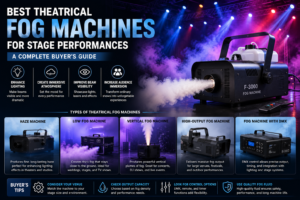
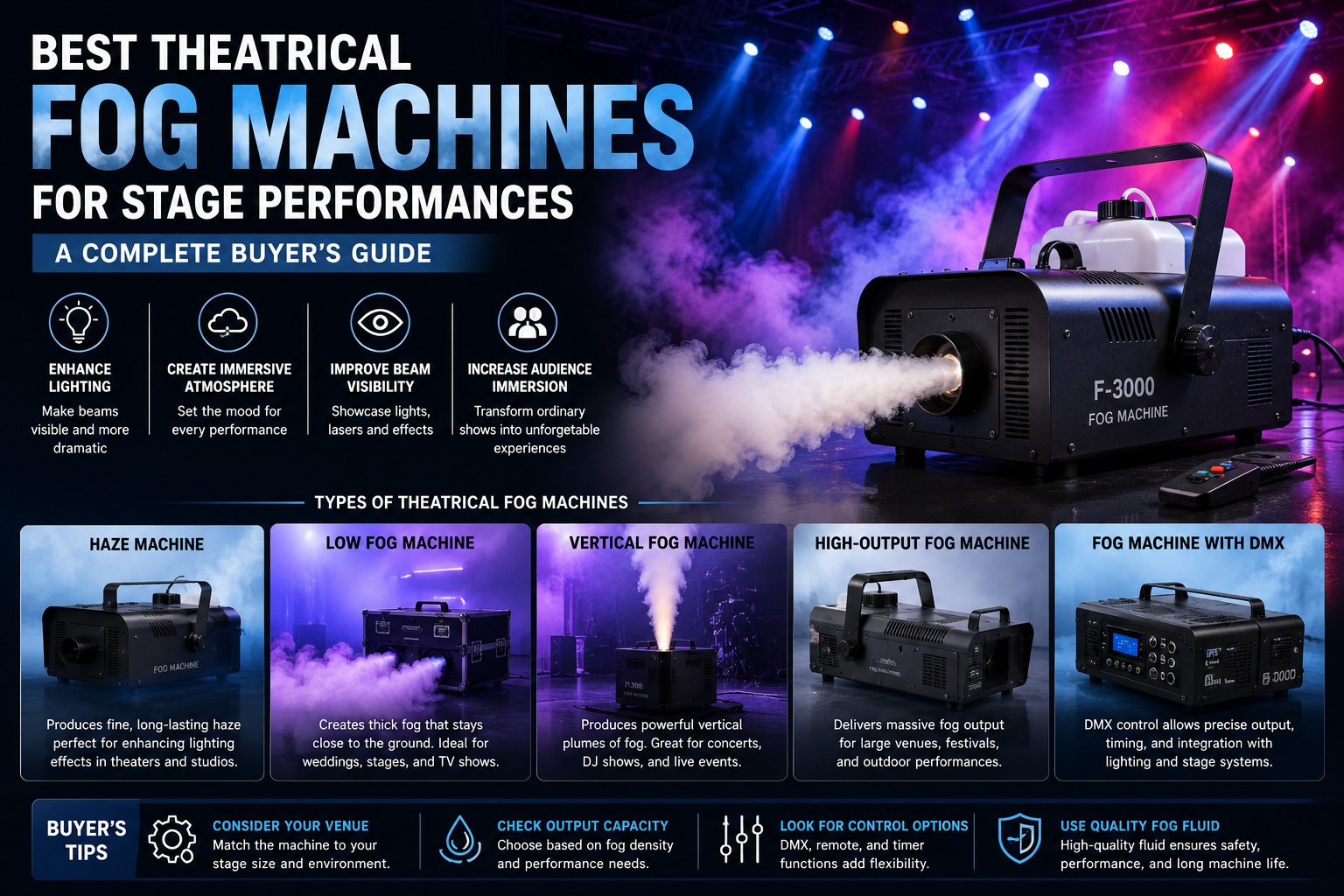
Types of Theatrical Fog Machines
Different productions require different atmospheric effects. Selecting the right machine depends on venue size, lighting design, performance style, and operational requirements.
Standard Fog Machines
The standard stage fog machine is the most versatile and widely used option across theaters, schools, churches, and event venues.
Advantages
- Affordable
- Easy operation
- Strong fog output
- Compatible with DMX control
- Suitable for most indoor events
Disadvantages
- Fog naturally rises and disperses
- Not ideal for low-lying cloud effects
- May require pauses between heavy output cycles
Best Applications
- School productions
- Churches
- Community theaters
- Conferences
- Small concerts
- Corporate presentations
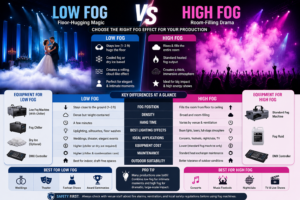
Low Fog Machines
Low fog machines create dense clouds that remain close to the floor, producing the popular “walking on clouds” effect.
Unlike standard fog machines, these systems cool the fog before release so it stays near ground level.
Advantages
- Elegant visual appearance
- Ideal for photography
- Excellent for weddings
- Realistic cloud effects
- Dramatic stage entrances
Disadvantages
- Higher equipment cost
- Additional cooling system required
- More maintenance
Best Applications
- Wedding first dances
- Theater productions
- Award ceremonies
- Luxury events
- Ballet performances
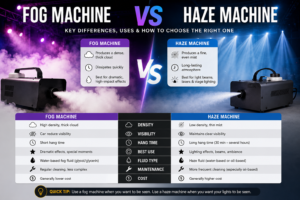
Haze Machines
Unlike traditional fog machines, haze machines generate extremely fine atmospheric particles that remain suspended in the air for long periods.
Instead of creating visible clouds, haze produces a subtle atmosphere that makes lighting beams appear sharper and more defined.
Advantages
- Long-lasting effect
- Minimal visual obstruction
- Even atmospheric coverage
- Excellent beam visibility
- Low fluid consumption
Disadvantages
- Less dramatic than dense fog
- Slower to build atmosphere
- Requires controlled ventilation
Best Applications
- Concert touring
- Television studios
- Large theaters
- Conferences
- Professional lighting demonstrations
Vertical Fog Machines
Vertical fog machines produce powerful columns of illuminated fog that shoot upward, creating dramatic visual moments without the need for CO₂ cylinders. Many models incorporate RGB or RGBW LEDs, allowing the fog plume to match the stage lighting or event theme.
Advantages
- Creates eye-catching vertical bursts of fog
- Built-in LED lighting enhances visual impact
- Ideal for synchronized lighting and music cues
- No external CO₂ cylinders required
- DMX control enables precise programming
Disadvantages
- Better suited to special effects than continuous atmospheric coverage
- Requires adequate ceiling height
- Consumes more fluid during intensive shows
Best Applications
- Concerts
- DJ performances
- Music festivals
- Product launches
- Opening ceremonies
- Nightclubs
- Television shows
Expert Tip: Position vertical fog machines behind performers or stage props to create dramatic entrances without obstructing audience views.
High-Output Fog Machines
High-output fog machines are designed for large venues where standard units cannot generate sufficient atmospheric coverage. Equipped with larger heating elements and high-capacity pumps, these machines can produce dense fog continuously throughout extended performances.
Advantages
- Extremely high fog volume
- Fast recovery between bursts
- Suitable for continuous operation
- Covers large venues efficiently
- Built for professional touring
Disadvantages
- Higher power consumption
- Larger physical size
- Greater initial investment
Best Applications
- Arenas
- Outdoor concerts
- Theme parks
- Cultural tourism performances
- Stadium productions
- Large theaters
- Rental companies
CO₂-Style Fog Effect Machines
These machines simulate the appearance of traditional CO₂ jets using water-based fog technology. They create dense, fast-dissipating white columns that deliver a similar visual effect without requiring compressed gas cylinders.
Advantages
- CO₂-like visual impact
- Reduced operating costs
- Easier transportation
- Safer logistics
- Programmable through DMX systems
Disadvantages
- Does not perfectly replicate real CO₂ cooling effects
- Performance depends on ambient temperature and airflow
Best Applications
- EDM concerts
- Nightclubs
- Sporting events
- Corporate launches
- Festival stages
Portable Fog Machines
Portable fog machines are lightweight and easy to transport, making them suitable for smaller venues and mobile production teams.
Advantages
- Compact design
- Easy setup
- Budget-friendly
- Suitable for temporary events
- Simple operation
Disadvantages
- Lower output
- Smaller fluid tank
- Limited continuous operation
Best Applications
- Schools
- Community theaters
- Mobile DJs
- Small churches
- Photography studios
- Home productions
Fog Machine Type Selection Guide
| Fog Machine Type | Best For | Output | Continuous Operation | Difficulty |
| Standard Fog Machine | General stage productions | ★★★★☆ | Medium | Easy |
| Low Fog Machine | Weddings, theater | ★★★☆☆ | Medium | Moderate |
| Haze Machine | Lighting enhancement | ★★★☆☆ | Excellent | Easy |
| Vertical Fog Machine | Concert effects | ★★★★☆ | Medium | Moderate |
| High-Output Fog Machine | Large venues | ★★★★★ | Excellent | Professional |
| CO₂-Style Machine | Festivals & concerts | ★★★★★ | Short bursts | Moderate |
| Portable Fog Machine | Small events | ★★☆☆☆ | Limited | Easy |
Key Features to Look for in the Best Theatrical Fog Machines
Choosing the best theatrical fog machines involves more than comparing price tags. Professional buyers should evaluate performance, reliability, control options, and long-term operating costs to ensure the equipment meets production requirements.
1. Fog Output Volume
Output volume determines how quickly a machine can fill a venue with atmospheric effects.
As a general guideline:
- Small theaters require moderate output.
- Medium venues benefit from higher-capacity machines.
- Large arenas and outdoor stages need high-output professional systems.
Selecting excessive output for a small venue can reduce visibility, while insufficient output in a large venue limits lighting effects.
2. Warm-Up Time
Professional productions often require immediate response during live performances.
Modern professional fog machines typically warm up within 3–8 minutes, with premium models offering rapid reheating between effects.
A shorter warm-up time means:
- Faster scene transitions
- Reduced downtime
- Greater flexibility during performances
3. Fluid Tank Capacity
Tank size directly influences operating time.
| Tank Size | Recommended Use |
| Under 1 L | Small events |
| 1–2 L | Community theaters |
| 2–5 L | Professional productions |
| 5 L+ | Concert touring & rental fleets |
Larger tanks reduce the need for refilling during long performances.
4. DMX512 Compatibility
DMX512 has become the industry standard for professional stage control.
A DMX fog machine allows operators to:
- Trigger fog remotely
- Adjust output levels
- Synchronize with lighting cues
- Integrate into automated show sequences
- Control multiple machines simultaneously
For theaters and live events, DMX compatibility is highly recommended.
5. Wireless Remote Control
Wireless control adds flexibility during setup and smaller productions.
Benefits include:
- Quick effect triggering
- Easy operation without running cables
- Convenient testing during installation
- Backup control if the DMX console is unavailable
Many professional systems combine wireless remotes with full DMX functionality.
6. Continuous Fog Capability
Not every production requires constant fog, but concerts, television studios, and touring shows often depend on sustained atmospheric effects.
Machines with continuous output features provide:
- Consistent beam visibility
- Stable atmospheric density
- Reduced interruptions
- Professional-quality lighting enhancement
7. Heating Technology
The heating element is the heart of every professional fog machine.
High-quality systems feature:
- Efficient heat exchangers
- Temperature monitoring
- Overheat protection
- Rapid recovery
- Stable vaporization
Reliable heating technology improves both performance and equipment lifespan.
8. Adjustable Fog Output
Different scenes require different atmospheric densities.
Professional machines should allow users to adjust:
- Fog intensity
- Burst duration
- Continuous output level
- Timer intervals
- Fan speed (where applicable)
This flexibility supports a wide range of productions, from subtle haze to dramatic fog effects.
9. Noise Level
Quiet operation is especially important in:
- Theaters
- Churches
- Television studios
- Classical concerts
- Conferences
Look for models with:
- Low-noise pumps
- Quiet cooling fans
- Smooth fluid delivery systems
Reducing operational noise helps maintain audience immersion.
10. Power Consumption
Energy efficiency affects operating costs, particularly for venues running multiple performances each week.
Modern machines often incorporate:
- Efficient heating systems
- Intelligent temperature management
- Automatic standby modes
- Faster reheating cycles
These features lower energy use without sacrificing performance.
11. Build Quality
Professional venues need equipment that can withstand frequent transportation, setup, and operation.
Look for:
- Metal housing
- Reinforced handles
- Durable pumps
- Reliable connectors
- High-quality heating components
- Professional-grade electronics
Robust construction reduces maintenance costs and extends equipment life.
Expert Buying Tips
Choose fog output based on venue size rather than simply buying the most powerful machine.
Prioritize DMX compatibility if you plan to synchronize fog with stage lighting or automation systems.
Always use manufacturer-approved fog fluid to protect the heating system and maintain warranty coverage.
For theaters, a haze machine often delivers better lighting enhancement than dense fog.
Rental companies should invest in durable, road-ready machines with fast warm-up times and large fluid tanks to maximize operational efficiency.
Best Applications for Professional Fog Machines
The best theatrical fog machines are designed to serve a wide range of entertainment and commercial environments. Choosing the right machine depends on the venue, production style, lighting design, and audience experience you want to create. Below are the most common professional applications and the fog machine types that work best for each.
Theater Productions
Theaters rely on atmospheric effects to enhance storytelling rather than overwhelm the audience. Fog and haze help lighting designers create depth, emphasize dramatic scenes, and produce seamless transitions between acts.
A haze machine is often the preferred choice for theatrical productions because it creates a fine, consistent atmosphere that makes lighting beams visible without obscuring actors or stage scenery. Standard fog machines and low fog machines are also commonly used for dream sequences, fantasy scenes, supernatural effects, and dramatic entrances.
Recommended Machines
- Haze Machine
- Standard Fog Machine
- Low Fog Machine
Concerts and Music Festivals
Concert productions demand high-impact visual effects synchronized with powerful lighting systems and music.
Professional fog machines make moving head beams, lasers, and LED effects far more dramatic, creating immersive experiences for audiences.
Large concert stages typically combine several atmospheric systems, including haze machines for continuous beam enhancement and vertical fog machines for exciting drops and musical climaxes.
Recommended Machines
- High-Output Fog Machine
- Vertical Fog Machine
- Haze Machine
- CO₂-Style Fog Effect Machine
Live Entertainment Performances
Dance productions, talent shows, award ceremonies, fashion shows, and touring performances all benefit from carefully controlled fog effects.
Operators often require adjustable output so each performance can use different atmospheric densities without changing equipment.
Recommended Machines
- Standard Fog Machine
- Vertical Fog Machine
- Haze Machine
Cultural Tourism Shows
Large-scale cultural tourism performances frequently combine storytelling, projection mapping, architectural lighting, fountains, lasers, and stage effects.
Atmospheric effects help blend these technologies into one immersive visual experience while emphasizing historical scenes, mythical stories, and large outdoor productions.
Because many cultural performances take place in expansive venues, high-output fog machines are typically preferred.
Recommended Machines
- High-Output Fog Machine
- Haze Machine
- Vertical Fog Machine
Theme Parks
Theme parks use fog throughout attractions, haunted houses, nighttime spectaculars, and seasonal events.
Fog creates mystery while helping themed lighting appear richer and more realistic.
Since equipment often operates daily, durability and continuous operation become critical purchasing factors.
Recommended Machines
- High-Output Fog Machine
- Standard Fog Machine
- Low Fog Machine
Television Studios
TV productions require subtle atmospheric effects that improve lighting quality without affecting camera visibility.
Haze machines are widely used because they provide consistent beam enhancement while remaining nearly invisible to viewers.
Noise levels are especially important in broadcast environments.
Recommended Machines
- Professional Haze Machine
- Low-Noise Fog Machine
Weddings
Wedding venues increasingly use low-lying fog during first dances to create the popular “dancing on clouds” effect.
The fog should remain close to the floor without rising around guests or photographers.
Recommended Machines
- Low Fog Machine
Corporate Events
Product launches, exhibitions, conferences, and brand presentations frequently use atmospheric effects to enhance stage entrances and reveal new products.
Professional equipment allows event planners to synchronize fog with lighting, video content, and music.
Recommended Machines
- Standard Fog Machine
- Vertical Fog Machine
Churches and Worship Centers
Modern worship environments often incorporate intelligent lighting systems to create engaging services and special events.
Rather than using dense fog, many churches choose haze machines to improve beam visibility while maintaining a clean and comfortable environment.
Recommended Machines
- Haze Machine
- Standard Fog Machine
Nightclubs and Entertainment Venues
Nightclubs depend heavily on fog to maximize the impact of moving head lights, lasers, and LED effects.
Reliable continuous output and DMX integration are essential because equipment may operate for several hours each night.
Recommended Machines
- Vertical Fog Machine
- High-Output Fog Machine
- Haze Machine
Recommended Fog Machine by Application
| Application | Recommended Machine | Why It Works |
| Theater Productions | Haze Machine | Clear beam visibility without blocking performers |
| Concerts | High-Output Fog Machine | Covers large stages with dense atmospheric effects |
| Music Festivals | Vertical Fog Machine | Dramatic synchronized effects |
| Cultural Tourism Shows | High-Output Fog Machine | Suitable for expansive outdoor venues |
| Theme Parks | High-Output Fog Machine | Continuous operation and durability |
| Television Studios | Haze Machine | Camera-friendly atmospheric effects |
| Weddings | Low Fog Machine | Elegant low-lying cloud effect |
| Churches | Haze Machine | Enhances lighting while remaining subtle |
| Corporate Events | Standard Fog Machine | Flexible and easy to control |
| Nightclubs | Vertical Fog Machine | High-energy visual effects |
Professional Fog Machine vs Consumer Fog Machine
Many buyers initially compare professional equipment with inexpensive consumer models. While consumer machines may be suitable for occasional home use, they rarely meet the reliability, performance, or control requirements of professional productions.
| Feature | Professional Fog Machine | Consumer Fog Machine |
| Output Volume | High and consistent | Limited output |
| Build Quality | Heavy-duty metal construction | Lightweight plastic housing |
| DMX Control | Standard feature | Usually unavailable |
| Continuous Operation | Designed for extended use | Short operating cycles |
| Warm-up Time | Fast recovery and efficient heating | Longer reheating periods |
| Durability | Built for touring and rental environments | Intended for occasional use |
| Fluid Capacity | Large tanks for long events | Small reservoirs |
| Control Options | DMX, wireless, timer, manual | Basic wired remote |
| Maintenance | Serviceable components | Limited repair options |
| Best Applications | Theaters, concerts, rental companies, theme parks | Home parties and seasonal decorations |
Why Professionals Choose Commercial Equipment
Professional stage productions demand equipment that performs consistently under demanding conditions. Commercial-grade fog machines offer:
- Reliable operation during long performances
- Faster response to lighting cues
- Better compatibility with DMX control systems
- Higher output for larger venues
- Longer equipment lifespan
- Lower maintenance costs over time
Although the initial investment is higher, professional equipment delivers greater reliability and a lower total cost of ownership.
Venue Size vs Recommended Fog Machine
Choosing a fog machine that matches your venue size is one of the most important purchasing decisions. Oversized machines can reduce visibility in smaller venues, while undersized units may fail to produce the desired atmospheric effect.
| Venue Size | Capacity | Recommended Fog Machine |
| Small Stage | Up to 150 seats | Portable or Standard Fog Machine |
| Medium Theater | 150–500 seats | Professional Standard Fog Machine or Haze Machine |
| Large Theater | 500–1,000 seats | High-Output Fog Machine |
| Arena | 1,000+ seats | Multiple High-Output Fog Machines with Haze System |
| Outdoor Festival | Large open area | High-Output Fog Machine with Vertical Fog Units |
| Theme Park Show | Large attraction | High-Output Continuous Fog System |
Expert Tip: Instead of relying on one oversized machine, many professional venues achieve better atmospheric consistency by strategically placing multiple fog machines around the stage.
How to Choose the Right Stage Fog Machine
Selecting the right stage fog machine requires balancing venue requirements, production goals, and long-term operating costs. The following factors will help you narrow your options.
1. Evaluate Your Venue Size
Start by considering the physical dimensions of the performance space.
Ask yourself:
- How large is the stage?
- How many audience members will attend?
- How high is the ceiling?
- Is the venue enclosed or open-air?
Larger spaces generally require higher-output equipment or multiple machines.
2. Determine Indoor or Outdoor Use
Indoor venues usually benefit from water-based fog or haze systems because they provide excellent beam visibility with controlled dispersion.
Outdoor venues, however, require more powerful equipment to compensate for wind and natural airflow.
3. Consider Ceiling Height
Ceiling height significantly affects how fog behaves.
- Low ceilings: Use haze machines or adjustable-output fog machines to avoid excessive accumulation.
- High ceilings: High-output units are more effective for filling the performance space.
4. Match the Machine to the Performance
Different productions require different atmospheric effects.
| Performance Type | Recommended Machine |
| Drama | Haze Machine |
| Concert | High-Output Fog Machine |
| Wedding | Low Fog Machine |
| Festival | Vertical Fog Machine |
| Church Service | Haze Machine |
| Haunted Attraction | Standard Fog Machine |
5. Set a Realistic Budget
Look beyond the purchase price.
Also consider:
- Fog fluid consumption
- Energy efficiency
- Maintenance costs
- Replacement parts
- Expected lifespan
- Warranty support
A higher-quality machine often provides better long-term value.
6. Ensure DMX Compatibility
If your venue already uses professional lighting control systems, choose a DMX-compatible fog machine that integrates seamlessly with your existing equipment.
This allows synchronized control of:
- Lighting fixtures
- Lasers
- Projection mapping
- Audio cues
- Special effects
7. Review Maintenance Requirements
Machines that are easy to clean and service reduce downtime and operating costs.
Look for:
- Accessible fluid tanks
- Easy-drain systems
- Durable pumps
- Replaceable components
- Clear maintenance instructions
Stage Fog Machine Buying Checklist
Before purchasing, confirm the following:
✓ Venue size matches the machine’s output capacity
✓ Suitable for indoor or outdoor use
✓ Compatible with your lighting control system (DMX512)
✓ Warm-up time meets show requirements
✓ Fluid tank capacity supports event duration
✓ Adjustable fog output available
✓ Reliable heating technology
✓ Low operating noise (if required)
✓ Durable metal construction
✓ Manufacturer offers technical support and spare parts
✓ Uses approved water-based fog fluid
✓ Includes warranty and after-sales service
Buying Advice: For professional theaters, concert venues, rental companies, and production firms, investing in a high-quality professional fog machine ensures reliable performance, safer operation, and superior visual effects for years to come.
Using Fog Machines with Stage Lighting
Professional lighting systems achieve their greatest visual impact when combined with carefully controlled atmospheric effects. Without fog or haze, many lighting beams remain nearly invisible to the audience, especially in large venues. The best theatrical fog machines create a medium that allows light to travel visibly through the air, producing dramatic three-dimensional effects that enhance every performance.
Whether you’re designing a theater production, concert, television broadcast, or cultural tourism show, synchronizing a professional fog machine with intelligent lighting creates a more immersive experience while giving lighting designers greater creative control.
Moving Head Lights
Moving head fixtures are among the biggest beneficiaries of atmospheric effects.
Without haze or fog, audiences primarily see the illuminated stage surface. With the proper atmosphere, they can also see the complete movement of each light beam through the venue.
Fog enhances moving head fixtures by:
- Making aerial beams clearly visible
- Creating dynamic sweeping effects
- Highlighting synchronized lighting movements
- Adding depth to stage designs
- Producing cinematic visual transitions
For most theatrical productions, a haze machine provides the ideal level of atmospheric density for moving head lights.
Beam Lights
Beam lights produce narrow, concentrated shafts of light designed to create striking aerial visuals.
These fixtures require atmospheric particles to reveal their full effect.
Using a stage fog machine allows beam lights to produce:
- Sharp light columns
- Crossing beam effects
- Tunnel lighting
- Fan-shaped aerial displays
- Long-distance beam projection
This combination is especially popular for concerts, festivals, and large-scale entertainment events.
Wash Lights
Wash lights are primarily used to illuminate performers, scenery, and architectural elements.
Although wash fixtures do not rely on fog as heavily as beam lights, subtle atmospheric effects can soften transitions between lighting zones and improve overall stage depth.
Benefits include:
- Increased visual texture
- Enhanced color blending
- Improved stage atmosphere
- More natural scene transitions
Laser Lighting
Laser systems produce some of the most dramatic visual effects in entertainment, but only when atmospheric particles are present.
A fine haze allows laser beams to remain visible throughout the venue without creating excessive cloudiness.
Professional productions typically pair laser systems with haze machines because they offer:
- Uniform beam visibility
- Minimal visual obstruction
- Long-lasting atmospheric coverage
Spotlights
Spotlights become more dramatic when their beams are visible from the fixture to the performer.
Atmospheric effects help create:
- Hero entrances
- Dramatic solos
- Award presentations
- Emotional theatrical moments
Instead of simply highlighting the performer, visible spotlight beams become part of the visual storytelling.
LED Stage Lighting
Modern LED fixtures produce vibrant colors and dynamic effects that appear richer when combined with controlled fog.
Fog enhances LED lighting by:
- Increasing color saturation
- Improving beam definition
- Adding three-dimensional depth
- Supporting synchronized lighting scenes
Because LED fixtures generate less heat than traditional lighting, they pair exceptionally well with modern water-based fog systems.
Projection Mapping
Projection mapping has become a popular technology for theaters, museums, theme parks, and cultural tourism attractions.
Carefully controlled atmospheric effects help projection mapping appear more immersive by:
- Creating depth around projected objects
- Softening scene transitions
- Enhancing volumetric lighting
- Blending lighting with projected visuals
However, excessive fog can reduce image clarity, so lighting designers typically use subtle haze rather than dense fog during projection mapping performances.
Synchronizing Fog Machines with DMX Controllers
One of the biggest advantages of professional equipment is DMX512 compatibility.
DMX allows lighting consoles to control fog machines alongside moving lights, LED fixtures, lasers, and other stage effects from a single interface.
A DMX-controlled fog machine enables operators to:
- Trigger fog at precise moments
- Adjust output levels in real time
- Synchronize fog with lighting cues
- Coordinate multiple fog machines
- Automate complete show sequences
- Reduce manual intervention during performances
For large productions, integrating fog machines into a DMX lighting network improves consistency, timing, and overall production quality.
Expert Tip: Assign fog machines to dedicated DMX channels and create preset atmospheric scenes. This allows operators to switch between subtle haze, dense fog, and special effects instantly during live performances.
Fog Machine Safety Tips
When operated correctly and maintained according to the manufacturer’s recommendations, professional fog machines are safe and reliable. However, proper planning and routine inspections are essential to protect performers, crew members, and audiences.
Ensure Proper Ventilation
Adequate ventilation prevents excessive fog accumulation and maintains audience comfort.
When designing atmospheric effects:
- Avoid overfilling enclosed spaces
- Monitor visibility during performances
- Allow fresh air circulation when appropriate
- Adjust output based on venue size
Balanced ventilation helps maintain the desired effect without compromising comfort or visibility.
Use Approved Fog Fluids
Always use fog fluids recommended by the equipment manufacturer.
Approved fluids help:
- Protect heating elements
- Prevent pump blockages
- Maintain consistent fog quality
- Reduce equipment wear
- Support warranty requirements
Avoid mixing different fluid formulations or using homemade alternatives.
Follow Electrical Safety Practices
Professional fog machines contain high-temperature heating systems and electrical components that require careful handling.
Safety recommendations include:
- Inspect power cables before each event
- Use grounded electrical outlets
- Avoid overloading circuits
- Keep electrical connections dry
- Disconnect power before servicing
Routine inspections help reduce the risk of equipment failure.
Consider Fire Alarm Systems
Dense fog can occasionally trigger optical smoke detectors if not managed properly.
Before using atmospheric effects:
- Coordinate with venue management
- Understand local fire safety requirements
- Consult the fire alarm provider if necessary
- Conduct pre-show testing
Many professional venues have procedures in place for productions using theatrical fog.
Prioritize Audience Comfort
Different audiences have different sensitivity levels.
Operators should:
- Avoid excessive fog density
- Maintain clear emergency exit visibility
- Monitor airflow throughout the venue
- Reduce output if visibility decreases significantly
Professional atmospheric effects should enhance the performance without distracting or discomforting attendees.
Perform Routine Equipment Inspections
Before every event, inspect:
- Fluid levels
- Hoses
- Pumps
- Heating systems
- Electrical connectors
- DMX cables
- Wireless receivers
Early detection of wear or damage helps prevent unexpected failures during live performances.
Store Equipment Properly
When transporting or storing fog machines:
- Empty fluid tanks if recommended
- Protect equipment from dust
- Avoid freezing temperatures
- Store in dry environments
- Use protective road cases for touring equipment
Proper storage extends equipment life and reduces maintenance needs.
Train Equipment Operators
Only trained personnel should operate professional fog machines.
Operators should understand:
- Machine controls
- DMX programming
- Warm-up procedures
- Emergency shutdown methods
- Cleaning schedules
- Fluid handling
Well-trained technicians improve both safety and production quality.
Stage Fog Machine Safety Checklist
✔ Use only manufacturer-approved fog fluid
✔ Confirm adequate venue ventilation
✔ Inspect electrical cables and connectors
✔ Test DMX communication before performances
✔ Check fluid levels before each show
✔ Keep emergency exits clearly visible
✔ Coordinate with venue fire safety personnel
✔ Train operators on equipment procedures
✔ Allow machines to cool before transport
✔ Store equipment in a clean, dry location
Fog Machine Maintenance Guide
Routine maintenance is one of the most effective ways to maximize the performance and lifespan of a professional fog machine. Proper care reduces downtime, maintains consistent fog output, and helps prevent costly repairs.
Clean the Machine Regularly
Over time, fog fluid residue can accumulate inside the heating chamber, pump, and tubing.
Regular cleaning helps:
- Maintain consistent output
- Prevent clogging
- Improve heating efficiency
- Extend equipment life
Many manufacturers recommend flushing the system with an approved cleaning solution after every 40–80 hours of operation, depending on usage conditions.
Replace Fog Fluid as Needed
Do not allow old or contaminated fog fluid to remain in the reservoir for extended periods.
Best practices include:
- Use fresh, manufacturer-approved fluid
- Keep the tank sealed when not in use
- Remove contaminated fluid immediately
- Avoid mixing different brands or formulations
Clean fluid ensures reliable performance and reduces wear on internal components.
Inspect the Heating System
The heating element is the heart of every fog machine.
During routine inspections, check for:
- Stable operating temperature
- Unusual odors
- Reduced fog output
- Error indicators
- Slow warm-up times
Addressing minor issues early can prevent major failures.
Maintain the Pump
The pump delivers fog fluid into the heating chamber.
Watch for signs of wear such as:
- Inconsistent output
- Reduced pressure
- Irregular pumping sounds
- Fluid leaks
Professional servicing should be scheduled if these symptoms persist.
Protect During Storage
Long-term storage should include:
- Emptying the fluid tank (if recommended)
- Cleaning internal components
- Covering the machine to prevent dust buildup
- Storing in a cool, dry environment
- Avoiding direct sunlight and extreme temperatures
Proper storage minimizes corrosion and prolongs service life.
Preventive Maintenance Schedule
| Maintenance Task | Recommended Frequency |
| Check fog fluid level | Before every event |
| Inspect power cables | Before every event |
| Test DMX control | Before every event |
| Clean exterior | Weekly |
| Flush internal system | Every 40–80 operating hours |
| Inspect pump and heater | Monthly |
| Check electrical connections | Monthly |
| Full professional inspection | Annually |
Fog Machine Maintenance Checklist
✔ Use approved cleaning solution
✔ Flush the heating system regularly
✔ Inspect the pump for leaks or reduced pressure
✔ Clean exterior vents and cooling fans
✔ Replace contaminated fog fluid
✔ Verify DMX communication
✔ Inspect power cables and connectors
✔ Test output before every performance
✔ Store equipment in a dry, dust-free environment
✔ Schedule annual professional servicing
Common Mistakes to Avoid When Buying and Using Fog Machines
Even the best theatrical fog machines cannot deliver professional results if they are selected or operated incorrectly. Many performance issues stem from avoidable mistakes that affect fog quality, equipment lifespan, and overall production value.
Understanding these common errors can help theaters, production companies, and event organizers maximize their investment.
1. Using the Wrong Fog Fluid
Not all fog fluids are formulated the same. Using an incompatible or low-quality fluid can clog pumps, damage heating elements, reduce output quality, and even void the manufacturer’s warranty.
Solution
- Always use the fluid recommended by the manufacturer.
- Never mix different fluid types or brands unless approved.
- Store fog fluid in clean, sealed containers to prevent contamination.
2. Choosing the Wrong Output Capacity
Buying the most powerful machine is not always the best choice. A machine that is too powerful for a small venue can reduce visibility, while one with insufficient output may fail to create the desired atmospheric effect in a large space.
Solution
Select equipment based on:
- Venue size
- Ceiling height
- Audience capacity
- Ventilation
- Production requirements
3. Ignoring Warm-Up Time
Some productions require immediate atmospheric effects during scene changes or live performances. Choosing equipment with slow warm-up or recovery times can disrupt the show.
Solution
For professional applications, choose machines with:
- Fast heating systems
- Quick recovery between bursts
- Continuous output capability when needed
4. Neglecting Routine Maintenance
A lack of regular cleaning is one of the leading causes of reduced fog output and equipment failure.
Solution
Create a preventive maintenance schedule that includes:
- Cleaning the heater
- Flushing the system
- Inspecting the pump
- Checking electrical connections
- Replacing contaminated fluid
5. Improper DMX Programming
Incorrect DMX addressing or poorly programmed cues can result in fog effects occurring at the wrong time or not triggering at all.
Solution
- Verify DMX addresses before rehearsals.
- Test every programmed cue during setup.
- Label channels clearly within the lighting console.
6. Poor Venue Ventilation Planning
Excessive fog in enclosed spaces can reduce visibility and affect audience comfort, while strong airflow may disperse fog too quickly.
Solution
Evaluate:
- Air conditioning systems
- Ventilation fans
- Door locations
- Natural airflow
- Audience seating layout
Adjust fog output to maintain a balanced atmosphere.
7. Purchasing Low-Quality Equipment
Low-cost consumer machines may seem attractive initially, but they often lack the durability, output consistency, and control features required for professional productions.
Solution
Invest in equipment designed for commercial use, especially if you operate:
- Theaters
- Concert venues
- Rental businesses
- Theme parks
- Television studios
- Cultural tourism attractions
Future Trends in Stage Fog Machines
Stage effects technology continues to evolve as entertainment venues seek smarter, safer, and more energy-efficient solutions. The next generation of professional fog machines focuses on automation, sustainability, and seamless integration with intelligent lighting systems.
Smart Fog Machines
Modern fog machines increasingly feature onboard processors that monitor temperature, fluid levels, and operating status in real time. These systems improve reliability while reducing manual adjustments during performances.
Wireless DMX and Network Control
Wireless DMX technology is becoming more common in theaters, concert venues, and touring productions.
Benefits include:
- Faster installation
- Reduced cable clutter
- Greater flexibility for temporary venues
- Easier expansion of lighting and effects systems
Eco-Friendly Fog Fluids
Manufacturers are developing environmentally responsible fog fluids with improved formulations that minimize residue while maintaining consistent atmospheric effects.
Advantages include:
- Cleaner operation
- Easier maintenance
- Reduced environmental impact
- Improved indoor air quality management
AI-Assisted Show Automation
Artificial intelligence is beginning to support show programming by helping operators synchronize lighting, fog, video, and audio cues more efficiently.
Future systems may automatically adjust atmospheric effects based on:
- Music tempo
- Lighting intensity
- Scene transitions
- Audience interaction
IoT Integration
Internet of Things (IoT) connectivity enables technicians to monitor equipment remotely, receive maintenance alerts, and track performance data across multiple venues.
This is particularly valuable for:
- Rental companies
- Touring productions
- Theme parks
- Large entertainment complexes
Energy-Efficient Heating Systems
Manufacturers continue to improve heating technology through better insulation, faster heat exchangers, and intelligent temperature control.
Benefits include:
- Reduced power consumption
- Faster warm-up
- Longer component life
- Lower operating costs
Intelligent Effects Synchronization
Future productions will increasingly integrate fog machines with moving lights, lasers, projection mapping, media servers, and audio systems to create fully synchronized immersive experiences.
Frequently Asked Questions
1. What is the best theatrical fog machine?
The best theatrical fog machine depends on your venue size, performance type, and lighting design. Professional models with fast warm-up times, DMX512 compatibility, adjustable output, and durable construction are ideal for theaters, concerts, and live events.
2. What is the difference between a fog machine and a haze machine?
A fog machine produces dense, visible clouds for dramatic effects, while a haze machine generates fine atmospheric particles that make lighting beams visible without creating thick fog. Haze is generally preferred for theatrical lighting enhancement.
3. Can fog machines be used indoors?
Yes. Most professional theatrical fog machines use water-based fog fluid and are designed for indoor venues such as theaters, churches, TV studios, conference halls, and schools. Always ensure proper ventilation and follow the manufacturer’s operating guidelines.
4. What fog fluid should I use?
Always use the fog fluid recommended by the equipment manufacturer. Using incompatible or low-quality fluids can reduce performance, damage internal components, and affect warranty coverage.
5. Are theatrical fog machines safe?
When operated correctly, using approved fog fluid and appropriate ventilation, professional theatrical fog machines are considered safe for entertainment applications. Operators should also follow local safety regulations and venue requirements.
6. Do professional fog machines support DMX control?
Yes. Most commercial-grade fog machines support DMX512, allowing seamless integration with lighting consoles for synchronized control of fog, lighting, lasers, and other stage effects.
7. How long does fog remain in the air?
The duration depends on the type of machine, fog fluid, airflow, temperature, and humidity. Dense fog typically dissipates within a few minutes, while haze can remain suspended much longer under controlled conditions.
8. How often should a fog machine be cleaned?
Cleaning frequency depends on usage. For professional applications, flushing the system after approximately 40–80 hours of operation and performing regular inspections helps maintain reliable performance.
9. Can fog machines be used outdoors?
Yes, but outdoor environments often require high-output fog machines because wind and natural airflow disperse atmospheric effects more quickly than indoor venues.
10. How do I choose the right stage fog machine?
Consider the venue size, indoor or outdoor use, stage dimensions, lighting setup, DMX compatibility, warm-up time, maintenance requirements, and expected frequency of use before making your purchase.
Conclusion
Selecting the best theatrical fog machines is about more than generating atmospheric effects it is about enhancing every aspect of a live performance. From improving the visibility of moving head lights and laser beams to supporting immersive storytelling in theaters, concerts, churches, theme parks, and cultural tourism shows, a professional fog machine plays a vital role in modern stage production.
Before investing, evaluate your venue size, performance style, lighting system, and long-term operational needs. Features such as DMX512 compatibility, rapid warm-up, adjustable output, continuous operation, and durable construction can significantly improve reliability and production quality.
Whether you need a haze machine for subtle theatrical lighting, a low fog machine for elegant floor effects, or a high-output system for large-scale concerts, choosing professional-grade equipment ensures consistent performance, easier maintenance, and greater creative flexibility.
By partnering with an experienced manufacturer, you gain access not only to reliable equipment but also to technical expertise and customized solutions tailored to your projects.
Contact JJY Stage for Professional Stage Fog Solutions
Looking for reliable professional fog machines and complete stage special effects equipment?
JJY Stage specializes in manufacturing high-performance fog machines, haze machines, vertical fog machines, stage lighting, and intelligent entertainment equipment for theaters, concerts, rental companies, TV studios, churches, theme parks, and cultural tourism projects worldwide.
Our team offers:
- Professional stage fog machines
- OEM & ODM manufacturing services
- Customized stage effects solutions
- Complete stage lighting systems
- Technical consultation and after-sales support
- Global export experience and quality assurance
Contact JJY Stage today to discuss your project and discover how our professional stage equipment can help create unforgettable live performances.