Introduction
Modern businesses are no longer treating lighting as a basic utility. Instead, commercial LED lighting has evolved into a strategic investment that directly influences customer experience, employee productivity, operational efficiency, and brand perception. Whether someone walks into a luxury hotel, a flagship retail store, a corporate headquarters, or an international airport, lighting quietly shapes their first impression before a single word is spoken.
Color changing LED technology has accelerated this transformation. Instead of relying on static white lighting, today’s commercial facilities can dynamically adjust colors, brightness, and lighting scenes to suit different activities, events, seasons, or branding campaigns. Advanced RGB and RGBW systems allow facility managers to create immersive environments while significantly reducing electricity consumption compared with legacy fluorescent, HID, and halogen lighting.
Another major advantage is integration with intelligent building platforms. Modern commercial lighting can communicate with occupancy sensors, daylight harvesting systems, scheduling software, and centralized Building Management Systems (BMS). This enables businesses to automate lighting based on occupancy, time schedules, weather conditions, or energy-saving targets, reducing operational costs without compromising comfort.
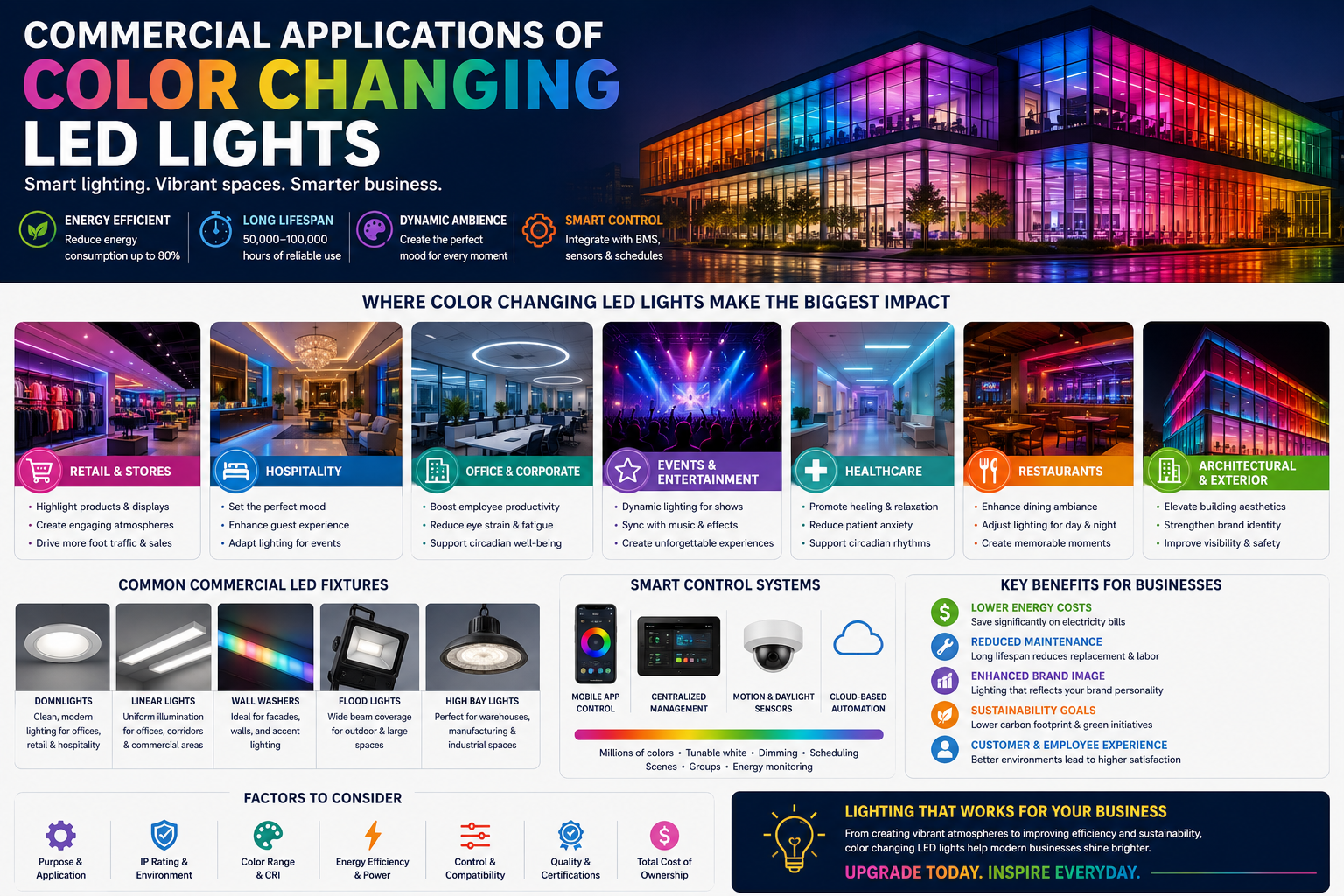
This guide explores how color changing LED lights are transforming virtually every commercial sector. You’ll discover where RGB lighting delivers the greatest value, which fixtures work best for different environments, how smart control technologies simplify management, and what factors commercial buyers should evaluate before investing in scalable LED lighting solutions.
What Is Commercial LED Lighting?
Definition
Commercial LED lighting refers to professional-grade lighting systems specifically engineered for business, institutional, industrial, and public-sector environments. Unlike residential lighting, commercial systems prioritize long operating hours, superior durability, precise optical control, high lumen output, and centralized management. These systems are designed to perform reliably in demanding applications such as office buildings, hospitals, airports, manufacturing facilities, educational campuses, hotels, stadiums, museums, and retail environments.
Modern commercial LED fixtures incorporate highly efficient semiconductor technology that converts a greater percentage of electrical energy into usable light while generating substantially less heat than traditional light sources. When combined with intelligent drivers and digital control systems, LEDs provide unmatched flexibility in brightness adjustment, color tuning, and automation.
Evolution of Commercial Lighting
Commercial lighting has progressed dramatically over the past several decades. Incandescent lamps gave way to fluorescent systems, which later competed with metal halide and high-intensity discharge (HID) fixtures. While these technologies improved efficiency, they still required frequent maintenance, generated excessive heat, and lacked intelligent controls.
LED technology fundamentally changed the industry. Instead of simply replacing existing fixtures, manufacturers began designing integrated lighting ecosystems capable of communicating with sensors, cloud software, and building automation platforms. Recent market analysis indicates continued expansion of commercial LED adoption as organizations pursue sustainability initiatives and smart building strategies.
Why Businesses Are Switching to LED
Businesses adopt LED lighting for several practical reasons. Energy efficiency remains the most visible benefit, often reducing electricity consumption significantly compared with older lighting technologies. Long operating life minimizes maintenance interruptions, especially in facilities where replacing lamps requires specialized equipment or after-hours labor.
Improved light quality also contributes to the transition. Higher Color Rendering Index (CRI), consistent illumination, instant startup, and dimming capabilities create more comfortable environments for customers and employees. Combined with smart controls, businesses gain detailed insight into lighting performance while reducing unnecessary energy usage.
Benefits of Color Changing Technology
Color changing technology extends these advantages beyond efficiency. Retailers use dynamic lighting to highlight promotions, hotels create welcoming ambiance throughout the day, stadiums synchronize lighting with live entertainment, and healthcare facilities introduce calming colors to reduce patient anxiety.
Rather than installing separate decorative and functional lighting systems, organizations can deploy a single RGB or RGBW infrastructure capable of supporting everyday operations as well as special events. This flexibility helps maximize return on investment while providing virtually unlimited creative possibilities for branding and architectural enhancement.
Benefits of Color Changing LED Lights in Commercial Spaces
Color changing LED technology has evolved from being a decorative feature into a strategic business tool. Today, organizations use commercial RGB LED lighting to improve customer engagement, reinforce brand identity, enhance workplace productivity, reduce operating expenses, and support sustainability initiatives. Combined with intelligent lighting controls, these systems provide flexibility that traditional lighting technologies simply cannot match.
Businesses also recognize that lighting influences human behavior. Studies in environmental psychology consistently show that light intensity, color temperature, and dynamic lighting scenes affect mood, concentration, purchasing decisions, and even the amount of time customers spend in a space. Rather than relying on static illumination, modern business LED lighting adapts to changing operational requirements throughout the day.
Improved Customer Experience
Lighting often creates a customer’s first emotional impression of a business. Warm colors can make restaurants feel inviting, while bright neutral lighting improves product visibility in retail stores. Dynamic RGB lighting enables businesses to change the atmosphere instantly for holidays, promotions, product launches, or themed events without replacing fixtures.
Retailers frequently use programmable lighting scenes to draw attention toward featured merchandise or seasonal displays. Hotels adjust lobby lighting from energetic daytime settings to relaxing evening environments. Entertainment venues synchronize lighting with music and multimedia presentations to create immersive experiences that encourage repeat visits.
The ability to personalize lighting helps businesses differentiate themselves in competitive markets where customer experience has become a primary factor in purchasing decisions.
Stronger Brand Identity
Lighting has become an extension of corporate branding. Many international companies incorporate signature colors into building façades, reception areas, conference rooms, and retail locations using commercial RGB LED lighting. This visual consistency strengthens brand recognition while creating memorable customer experiences.
Corporate headquarters frequently illuminate exterior architecture using company colors during product launches or awareness campaigns. Shopping malls coordinate color themes during holidays, while hotels adapt façade lighting for festivals, local celebrations, or special events. These installations transform buildings into recognizable landmarks without requiring expensive structural renovations.
Because LED systems are programmable, businesses can update their visual identity instantly instead of investing in permanent decorative elements.
Flexible Lighting Scenes
One of the greatest advantages of smart commercial lighting is scene flexibility. Instead of operating at a single brightness level throughout the day, businesses can program different lighting profiles for varying operational needs.
For example:
| Time or Event | Recommended Lighting Scene | Business Benefit |
| Morning | Bright cool white | Increased alertness |
| Afternoon | Neutral white | Comfortable productivity |
| Evening | Warm white | Relaxed atmosphere |
| Promotional Event | Dynamic RGB | Increased customer attention |
| Holiday Season | Branded color scenes | Enhanced customer engagement |
| Cleaning Hours | Maximum brightness | Improved visibility |
Scene scheduling reduces manual adjustments while maintaining optimal lighting conditions throughout daily operations.
Energy Efficiency
Energy savings remain the primary reason organizations invest in energy-efficient commercial lighting. LED fixtures consume substantially less electricity than fluorescent, metal halide, and incandescent systems while delivering higher lumen output and superior light quality.
Adding smart sensors further improves efficiency. Occupancy sensors automatically turn lights off in unused areas, while daylight harvesting systems reduce artificial lighting when sufficient natural daylight is available. Combined with programmable scheduling, these technologies significantly lower utility costs across large commercial properties.
For facilities operating 24 hours a day, such as hospitals and airports, even modest efficiency improvements can translate into substantial annual savings.
Lower Maintenance Costs
Maintenance expenses often exceed initial equipment costs over the lifetime of a commercial lighting installation. Traditional lamps require frequent replacement, resulting in labor costs, equipment rentals, and operational disruptions.
LED fixtures typically operate for tens of thousands of hours before significant lumen depreciation occurs. Fewer replacements mean lower maintenance budgets and less downtime, particularly in difficult-to-access locations such as warehouses, stadium ceilings, airport terminals, and industrial facilities.
Predictive maintenance capabilities available through smart lighting systems also allow facility managers to monitor fixture health remotely, enabling proactive service before failures occur.
Smart Automation
Automation transforms lighting from a manually controlled utility into an intelligent building system. Modern LED lighting controls integrate with occupancy sensors, daylight sensors, scheduling software, mobile applications, and centralized management platforms.
Facility managers can:
- Schedule lighting automatically.
- Monitor energy usage in real time.
- Receive maintenance alerts.
- Control multiple buildings remotely.
- Adjust lighting based on occupancy.
- Synchronize lighting with security systems.
- Integrate lighting into Building Management Systems (BMS).
These capabilities simplify operations while reducing energy consumption and improving occupant comfort.
Sustainability
Environmental responsibility has become a strategic priority for many organizations. Commercial LED lighting supports sustainability goals by reducing electricity consumption, lowering greenhouse gas emissions associated with power generation, and minimizing waste through extended fixture lifespans.
Many organizations pursuing LEED certification or other green building standards incorporate intelligent LED lighting as part of their sustainability strategies. Reduced maintenance also decreases material waste by lowering the frequency of lamp replacements.
For businesses committed to Environmental, Social, and Governance (ESG) objectives, energy-efficient LED lighting represents one of the fastest and most measurable improvements available.
Commercial Applications Across Different Industries
Different industries have unique operational requirements, customer expectations, and regulatory standards. Successful commercial lighting design considers these factors when selecting fixtures, control systems, and lighting strategies.
Retail Stores
Retail lighting directly influences purchasing behavior. Bright accent lighting highlights featured merchandise, while programmable RGB lighting creates excitement during promotions and seasonal campaigns.
Lighting Objectives
- Increase product visibility
- Guide customer movement
- Highlight premium products
- Support seasonal marketing
Recommended Fixtures
- LED track lights
- Adjustable spotlights
- LED strip lighting
- RGB wall washers
Control Systems
- DALI
- DMX
- Zigbee
Business Benefits
- Increased sales
- Improved customer engagement
- Better product presentation
- Flexible promotional displays
Shopping Malls
Large shopping centers require layered lighting capable of supporting multiple tenants, architectural features, and public gathering spaces.
RGB façade lighting attracts visitors after dark, while intelligent scheduling reduces energy consumption during off-peak hours. Interactive lighting installations are increasingly used to create memorable visitor experiences that encourage longer stays and increased spending.
Restaurants and Cafés
Restaurants depend heavily on atmosphere. Lighting should complement interior design while supporting comfort and food presentation.
Warm white lighting typically dominates dining areas, while RGB accents highlight architectural features, bars, and entertainment spaces. Dynamic scenes can transition naturally from daytime lunch service to evening dining without changing fixtures.
Hotels and Resorts
Hospitality properties use hospitality lighting to create luxury experiences from arrival through departure.
Guest rooms increasingly feature customizable lighting scenes that allow visitors to adjust brightness and color temperature according to personal preference. Public spaces—including lobbies, restaurants, spas, conference centers, and outdoor landscapes—benefit from programmable lighting capable of adapting throughout the day.
Hotel operators also use branded façade lighting to improve visibility and reinforce brand identity.
Office Buildings
Modern office LED lighting prioritizes employee wellbeing alongside operational efficiency.
Dynamic white lighting supports circadian rhythms by adjusting color temperature throughout the workday. Meeting rooms utilize programmable lighting for presentations, while collaborative areas employ warmer tones to encourage creativity and communication.
Occupancy sensors, daylight harvesting, and scheduling automation reduce energy consumption without compromising comfort.
Hospitals and Healthcare Facilities
Healthcare lighting must balance patient comfort with clinical performance.
Color-changing LEDs help reduce patient anxiety in waiting rooms while maintaining bright, high-CRI lighting for treatment areas requiring accurate color perception. Pediatric hospitals often incorporate calming RGB lighting to create less intimidating environments for children.
Reliable emergency lighting and redundant control systems remain essential components of healthcare installations.
Educational Institutions
Schools and universities increasingly deploy intelligent LED systems to improve learning environments while reducing utility costs.
Classrooms benefit from adjustable lighting that supports lectures, examinations, multimedia presentations, and collaborative learning. Libraries often combine uniform ambient lighting with focused task lighting to reduce eye strain.
Campus administrators also appreciate centralized management that simplifies maintenance across multiple buildings.
Museums and Art Galleries
Museums require exceptional control over color rendering and illumination levels to protect sensitive collections while presenting artwork accurately.
RGB accent lighting enhances exhibitions without compromising conservation standards. Programmable scenes enable curators to create immersive visitor experiences while maintaining strict environmental controls for valuable artifacts.
Entertainment Venues
Concert halls, theaters, convention centers, casinos, and event venues rely extensively on stage lighting and event lighting systems.
DMX-controlled RGB fixtures synchronize with music, video, and special effects to create dynamic productions. Flexible programming allows venues to host diverse events without investing in multiple lighting systems.
Stadiums and Sports Arenas
Sports facilities combine powerful floodlighting with architectural RGB systems.
Exterior façades frequently display team colors before games, while interior lighting supports player performance, television broadcasting, and audience entertainment. Victory celebrations increasingly incorporate synchronized lighting shows that enhance fan engagement.
Airports and Transportation Hubs
Transportation facilities require reliable lighting for passenger safety, navigation, and operational efficiency.
Color changing systems improve wayfinding, highlight emergency routes, and enhance terminal architecture while maintaining strict illumination standards for security and transportation operations.
Warehouses and Industrial Facilities
Industrial lighting prioritizes visibility, durability, and energy efficiency.
High-bay LED fixtures deliver consistent illumination across large storage areas, while color-coded lighting assists with workflow management, safety zones, and operational alerts. Smart controls reduce lighting in unoccupied aisles to minimize energy consumption.
Public Buildings and Government Facilities
Government offices, civic centers, libraries, and cultural institutions increasingly adopt architectural lighting to improve public engagement while reducing operating costs.
Programmable façade lighting supports national celebrations, awareness campaigns, and community events without requiring temporary decorative installations.
Industry Comparison Table
| Industry | Primary Objective | Recommended Fixtures | Smart Control | Key Business Benefit |
| Retail | Product visibility | Track lights, strips | DALI | Higher sales |
| Shopping Mall | Visitor engagement | Wall washers, linear LEDs | DMX | Enhanced experience |
| Restaurant | Ambience | Downlights, strips | Zigbee | Customer retention |
| Hotel | Guest comfort | Panels, RGB fixtures | BMS | Luxury experience |
| Office | Productivity | LED panels | DALI | Employee wellbeing |
| Healthcare | Patient comfort | Panels, downlights | KNX | Better healing environments |
| Education | Learning | LED panels | DALI | Improved concentration |
| Museum | Artwork display | Track lights | DMX | Accurate color rendering |
| Entertainment | Visual effects | Pixel LEDs | DMX512 | Immersive shows |
| Stadium | Broadcast lighting | Floodlights | DMX | Fan engagement |
| Airport | Safety | Linear LEDs | BMS | Operational efficiency |
| Warehouse | Visibility | High-bay LEDs | Occupancy Sensors | Lower operating costs |
| Government | Public identity | Wall washers | Cloud Control | Civic engagement |
Best Commercial LED Fixtures
Selecting the right commercial LED lighting fixtures is one of the most important decisions in any lighting project. Every commercial environment has unique operational goals, architectural requirements, and lighting standards. A retail boutique may require adjustable accent lighting to highlight merchandise, while a warehouse needs high-output fixtures that provide uniform illumination over large spaces. Choosing the appropriate fixture not only improves aesthetics but also reduces energy consumption, maintenance costs, and long-term operational expenses.
Explore our Popular LED Lighting Series to discover high-performance lighting solutions for stages, concerts, architectural projects, cultural tourism, and commercial venues. From moving head lights and LED wall washers to pixel lighting and DMX-controlled fixtures, our product range is designed to deliver outstanding brightness, energy efficiency, and reliable performance for professional lighting applications.
Below are the most widely used commercial LED fixtures and their ideal applications.
1. LED Panel Lights
LED panel lights are among the most popular choices for offices, schools, hospitals, and conference rooms. Their slim profile, uniform light distribution, and low glare create comfortable environments for employees, students, and patients.
Best Applications
- Corporate offices
- Educational institutions
- Healthcare facilities
- Libraries
- Meeting rooms
Advantages
- Uniform illumination
- Low glare (UGR compliant options)
- High energy efficiency
- Long service life
- Minimal maintenance
2. LED Downlights
LED downlights provide clean, focused illumination and blend seamlessly into modern ceilings. Available in fixed, adjustable, and gimbal designs, they are widely used for general and accent lighting.
Best Applications
- Hotel lobbies
- Restaurants
- Retail stores
- Reception areas
- Luxury residential-commercial projects
Advantages
- Elegant appearance
- Excellent beam control
- Multiple color temperatures
- High CRI options available
3. LED Track Lights
Track lighting offers exceptional flexibility since fixtures can be repositioned without major electrical modifications. This makes them ideal for spaces where displays change frequently.
Best Applications
- Retail stores
- Museums
- Art galleries
- Showrooms
- Automotive dealerships
Advantages
- Adjustable beam direction
- Easy fixture relocation
- Excellent accent lighting
- High CRI for merchandise
4. LED Strip Lights
LED strip lights are among the most versatile lighting products available. RGB and RGBW versions are especially popular for architectural lighting and brand-focused commercial environments.
Best Applications
- Restaurants
- Hotels
- Retail shelving
- Display cabinets
- Cove lighting
- Reception desks
Advantages
- Flexible installation
- Dynamic color changing
- Low energy consumption
- Excellent architectural effects
5. LED Wall Washers
Wall washers distribute light evenly across large vertical surfaces to highlight architectural features and building facades.
Best Applications
- Hotels
- Shopping malls
- Museums
- Government buildings
- Corporate headquarters
Advantages
- Uniform façade illumination
- RGB color-changing capability
- Weather-resistant options
- Long-distance beam projection
6. LED Flood Lights
Commercial LED floodlights deliver powerful illumination for large outdoor spaces and security applications.
Best Applications
- Stadiums
- Parking lots
- Warehouses
- Industrial yards
- Building exteriors
Advantages
- High lumen output
- Wide beam angles
- Durable construction
- IP65/IP66 ratings available
7. Linear LED Fixtures
Linear LEDs provide continuous illumination and are increasingly popular in modern commercial architecture.
Best Applications
- Offices
- Airports
- Universities
- Retail stores
- Shopping centers
Advantages
- Modern appearance
- Uniform lighting
- Custom lengths available
- Suspended or recessed installation
8. High Bay LED Lights
High bay fixtures are engineered for ceilings typically higher than 20 feet.
Best Applications
- Warehouses
- Manufacturing plants
- Distribution centers
- Sports halls
- Logistics facilities
Advantages
- Extremely high lumen output
- Excellent energy savings
- Reduced maintenance
- Long operating life
9. Pixel LED Systems
Pixel LEDs consist of individually addressable LEDs capable of displaying animations, graphics, and dynamic lighting effects.
Best Applications
- Entertainment venues
- Stadiums
- Media facades
- Shopping malls
- Theme parks
Advantages
- Full animation capability
- Unlimited lighting scenes
- High visual impact
- DMX integration
Fixture Selection Guide
Selecting commercial LED fixtures involves balancing aesthetics, functionality, efficiency, and long-term operating costs.
| Application | Recommended Fixture | Why It Works |
| Office | LED Panel Lights | Uniform, glare-free illumination |
| Retail | Track Lights | Adjustable merchandising displays |
| Restaurant | Downlights + LED Strips | Comfortable ambiance |
| Hotel | Downlights + Wall Washers | Premium appearance |
| Warehouse | High Bay LEDs | Maximum efficiency |
| Airport | Linear LEDs | Continuous uniform lighting |
| Museum | Track Lights | Precise artwork illumination |
| Stadium | Flood Lights | High-output lighting |
| Building Façade | Wall Washers | Architectural highlighting |
| Entertainment | Pixel LEDs | Dynamic visual effects |
Commercial Buyer’s Checklist
Before investing in a commercial LED lighting system, evaluate the following factors to ensure long-term performance and value.
Performance
- Required illumination (lux levels)
- Lumen output
- Fixture efficacy (lumens per watt)
- Beam angle
- Uniformity
Light Quality
- Color temperature
- CRI above 80 (90+ for retail and museums)
- Flicker-free drivers
- Glare control
Fixture Construction
- Aluminum housing
- Quality heat sink
- IP rating
- IK impact rating
- Corrosion resistance
Controls
- Dimming capability
- Motion sensors
- Daylight sensors
- Smart controls
- BMS compatibility
Energy Efficiency
- DLC or equivalent certification
- ENERGY STAR (where applicable)
- High driver efficiency
- Low standby power
Maintenance
- Driver accessibility
- Modular components
- Warranty (5–10 years preferred)
- Spare parts availability
Financial
- Installation cost
- Operating cost
- Maintenance cost
- Expected ROI
- Utility rebate eligibility
Choosing the Right Commercial LED Lighting System
A successful commercial LED lighting project goes beyond selecting attractive fixtures. It requires careful planning to ensure the lighting system meets operational goals, complies with industry standards, and delivers long-term value. The following considerations are essential when specifying a commercial lighting solution.
Brightness (Lumens)
Commercial lighting should be specified using lumens rather than wattage. Lumens measure the actual amount of visible light produced. Different spaces require different illumination levels depending on tasks, safety, and occupant comfort. For example, warehouses typically require high lumen output for visibility and safety, while hospitality spaces often prioritize a softer, more inviting atmosphere.
Color Temperature
Color temperature, measured in Kelvin (K), influences the mood and functionality of a space.
| Color Temperature | Best Applications |
| 2700K–3000K | Restaurants, Hotels |
| 3500K | Retail Stores |
| 4000K | Offices, Schools |
| 5000K | Warehouses |
| 6500K | Industrial Facilities |
RGB vs RGBW
Understanding the difference between RGB and RGBW systems is essential.
| RGB | RGBW |
| Red, Green, Blue LEDs | RGB plus dedicated White LED |
| Decorative lighting | Decorative + functional lighting |
| Limited white quality | True white illumination |
| Entertainment | Hospitality, Retail, Architecture |
RGBW fixtures provide superior white light quality while retaining full color-changing capability.
Color Rendering Index (CRI)
The Color Rendering Index (CRI) measures how accurately a light source reveals colors compared to natural daylight.
Recommended CRI Levels
- Office: 80+
- Retail: 90+
- Museum: 95+
- Hospital: 90+
- Restaurant: 90+
Higher CRI enhances product presentation, visual comfort, and task accuracy.
Beam Angle
Selecting the correct beam angle ensures light is distributed effectively.
- Narrow (10°–25°): Accent lighting
- Medium (30°–45°): Retail displays
- Wide (60°–120°): General illumination
- Flood (120°+): Warehouses and large spaces
IP Ratings
Ingress Protection (IP) ratings indicate resistance to dust and moisture.
| IP Rating | Suitable Location |
| IP20 | Indoor Offices |
| IP44 | Kitchens |
| IP54 | Commercial Interiors |
| IP65 | Outdoor Buildings |
| IP66 | Heavy Weather |
| IP67 | Temporary Water Exposure |
Smart Controls
Smart controls improve energy efficiency and operational flexibility by enabling:
- Scheduling
- Occupancy sensing
- Daylight harvesting
- Remote monitoring
- Scene programming
- Energy reporting
Energy Efficiency
Prioritize fixtures with:
- High lumens per watt
- Efficient LED drivers
- Low standby consumption
- Long service life (50,000+ hours)
Maintenance Requirements
Evaluate:
- Ease of driver replacement
- Modular design
- Warranty length
- Availability of spare components
- Remote diagnostics
Budget Planning
A comprehensive budget should include:
- Fixture costs
- Installation
- Controls
- Commissioning
- Maintenance
- Energy savings
- Potential utility incentives
Smart Controls for Commercial LED Lighting
Modern smart commercial lighting systems deliver greater flexibility, automation, and energy efficiency. By integrating intelligent controls, businesses can optimize lighting performance while reducing operating costs.
DMX512
DMX512 is the industry standard for dynamic lighting in entertainment, architectural façades, stadiums, and event venues. It enables precise control of color, brightness, and effects across hundreds of fixtures.
Ideal For:
- Entertainment venues
- Architectural lighting
- Stage productions
- Stadiums
- Theme parks
DALI (Digital Addressable Lighting Interface)
DALI provides two-way communication between fixtures and controllers, allowing individual fixture addressing, dimming, fault reporting, and scene creation. It is widely used in offices, schools, hospitals, and commercial buildings.
Benefits
- Individual fixture control
- Energy monitoring
- Simplified maintenance
- Flexible zoning
KNX
KNX is an open standard for building automation that integrates lighting with HVAC, blinds, security, and other building systems.
Ideal Applications
- Smart office buildings
- Hotels
- Universities
- Healthcare facilities
Zigbee
Zigbee is a wireless mesh networking protocol suitable for retrofit projects and smart lighting installations. It enables reliable communication between sensors, switches, and fixtures without extensive rewiring.
Advantages
- Wireless installation
- Low power consumption
- Scalable networks
- Easy expansion
Wi-Fi Control
Wi-Fi-enabled lighting allows facility managers to control fixtures via mobile apps or web interfaces. It is commonly used in small to medium-sized commercial environments.
Benefits
- Remote access
- Real-time adjustments
- User-friendly interfaces
- Firmware updates
Cloud-Based Management
Cloud platforms centralize lighting control across multiple buildings, providing real-time monitoring, analytics, scheduling, and maintenance alerts.
Key Features
- Remote diagnostics
- Energy reporting
- Multi-site management
- Automated updates
- Predictive maintenance
Building Management System (BMS) Integration
Integrating LED lighting with a Building Management System (BMS) enables coordinated control of lighting, HVAC, security, and energy management. This holistic approach improves operational efficiency and occupant comfort.
Business Benefits
- Centralized control
- Reduced energy costs
- Enhanced security
- Simplified facility management
- Data-driven optimization
Scheduling and Automation
Scheduling and automation reduce manual intervention while ensuring optimal lighting conditions throughout the day.
Common automated functions include:
- Time-based scheduling
- Occupancy-based activation
- Daylight harvesting
- Holiday lighting scenes
- Emergency lighting overrides
- Demand-response participation
Commercial Lighting Design Best Practices
A well-designed commercial lighting system balances aesthetics, functionality, safety, and efficiency. The following best practices help ensure optimal performance and long-term value.
Layered Lighting
Combine ambient, task, and accent lighting to create visually comfortable and adaptable environments. Layered lighting improves functionality while adding depth and interest to commercial spaces.
Zoning
Divide spaces into functional lighting zones based on occupancy, activities, or architectural features. Independent control of each zone enhances flexibility and energy savings.
Accent Lighting
Use accent lighting to draw attention to products, artwork, signage, or architectural details. Adjustable fixtures and RGBW systems provide maximum versatility.
Uniform Illumination
Maintain consistent light levels to reduce eye strain, improve visibility, and create a comfortable environment. Proper fixture spacing and optical design are essential.
Glare Reduction
Select fixtures with appropriate shielding, diffusers, or low Unified Glare Rating (UGR) values to minimize discomfort and improve visual performance.
Emergency Lighting
Ensure emergency lighting complies with local building codes and provides reliable illumination during power outages. Integrate emergency systems with the overall lighting design where appropriate.
Maintenance Accessibility
Design installations with maintenance in mind. Choose fixtures with accessible drivers, modular components, and easy serviceability to reduce downtime and lifecycle costs.
By combining the right fixtures, intelligent controls, and thoughtful design principles, businesses can create commercial lighting systems that deliver exceptional performance, enhance user experiences, and provide measurable long-term value.
Common Commercial Lighting Mistakes to Avoid
Even the highest-quality commercial LED lighting products can fail to deliver expected results if the lighting system is poorly planned or improperly installed. Many businesses focus primarily on fixture costs while overlooking design, controls, maintenance, and long-term operational requirements. Avoiding these common mistakes helps maximize energy savings, improve user experience, and extend the lifespan of the lighting system.
1. Choosing Fixtures Based Only on Price
Low-cost fixtures may appear attractive during procurement, but they often compromise on LED chip quality, driver reliability, thermal management, and warranty coverage. Inferior components can lead to premature failures, inconsistent light output, and higher maintenance expenses.
Expert Recommendation
- Compare total cost of ownership (TCO), not just purchase price.
- Select products from reputable manufacturers.
- Look for long warranties (5–10 years).
- Verify independent certifications and testing.
2. Using Incorrect Brightness Levels
Installing fixtures with insufficient or excessive brightness affects productivity, safety, and customer comfort. Under-lighting creates visibility issues, while over-lighting wastes energy and increases glare.
Expert Recommendation
- Design lighting based on recommended lux levels.
- Perform lighting calculations before installation.
- Consider task-specific illumination requirements.
- Use dimmable fixtures where flexibility is needed.
3. Ignoring Color Rendering Index (CRI)
CRI significantly impacts how colors appear under artificial lighting. Low-CRI fixtures may distort merchandise, artwork, food, or medical environments.
Recommended CRI Levels
| Application | Minimum CRI |
| Office | 80+ |
| Retail | 90+ |
| Restaurants | 90+ |
| Hospitals | 90+ |
| Museums | 95+ |
4. Poor Fixture Placement
Improper spacing or positioning can create shadows, uneven illumination, and glare, reducing the effectiveness of the lighting design.
Expert Recommendation
- Follow photometric layouts.
- Consider ceiling height.
- Avoid overlapping beam patterns.
- Use professional lighting simulations.
5. Neglecting Smart Control Planning
Installing advanced fixtures without intelligent controls limits energy savings and operational flexibility.
Expert Recommendation
Integrate:
- Occupancy sensors
- Daylight harvesting
- Scheduling
- Scene control
- Remote monitoring
6. Overlooking Maintenance Access
Fixtures installed in difficult-to-access locations increase maintenance costs and downtime.
Expert Recommendation
Choose modular fixtures with accessible drivers and plan maintenance routes during the design phase.
7. Underestimating Future Expansion
Many facilities expand or reconfigure over time. Installing a system without scalability may require costly upgrades later.
Expert Recommendation
- Use expandable control systems.
- Reserve network capacity.
- Select interoperable technologies.
- Plan for future fixture additions.
Measuring ROI of Commercial LED Lighting
Investing in energy-efficient commercial lighting should generate measurable financial and operational benefits. Evaluating Return on Investment (ROI) helps justify capital expenditures and supports informed decision-making.
1. Energy Savings
LED fixtures consume significantly less electricity than traditional lighting technologies. Combined with smart controls, occupancy sensors, and daylight harvesting, businesses can achieve substantial reductions in energy costs.
Measure:
- Annual kWh consumption before and after installation.
- Utility cost reductions.
- Peak demand reductions.
2. Reduced Maintenance Costs
LEDs have a much longer service life than conventional lighting, reducing replacement frequency and maintenance labor.
Evaluate:
- Lamp replacement costs.
- Labor expenses.
- Equipment rental (e.g., lifts for high ceilings).
- Downtime reduction.
3. Improved Customer Satisfaction
Lighting influences customer perception, dwell time, and purchasing behavior.
Track:
- Customer feedback.
- Store traffic.
- Average visit duration.
- Sales conversion rates.
4. Increased Employee Productivity
Well-designed lighting can improve visual comfort, reduce fatigue, and enhance concentration.
Key Metrics
- Employee satisfaction surveys.
- Absenteeism rates.
- Productivity indicators.
- Workplace safety incidents.
5. Enhanced Brand Visibility
Dynamic RGB lighting strengthens brand identity and creates memorable customer experiences.
Measure
- Social media engagement.
- Event attendance.
- Brand recognition.
- Customer reviews.
6. Sustainability Performance
LED lighting contributes to corporate sustainability goals by reducing energy consumption and carbon emissions.
Evaluate
- Carbon footprint reduction.
- ESG reporting metrics.
- Green building certifications.
- Annual energy savings.
ROI Evaluation Checklist
Use this checklist to assess the financial and operational performance of your commercial LED lighting investment.
| Evaluation Item | Status |
| Energy consumption reduced | ☐ |
| Utility costs lowered | ☐ |
| Maintenance costs decreased | ☐ |
| Lighting quality improved | ☐ |
| Customer satisfaction increased | ☐ |
| Employee productivity enhanced | ☐ |
| Smart controls optimized | ☐ |
| Carbon emissions reduced | ☐ |
| ROI payback calculated | ☐ |
| Warranty documentation maintained | ☐ |
Future Trends in Commercial LED Lighting
The future of commercial LED lighting is being shaped by intelligent technologies, sustainability initiatives, and user-centric design. As businesses continue to digitize their operations, lighting systems are evolving into connected platforms that support analytics, automation, and enhanced occupant experiences.
AI-Powered Lighting
Artificial intelligence enables lighting systems to analyze occupancy patterns, daylight availability, and user preferences to optimize illumination automatically. AI can also support predictive maintenance by identifying potential fixture or driver failures before they occur.
Internet of Things (IoT) Integration
IoT-connected lighting networks allow fixtures, sensors, and control devices to communicate in real time. This connectivity enables centralized monitoring, energy reporting, and seamless integration with other smart building systems.
Human-Centric Lighting
Human-centric lighting is designed to support occupants’ natural circadian rhythms by adjusting brightness and color temperature throughout the day. This approach is increasingly adopted in offices, schools, healthcare facilities, and hospitality environments to improve comfort, focus, and well-being.
Smart Sensors
Advanced sensors provide more than occupancy detection. They can monitor daylight levels, air quality, temperature, and even space utilization, enabling smarter building management and more efficient resource allocation.
Adaptive Lighting
Adaptive lighting systems automatically respond to environmental changes and operational requirements. For example, warehouse lighting can increase brightness in active work zones while dimming unused areas, improving both safety and energy efficiency.
Sustainable Lighting Technologies
Manufacturers continue to improve fixture efficiency, recyclability, and environmental performance. Future innovations include higher-efficacy LEDs, recyclable materials, modular components, and reduced embodied carbon, helping businesses meet sustainability goals and regulatory requirements.
Conclusion
Commercial LED lighting has transformed from a simple utility into a strategic business investment. Modern color changing LED lights for commercial use offer far more than illumination—they enhance customer experiences, strengthen brand identity, improve employee productivity, reduce operating costs, and support long-term sustainability objectives.
Whether designing lighting for retail stores, hotels, offices, healthcare facilities, educational institutions, warehouses, or public infrastructure, selecting the right combination of fixtures, smart controls, and lighting strategies is essential. Careful planning ensures that lighting systems deliver exceptional visual performance, energy efficiency, and scalability while meeting the specific needs of each commercial environment.
As technologies such as AI, IoT, cloud-based management, and human-centric lighting continue to evolve, businesses that invest in intelligent, future-ready LED lighting systems will be well-positioned to improve operational efficiency and create engaging, adaptable spaces. By choosing high-quality fixtures, integrating advanced control systems, and following proven design best practices, organizations can maximize return on investment and build lighting infrastructures that deliver lasting value.
Frequently Asked Questions (FAQs)
1. What is commercial LED lighting?
Commercial LED lighting refers to professional-grade lighting systems designed for business, industrial, institutional, and public-sector environments, offering high efficiency, durability, and advanced control capabilities.
2. Why should businesses use color changing LED lights?
Color changing LED lights improve customer engagement, reinforce brand identity, create flexible lighting scenes, and support energy-efficient operations.
3. Which industries benefit most from RGB LED lighting?
Retail, hospitality, entertainment, corporate offices, museums, stadiums, healthcare facilities, educational institutions, and public infrastructure all benefit from RGB lighting systems.
4. What is the difference between RGB and RGBW lighting?
RGB fixtures use red, green, and blue LEDs to create colors, while RGBW fixtures include a dedicated white LED for higher-quality white illumination and improved versatility.
5. What smart control systems are commonly used in commercial lighting?
Common systems include DMX512, DALI, KNX, Zigbee, Wi-Fi-based controls, cloud management platforms, and Building Management System (BMS) integration.
6. How much energy can commercial LED lighting save?
Actual savings depend on the application and existing system, but LED lighting combined with intelligent controls can significantly reduce energy consumption compared with conventional lighting technologies.
7. Which LED fixtures are best for office buildings?
LED panel lights, linear fixtures, and downlights are commonly used due to their uniform illumination, low glare, and compatibility with smart controls.
8. Are commercial LED lights suitable for outdoor applications?
Yes. Outdoor-rated fixtures with appropriate IP ratings, such as floodlights and wall washers, are designed to withstand harsh weather conditions.
9. How often should commercial LED lighting systems be maintained?
Routine inspections should be conducted periodically, while most quality LED fixtures require minimal maintenance thanks to their long operating life.
10. What factors should be considered before purchasing commercial LED lighting?
Consider lumen output, color temperature, CRI, beam angle, IP rating, control compatibility, energy efficiency, maintenance requirements, warranty, and total lifecycle cost.
11. Can commercial LED lighting integrate with Building Management Systems?
Yes. Many modern LED lighting systems integrate seamlessly with BMS platforms, allowing centralized control, automation, and energy monitoring.
12. What are the latest trends in commercial LED lighting?
Current trends include AI-powered lighting, IoT integration, cloud-based management, human-centric lighting, adaptive controls, smart sensors, and sustainable lighting technologies.