Introduction
Not all fog effects are created equal. A low fog machine creates a completely different visual experience than a standard high-output fog machine, and choosing the wrong one can undermine an otherwise well-designed production. Low fog clings to the floor in a dreamlike layer, while high fog fills a room or stage with a dramatic, all-encompassing cloud.
For theater owners, lighting designers, event planners, and production companies, understanding this distinction isn’t just a technical detail it directly affects how a scene reads to an audience, how lighting fixtures perform, and how memorable a moment feels. Stage fog effects are one of the most versatile tools in live production, but only when matched correctly to the performance.
In this guide, we’ll cover exactly how low fog and high fog are produced, where each excels, how they interact with different lighting fixtures, what equipment each requires, and how to decide which effect (or combination of both) is right for your venue, budget, and production style.
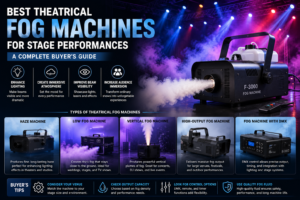
Want to learn more about professional stage fog systems? Explore our comprehensive Theatrical Fog Machines guide to discover how different fog machine types work, their applications in theaters, concerts, TV studios, theme parks, and live events, along with expert tips for selecting the right fog effects equipment for your venue.
What Is a Low Fog Machine?
Definition
A low fog machine is a specialized device designed to produce a dense, cool fog that hugs the floor rather than rising and filling the room. This low-lying fog creates a striking “walking on clouds” effect often seen in weddings, theatrical productions, and high-end stage designs.
For productions that require powerful atmospheric effects, the 3000W Fog Machine for Professional Stage & Event Use delivers high-output fog, fast heat-up performance, DMX control, and reliable operation for theaters, concerts, live events, TV studios, clubs, and large entertainment venues. It’s an excellent choice for creating dramatic stage effects with consistent, professional-quality fog.
How Low Fog Is Produced
Low fog is typically created in one of two ways: dry ice fog machines, which submerge dry ice in hot water to produce a heavy, floor-hugging vapor, or chilled fog machines, which pass standard heated fog through a cooling chamber or fog chiller before release. The cooling process is what causes the fog to sink and roll along the ground instead of rising into the air.
Characteristics of Low-Lying Fog
Low fog is dense but contained to a low height, typically staying within 1–3 feet of the floor. It has a rolling, cloud-like appearance and dissipates upward gradually as it warms to room temperature.
Common Equipment Used
Low fog effects rely on dedicated low fog machines, fog chillers attached to standard units, or dry ice-based systems. Some professional rigs combine a standard fog machine with a chilling attachment to achieve consistent low-lying output.
Advantages
- Creates a visually stunning, elegant floor-hugging effect
- Doesn’t obscure performers’ upper bodies or faces
- Popular for high-end, photogenic moments like first dances
- Works well in relatively enclosed indoor spaces
- Doesn’t interfere significantly with sightlines above waist height
Limitations
- Requires precise temperature control to maintain the low-lying effect
- Dry ice-based systems require careful handling and consistent ice supply
- Less effective in venues with strong air currents or HVAC drafts
- Can be more expensive due to chiller equipment or dry ice costs
- Limited use for filling a large volume of space dramatically
What Are High Fog Effects?
Theatrical fog at standard or high output is designed to rise and fill a space rather than stay low. This is the fog effect most people picture when they think of stage smoke: a full, room-filling cloud used for dramatic impact.
Definition
High fog refers to standard-output fog effects that disperse upward and outward, filling a stage, room, or performance area with a visible atmospheric cloud rather than remaining close to the ground.
How High Fog Is Produced
High fog is produced using standard heat-exchanger fog machines, where fog fluid is vaporized and expelled at room temperature (or close to it) without a chilling process. Because the vapor isn’t cooled below ambient air temperature, it naturally rises and spreads throughout the space.
Characteristics
High fog is broad, voluminous, and can quickly reduce visibility throughout an entire venue. It creates an immersive, all-encompassing atmosphere rather than a contained, low-lying effect.
Fog Dispersion
Without chilling, fog vapor mixes readily with ambient air and rises, dispersing across ceiling height in larger venues or filling smaller rooms entirely within moments of activation.
Advantages
- Creates immediate, dramatic, room-filling atmosphere
- Excellent for concerts, festivals, and high-energy performances
- Enhances lighting beams and silhouette effects across the entire stage
- Generally requires simpler, less expensive equipment than low fog
- Effective for larger venues and bigger crowds
Limitations
- Can obscure performers and set details if overused
- May trigger fire alarms or smoke detectors without proper venue coordination
- Less suited to elegant or intimate visual moments
- Dissipates unevenly in venues with strong ventilation
- Not ideal when a “clean,” low-key ambient effect is desired
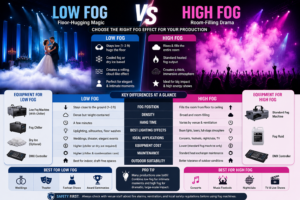
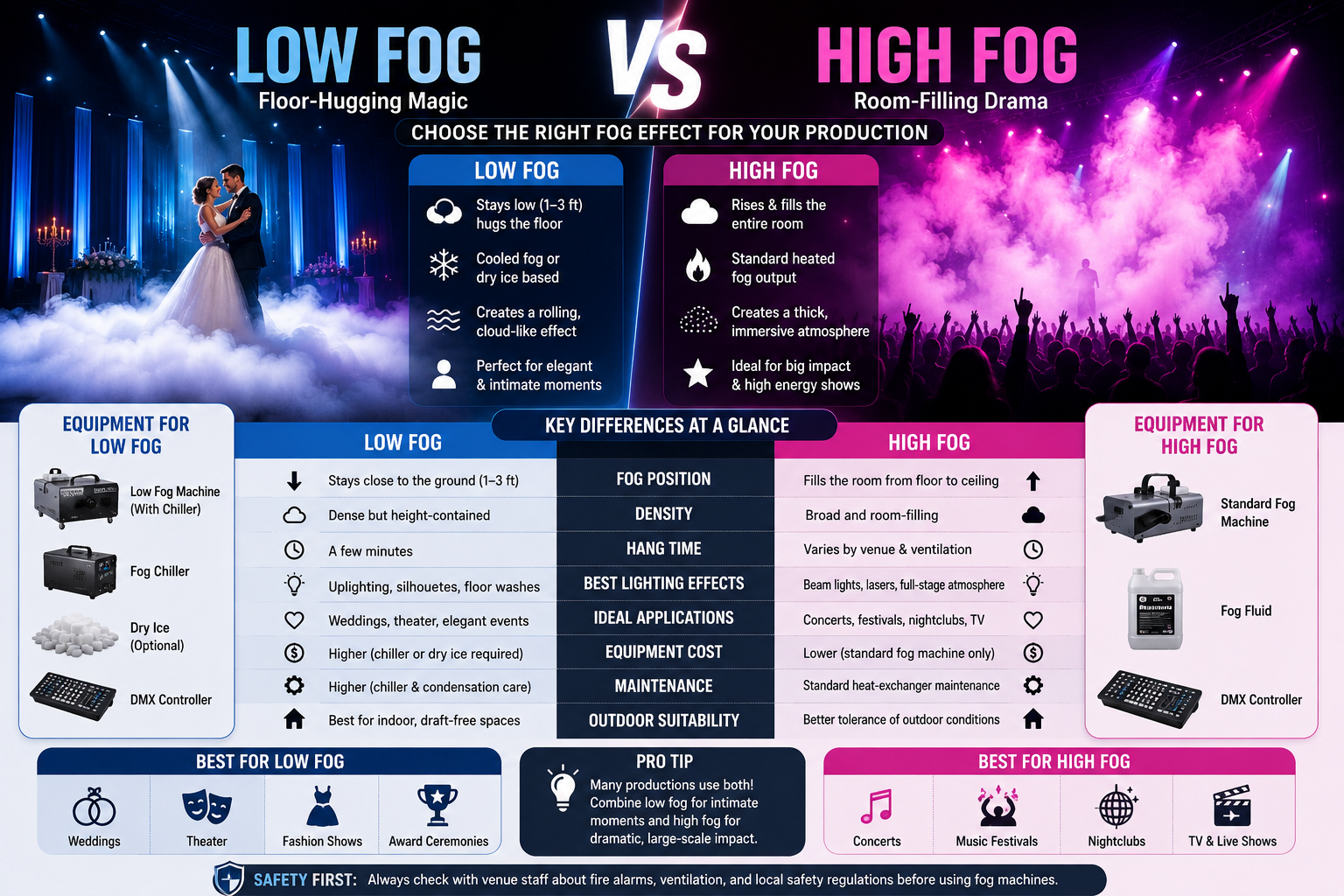
Low Fog vs High Fog Effects: Key Differences
Fog Height
Low fog stays close to the ground, typically within a few feet. High fog rises and fills the vertical space of a room or stage.
Density
Both effects can be dense, but low fog concentrates that density near the floor, while high fog distributes density throughout the room.
Visual Appearance
Low fog resembles a rolling cloud bank across the floor. High fog resembles a full atmospheric haze or smoke-filled room.
Duration
Low fog dissipates as it warms, typically lasting a few minutes before rising and dispersing. High fog dissipates as it disperses into ambient air, with duration depending on venue size and ventilation.
Lighting Performance
Low fog is excellent for uplighting and silhouette effects at ground level. High fog enhances beam lighting, wash effects, and full-stage atmospheric lighting.
Indoor vs Outdoor Use
Low fog performs best indoors, in stable, draft-free environments. High fog is more forgiving outdoors, though wind will still disperse it faster than indoor use.
Equipment Requirements
Low fog requires a chiller unit or dry ice setup in addition to a base fog machine. High fog only requires a standard fog machine with adequate output for the venue size.
Maintenance
Low fog equipment (particularly chillers) requires more thorough cleaning to prevent condensation-related buildup. Standard high-fog machines require routine descaling similar to any heat-exchanger fog unit.
Low Fog vs High Fog Comparison Table
| Feature | Low Fog | High Fog |
| Fog Position | Stays low, 1–3 feet off the ground | Fills the room from floor to ceiling |
| Density | Dense but height-contained | Broad and room-filling |
| Hang Time | A few minutes before rising/dispersing | Varies by venue size and ventilation |
| Best Lighting Effects | Uplighting, silhouettes, floor washes | Beam lighting, full-stage atmosphere |
| Ideal Applications | Weddings, elegant reveals, theater | Concerts, festivals, nightclubs, TV |
| Equipment Cost | Higher (chiller or dry ice required) | Lower (standard fog machine only) |
| Maintenance | Higher (chiller/condensation care) | Standard heat-exchanger maintenance |
| Outdoor Suitability | Limited; needs still air | Better tolerance of light outdoor wind |
Best Applications for Low Fog Effects
Weddings
Low fog is the signature effect for elegant first dances, creating a dreamlike “walking on clouds” moment that photographs and films beautifully.
Theater Productions
Directors use low fog for ghostly, mystical, or otherworldly scenes where floor-level atmosphere adds mood without obscuring actors’ faces or dialogue delivery.
First Dance Performances
Beyond weddings, first dance or featured performance moments in galas and formal events benefit from the same elegant, contained fog effect.
Luxury Events
High-end product launches and VIP events use low fog to add a touch of sophistication and visual polish without overwhelming the room.
Fashion Shows
Runway productions use low fog to create a striking visual base for models walking the runway, adding drama at ground level while keeping outfits and faces clearly visible.
Award Ceremonies
Low fog enhances red-carpet moments and stage reveals with a refined, cinematic quality suited to formal, camera-heavy events.
Low fog enhances these productions because it adds atmosphere and visual drama without sacrificing visibility of the people at the center of the moment.
Best Applications for High Fog Effects
Stage fog effects at high output are built for scale, energy, and drama across an entire performance space.
Concerts
High fog is a staple at concerts, amplifying lighting design and creating an immersive atmosphere that matches the scale and energy of a live performance.
Music Festivals
Outdoor festival stages use high fog to punctuate big moments, drops, and headline performances with maximum visual impact.
Nightclubs
Nightclub lighting design depends on high fog to keep the room’s atmosphere thick enough for constant, dramatic lighting effects throughout the night.
TV Productions
Television and film productions use high fog for dramatic scene-setting, particularly in music performance segments or dramatic reveals.
Theme Parks
Theme park attractions and shows use high fog to build immersive environments for dark rides, stage shows, and themed experiences.
Live Shows
Touring live shows, from comedy specials to full theatrical productions, use high fog to reinforce dramatic entrances, transitions, and big finale moments.
High fog creates dramatic visual impact because it transforms the entire space at once, giving lighting designers a full-room canvas to work with.
Which Fog Effect Works Best with Stage Lighting?
Moving Head Lights
High fog provides more surface area for moving head beams to cut through, making it the stronger match for dynamic, large-scale lighting choreography.
Beam Lights
Beam lighting depends on atmosphere to be visible at all — high fog (or haze) fills the room enough to sustain visible beam lines throughout a set.
Wash Lights
Low fog complements wash lighting used for ground-level color effects, while high fog supports broader, full-room wash coverage.
Spotlights
Low fog pairs beautifully with spotlights aimed at performers, since it enhances the ground-level atmosphere without fogging the performer’s face or upper body.
Lasers
High fog (often paired with haze for sustained visibility) is essential for laser shows that need consistent atmospheric density throughout a performance.
LED Pars
Both effects work with LED pars, but low fog suits accent lighting at stage level, while high fog enhances full-stage color washes.
Equipment Needed for Low and High Fog Effects
Low Fog Machines
Purpose-built low fog machines combine a fog generator with an integrated chilling mechanism to produce consistent floor-hugging output without manual dry ice handling.
Standard Fog Machines
Standard heat-exchanger fog machines form the base equipment for high fog effects and can also feed into a chiller attachment for low fog output.
Vertical Fog Machines
Vertical fog machines direct output straight upward, often used to create dramatic beams or curtain-like fog walls in theatrical and concert productions.
Fog Chillers
Fog chillers cool standard fog machine output before release, transforming ordinary high fog into a low, floor-hugging effect.
DMX Controllers
A DMX fog machine setup allows lighting designers to precisely cue fog bursts in sync with lighting and sound cues, critical for professional productions.
Fog Fluids
Fog fluid formulations vary by machine type and desired density; using the correct fluid protects equipment and ensures consistent output quality.
Cooling Systems
Beyond dedicated chillers, some productions use dry ice, cooling tubes, or ambient temperature control to help maintain low fog’s floor-hugging characteristics.
How to Choose the Right Fog Effect
Venue Size
Larger venues typically benefit from high fog’s room-filling capability, while smaller, more intimate spaces often suit low fog’s contained effect.
Stage Design
Elevated stages or platforms may benefit from low fog pooling at the base, while flat, open stages often showcase high fog’s full-room presence more effectively.
Performance Type
Dramatic, story-driven, or elegant productions lean toward low fog, while high-energy concerts and festivals lean toward high fog.
Budget
High fog setups are generally more budget-friendly, since they don’t require chiller attachments or specialized dry ice logistics.
Lighting Equipment
Rigs built around moving heads and beam effects generally pair better with high fog, while spotlight- and uplighting-focused designs pair well with low fog.
Indoor vs Outdoor Events
Low fog performs best in controlled indoor environments, while high fog tolerates a wider range of conditions, including outdoor use.
Safety Requirements
Always confirm compatibility with fire suppression systems and local fire code requirements, particularly for dry ice-based low fog systems, which require careful handling.
Buyer’s Checklist
- [ ] Identify whether your goal is a contained floor effect (low fog) or full-room atmosphere (high fog)
- [ ] Confirm venue size and ceiling height
- [ ] Check for HVAC drafts or airflow that could disrupt low fog
- [ ] Verify budget covers chiller equipment if pursuing low fog
- [ ] Confirm DMX compatibility with your lighting console
- [ ] Review fire code and smoke detector compatibility
- [ ] Assess whether dry ice logistics are feasible for your event
- [ ] Test the chosen effect with your actual lighting setup beforehand
- [ ] Plan for ongoing fluid, dry ice, or maintenance costs
- [ ] Consider whether your production needs both effects at different points
Common Mistakes When Creating Fog Effects
- Using high fog when low fog is needed. A room-filling cloud can overwhelm an intimate moment meant to stay elegant and contained.
- Choosing the wrong fog fluid. Mismatched fluid can damage equipment or fail to produce the intended density and hang time.
- Ignoring venue ventilation. Airflow can destroy a carefully planned low fog effect or disperse high fog too quickly to be effective.
- Poor DMX synchronization. Fog cues that fire too early or late can undercut a carefully timed lighting or music moment.
- Overproducing fog. Excess fog, whether low or high, can reduce visibility to the point of obscuring performers entirely.
- Inadequate maintenance. Skipping cleaning and descaling shortens equipment lifespan and reduces output quality over time.
- Using unsuitable lighting fixtures. Pairing the wrong lighting style with the wrong fog effect wastes both the atmospheric and lighting investment.
Expert recommendation: Always match the fog effect to the specific visual goal of the moment, test in the actual venue beforehand, and coordinate closely with your lighting designer and venue staff on ventilation and safety requirements.
Frequently Asked Questions
What is a low fog machine?
A low fog machine produces a dense, chilled fog that stays close to the ground, creating a floor-hugging cloud effect rather than filling the entire room.
What is the difference between low fog and high fog?
Low fog stays contained near the floor due to cooling, while high fog rises and fills the room or stage with atmospheric cloud.
Which fog effect is best for weddings?
Low fog is the preferred choice for weddings, especially for first dances, thanks to its elegant, floor-hugging “walking on clouds” appearance.
Which fog effect works best with moving head lights?
High fog generally works best with moving head lights, since it fills more of the room and provides greater surface area for beams to cut through.
Can low fog be used outdoors?
Low fog is best suited to indoor, draft-free environments, since outdoor wind quickly disrupts its floor-hugging effect.
Does low fog require special fluid?
Low fog often requires standard fog fluid combined with a chiller attachment, or dry ice, rather than a unique fluid formulation on its own.
Which fog effect lasts longer?
High fog tends to linger longer in larger spaces with stable air, while low fog naturally dissipates as it warms and rises within a few minutes.
Are low fog machines more expensive?
Yes, low fog setups are generally more expensive due to the added cost of chiller equipment or ongoing dry ice supply.
Can one venue use both low and high fog?
Yes, many professional productions use both effects at different points in a show to achieve different visual goals.
What lighting fixtures work best with stage fog effects?
Beam lights, moving heads, and lasers pair best with high fog, while spotlights and uplighting pair especially well with low fog.
How do I maintain a low fog machine?
Regularly clean the chiller unit to prevent condensation buildup, descale the heat exchanger, and flush fluid lines to keep output consistent.
How do I choose the right fog effect?
Start with your production’s visual goal, then factor in venue size, lighting equipment, budget, and indoor/outdoor conditions to decide between low fog, high fog, or both.
Can low fog be used on an outdoor stage?
It’s possible but not ideal, since outdoor air currents typically disperse low fog’s contained effect faster than in a controlled indoor space.
Is dry ice necessary for low fog effects?
Not always. Dedicated low fog machines with built-in chillers can achieve similar results without the logistical demands of dry ice.
Do high fog machines need a chiller?
No, standard high fog machines operate without a chiller, since the goal is for the fog to rise and disperse rather than stay low.
Conclusion
Low fog and high fog effects serve very different creative purposes on stage. Low fog delivers an elegant, floor-hugging visual perfect for weddings, theater, and refined moments where visibility of performers matters most. High fog delivers a dramatic, room-filling atmosphere ideal for concerts, festivals, and high-energy productions where scale and impact are the priority.
Choosing between them comes down to your venue, budget, lighting setup, and the specific visual story you’re trying to tell. Many professional productions ultimately use both effects at different points in a show, layering intimate low fog moments with dramatic high fog crescendos.