Introduction
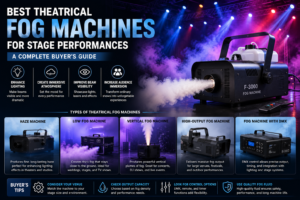
Modern stage productions rely on more than impressive performers and creative set designs. Atmospheric effects play a crucial role in transforming ordinary performances into immersive visual experiences. Among the most widely used stage effects, theatrical fog machines are essential tools for creating dramatic lighting, enhancing beam visibility, and adding depth to live performances.
Whether you’re producing a Broadway-style theater show, organizing a large-scale concert, designing a church production, or managing a cultural tourism attraction, the right theatrical fog machine can significantly improve the audience’s experience. By producing controlled atmospheric effects, these machines make lighting beams visible, create mood, emphasize movement, and add cinematic realism that cannot be achieved with lighting alone.
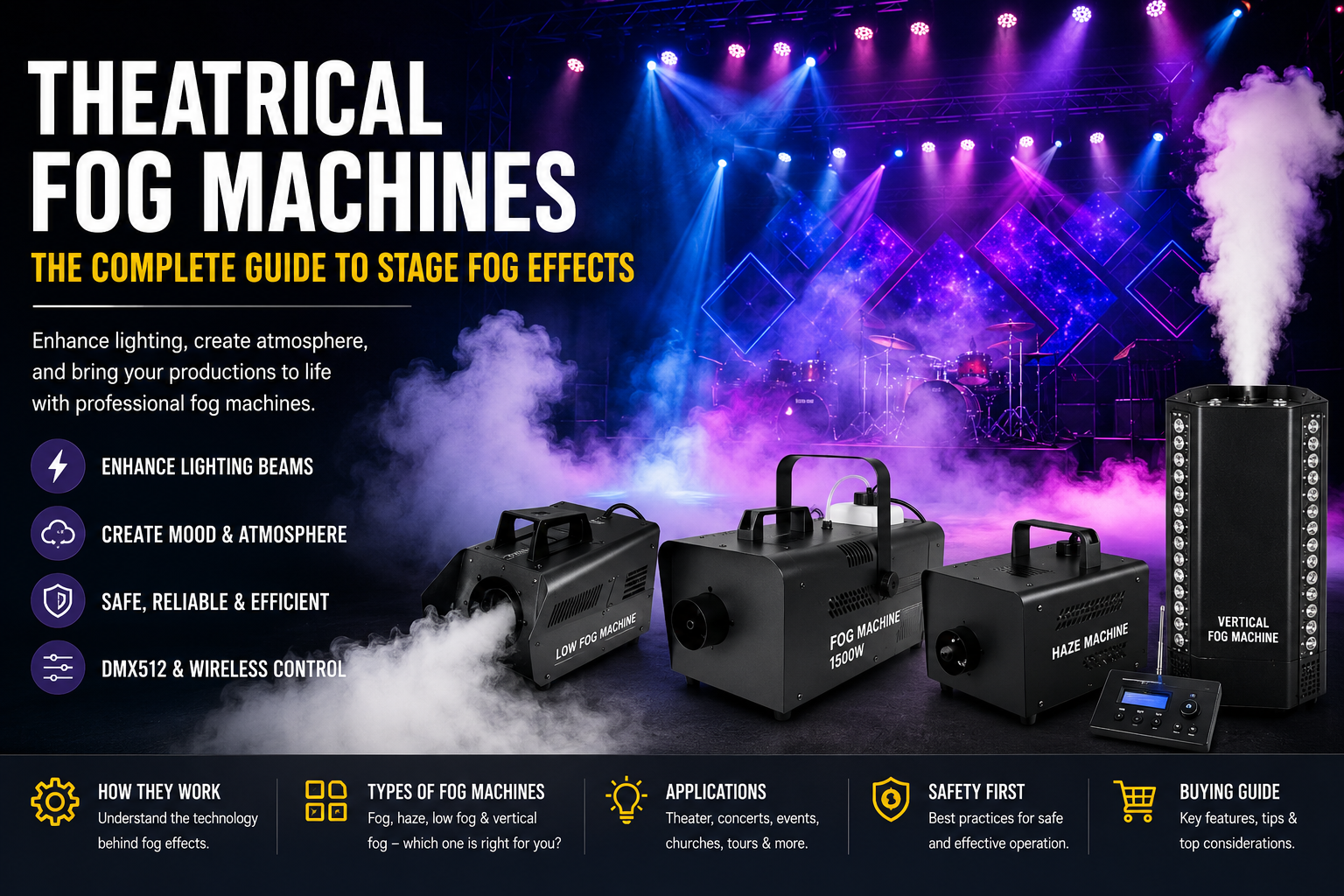
Today’s professional stage productions use a variety of fog technologies, including traditional fog machines, haze machines, low fog systems, and vertical fog machines. Many models also feature DMX512 integration, wireless control, programmable automation, and energy-efficient heating systems, making them an indispensable part of modern entertainment lighting and stage production equipment.
This comprehensive guide explains everything you need to know about theatrical fog machines, including how they work, their different types, applications, safety guidelines, maintenance practices, buying considerations, and future innovations. Whether you are a theater owner, lighting designer, event organizer, AV integrator, rental company, school, church, or live production professional, this guide will help you choose and operate the right stage fog solution with confidence.
What Are Theatrical Fog Machines?
Definition
A theatrical fog machine is a specialized piece of stage effects equipment designed to produce artificial fog or smoke-like atmospheric effects for entertainment, theatrical performances, concerts, television studios, and live events. Rather than creating real smoke, these machines vaporize specially formulated fog fluid to generate a fine mist that enhances lighting and creates visual depth.
Professional fog machines are engineered to deliver consistent output, rapid warm-up times, and precise control over fog density. They are commonly integrated with lighting systems through DMX control, allowing operators to synchronize fog effects with music, lighting cues, and stage movements.
Unlike household novelty fog machines, professional theatrical fog machines are built for continuous operation, high output, and reliable performance in demanding production environments.
History of Stage Fog Effects
The use of atmospheric effects in entertainment dates back centuries. Early theaters relied on burning incense, oil lamps, and smoke-producing materials to create dramatic scenes. While effective, these methods often presented safety hazards and offered little control over the density or duration of the effect.
In the twentieth century, technological advancements introduced electrically heated fog machines capable of producing cleaner, safer, and more consistent atmospheric effects. These innovations quickly became standard equipment for theaters, concerts, and television productions.
As entertainment technology evolved, fog machines became increasingly sophisticated, incorporating digital controls, wireless operation, programmable sequences, and compatibility with professional lighting consoles. Today, they are an integral component of modern stage production.
How Modern Fog Machines Have Evolved
Modern theatrical fog machines differ significantly from earlier designs. Advances in engineering have improved performance, efficiency, and reliability while expanding creative possibilities.
Key developments include:
- Fast warm-up heating systems
- Precision electronic pumps
- DMX512 lighting integration
- Wireless remote control
- Variable output adjustment
- Energy-efficient heating elements
- Eco-friendly water-based fog fluids
- Quiet operation for theatrical environments
- Automatic temperature regulation
- Intelligent self-cleaning features on premium models
These improvements enable lighting designers and production teams to create highly synchronized atmospheric effects that enhance every aspect of a live performance.
Why Fog Is Essential for Professional Productions
One of the primary reasons fog is used in professional productions is its ability to reveal light beams. Without atmospheric particles suspended in the air, beams from moving heads, lasers, and spotlights remain largely invisible to the audience.
Fog creates a medium through which light can scatter, making beams appear solid and dramatically increasing their visual impact. This effect is especially important in concerts, theatrical performances, dance productions, theme parks, and television broadcasts.
Beyond enhancing lighting, fog contributes to storytelling by helping establish mood, emphasize dramatic moments, create realistic environmental effects, and immerse audiences in the performance. From eerie haunted attractions to elegant wedding entrances and high-energy music festivals, controlled fog adds another dimension to the visual experience.
How Do Theatrical Fog Machines Work?
Despite their sophisticated performance, theatrical fog machines operate using a relatively straightforward process that combines heat, fluid, pressure, and controlled airflow.
Understanding this process helps operators maximize efficiency, improve reliability, and maintain consistent output throughout an event.
Heating System
Every professional fog machine contains a high-performance heater block made from aluminum or other heat-conductive materials. An electric heating element raises the block to an operating temperature typically between 200°C and 300°C, depending on the machine’s design and the type of fog fluid being used.
Advanced models feature electronic temperature monitoring to ensure consistent performance and prevent overheating. Many also include automatic standby modes that maintain optimal operating temperature during pauses in production.
Pump Mechanism
Once the heater reaches the correct temperature, a high-pressure pump draws fog fluid from the machine’s reservoir and pushes it through the heated block. The quality of the pump directly affects output consistency, pressure stability, and overall performance.
Professional-grade pumps are designed for continuous use and can deliver large volumes of fluid quickly, making them ideal for concerts, theaters, and large-scale events.
Fog Fluid Vaporization
As the fluid passes through the heated chamber, it rapidly vaporizes into microscopic particles. When this vapor exits the nozzle and mixes with cooler surrounding air, it condenses into the visible fog effect.
The composition of the fog fluid determines several characteristics, including:
- Fog density
- Hang time
- Dissipation speed
- Particle size
- Beam visibility
Selecting the appropriate fluid is just as important as selecting the right machine.
Nozzle Operation
The nozzle is responsible for directing the fog into the performance space. Different nozzle designs produce varying spray patterns, ranging from concentrated streams to wide dispersal.
Some professional machines allow interchangeable nozzles or adjustable output angles to suit different venue layouts and production requirements.
Fog Output Control
Modern theatrical fog machines provide multiple methods of controlling output:
- Manual activation
- Timer-based operation
- Wired remote control
- Wireless remote control
- DMX512 integration
- Art-Net or network-based control on advanced systems
- Automated show programming
Variable output control allows operators to create everything from subtle atmospheric haze to dense bursts of dramatic fog.
Step-by-Step: How a Fog Machine Produces Stage Fog
- The heater block warms to its operating temperature.
- Fog fluid is drawn from the reservoir by the pump.
- The fluid passes through the heated chamber.
- Heat instantly vaporizes the fluid.
- Vapor exits through the nozzle.
- Contact with cooler air condenses the vapor into visible fog.
- The controller regulates timing, duration, and output intensity.
- Lighting fixtures illuminate the suspended particles to create dramatic stage effects.
Types of Theatrical Fog Machines
Not every production requires the same type of atmospheric effect. Different venues, lighting designs, and creative goals call for different fog technologies. Understanding the strengths of each machine type helps ensure optimal performance and visual impact.
Standard Fog Machines
Standard fog machines are the most commonly used atmospheric effect devices in entertainment. They produce dense clouds of fog that disperse throughout the venue, making them suitable for concerts, DJs, theaters, haunted houses, weddings, and corporate events.
Best for:
- General stage effects
- Concerts
- Mobile DJs
- School productions
- Event rentals
Advantages:
- Affordable
- Easy to operate
- High output
- Versatile for many applications
Low Fog Machines
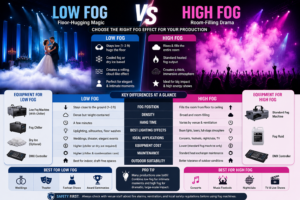
Low fog machines create a dense layer of fog that stays close to the ground, producing the popular “walking on clouds” effect. This is achieved by cooling the fog before it exits the machine.
Low fog is widely used for weddings, theatrical performances, dance productions, and ceremonial events where a dramatic floor-level effect is desired.
Best for:
- Weddings
- Stage performances
- Dance shows
- Award ceremonies
- Luxury events
Advantages:
- Elegant appearance
- Minimal obstruction of performers
- Photogenic effect
Haze Machines
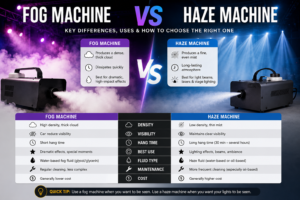
Unlike standard fog machines, haze machines generate extremely fine particles that remain suspended in the air for extended periods. Instead of creating thick clouds, haze provides a subtle atmospheric layer that makes lighting beams highly visible without obscuring the stage.
Haze is the preferred choice for concerts, television broadcasts, and architectural lighting applications where continuous beam enhancement is required.
Best for:
- Concert tours
- Broadcast studios
- Corporate events
- Permanent installations
Advantages:
- Long hang time
- Even atmospheric coverage
- Excellent beam definition
- Low fluid consumption
Vertical Fog Machines
Vertical fog machines project powerful columns of illuminated fog vertically into the air, creating dramatic visual accents synchronized with music or lighting cues.
These machines often incorporate RGB or RGBW LEDs, allowing the fog plume itself to change color for added impact.
Best for:
- Concerts
- Nightclubs
- Festivals
- Product launches
- High-energy performances
Advantages:
- Dynamic vertical effects
- LED color integration
- Fast response time
CO₂-Style Fog Machines
CO₂-style fog machines replicate the appearance of traditional carbon dioxide jets using specially designed fog systems. While they produce a similar visual effect, many operate without requiring high-pressure CO₂ cylinders, simplifying setup and reducing operational complexity.
Best for:
- Music festivals
- EDM events
- Sports entertainment
- Live television
- Indoor arenas
Advantages:
- Dramatic burst effects
- Safer handling than high-pressure gas systems
- Reusable fluid-based operation
Water-Based Fog Machines
Water-based fog machines are the industry standard for most indoor theatrical and event applications. They use water-based fog fluid to produce clean, consistent atmospheric effects with minimal residue.
Best for:
- Theaters
- Churches
- Schools
- Corporate venues
- TV studios
Advantages:
- Easy maintenance
- Low residue
- Broad compatibility
- Environmentally friendlier than oil-based systems
Oil-Based Haze Machines
Oil-based haze machines generate exceptionally fine particles that remain airborne longer than water-based haze, making them suitable for large venues and professional touring productions.
Because they can leave light residue over time, proper ventilation and maintenance are important.
Best for:
- Arenas
- Large concert venues
- Film productions
- Long-duration shows
Advantages:
- Extremely long hang time
- Superior beam visibility
- Efficient coverage of large spaces
Fog Machine Comparison Table
| Machine Type | Best For | Fog Density | Indoor/Outdoor | Key Advantages |
| Standard Fog Machine | Concerts, DJs, theaters | High | Both | Versatile, affordable, high output |
| Low Fog Machine | Weddings, stage performances | High (ground level) | Indoor | Creates cloud-like floor effects |
| Haze Machine | Concerts, TV studios | Low | Indoor | Long hang time, excellent beam visibility |
| Vertical Fog Machine | Festivals, clubs, concerts | High | Both | Vertical bursts with optional LED lighting |
| CO₂-Style Fog Machine | Live entertainment, sports events | Very High | Both | Explosive visual effects without traditional CO₂ cylinders |
| Water-Based Fog Machine | Schools, churches, theaters | Medium–High | Indoor | Cleaner operation, minimal residue |
| Oil-Based Haze Machine | Arenas, touring productions | Very Low | Indoor | Ultra-fine haze with extended suspension time |
Main Components of a Theatrical Fog Machine
A professional theatrical fog machine is more than a simple device that produces fog. It is a carefully engineered system where each component contributes to output quality, reliability, safety, and overall performance. Understanding these components helps buyers choose the right equipment and enables technicians to maintain optimal operation.
Heater Block
The heater block is the heart of every stage fog machine. It contains an electric heating element that rapidly heats the fog fluid to its vaporization temperature.
A high-quality heater block offers:
- Fast warm-up times
- Consistent fog output
- Stable operating temperatures
- Reduced clogging
- Longer service life
Professional machines often use aluminum or stainless-steel heater blocks with electronic temperature sensors that prevent overheating while maintaining consistent performance throughout long productions.
Performance Impact:
A larger, well-designed heater block produces thicker, more consistent fog while reducing recovery time between bursts.
Fluid Tank
The fluid tank stores the fog fluid before it is pumped into the heating system. Tank capacities vary depending on machine size and intended application.
Typical capacities include:
- 0.5–1 L for portable units
- 2–5 L for professional stage machines
- 5–10+ L for touring and permanent installations
Transparent tanks or fluid-level indicators allow operators to monitor remaining fluid during performances, reducing the risk of interruptions.
Performance Impact:
Larger tanks support longer operating periods without refilling, making them ideal for concerts, theaters, and large-scale productions.
Pump
The pump draws fog fluid from the reservoir and delivers it to the heater block under controlled pressure.
Professional pumps are designed for:
- High-pressure operation
- Precise fluid delivery
- Continuous use
- Quiet performance
- Long operating life
The quality of the pump directly influences fog consistency, output volume, and machine reliability.
Performance Impact:
A premium pump ensures stable fog production and minimizes fluctuations during demanding shows.
Controller
The controller manages every aspect of machine operation, including:
- Output intensity
- Burst duration
- Timer functions
- Preheating status
- Temperature monitoring
- Error notifications
Many professional fog machines feature LCD displays, touch controls, or programmable interfaces that simplify operation.
Performance Impact:
Advanced controllers provide greater precision and allow operators to create repeatable atmospheric effects.
DMX Interface
DMX512 has become the industry standard for controlling stage effects.
A DMX-enabled fog machine can be integrated into the same control system as:
- Moving head lights
- LED fixtures
- Lasers
- Strobes
- Follow spots
- Media servers
Using DMX, lighting designers can synchronize fog output with music, lighting cues, and stage movements.
Performance Impact:
DMX integration delivers consistent, automated effects and eliminates the need for manual triggering during live performances.
Wireless Remote
Wireless remotes provide convenient control when a wired connection is impractical.
Common features include:
- Instant fog activation
- Adjustable output
- Timer operation
- Multiple machine control
- Portable operation
Wireless control is especially useful for mobile DJs, weddings, temporary stages, and rental companies.
Performance Impact:
Wireless operation increases flexibility while reducing cable clutter around the stage.
Power Supply
Professional fog machines require stable electrical power to maintain heater temperature and pump performance.
Power requirements typically range from:
- 400–700 W for compact machines
- 1,000–1,500 W for mid-range units
- 2,000–3,000+ W for high-output systems
Voltage protection and thermal safeguards improve reliability and reduce the risk of equipment damage.
Performance Impact:
A reliable power supply ensures consistent operation throughout long performances.
Applications of Theatrical Fog Machines
The versatility of theatrical fog machines makes them indispensable across a wide range of entertainment and event industries.
Theater Productions
Theaters use fog to create dramatic scenes, atmospheric environments, dream sequences, battle effects, and supernatural moments. Controlled fog also enhances beam lighting without distracting the audience.
Concerts
Concert lighting is significantly enhanced by atmospheric effects. Fog reveals moving beam patterns, laser graphics, and synchronized lighting sequences that would otherwise be invisible.
Festivals
Outdoor festivals often use high-output fog machines to produce dramatic effects across large performance areas, particularly during headline performances and opening ceremonies.
Churches
Modern worship productions increasingly incorporate professional lighting and atmospheric effects to enhance music performances and seasonal productions.
Low-density haze is generally preferred because it improves beam visibility without overwhelming the audience.
Television Studios
Broadcast environments require carefully controlled atmospheric effects that improve camera depth while maintaining image clarity.
Television productions typically favor haze machines for their subtle and even atmospheric coverage.
Film Production
Film crews use theatrical fog to create realistic environmental conditions such as:
- Morning mist
- Forest fog
- Industrial smoke
- Fantasy environments
- Night scenes
Fog adds depth and cinematic realism while improving lighting composition.
Cultural Tourism Shows
Large-scale cultural performances, historical reenactments, and outdoor tourism attractions rely on atmospheric effects to create immersive storytelling.
Fog enhances projection mapping, synchronized lighting, fountains, and multimedia performances.
Theme Parks
Theme parks use fog extensively for:
- Haunted attractions
- Adventure rides
- Live entertainment
- Character entrances
- Special events
Programmable fog systems help create immersive guest experiences.
Weddings
Low fog machines remain one of the most popular wedding special effects.
Applications include:
- First dance
- Grand entrance
- Stage reveals
- Photography
Corporate Events
Corporate presentations use fog strategically during:
- Product launches
- Award ceremonies
- Brand reveals
- Multimedia presentations
Subtle atmospheric effects increase visual impact while maintaining a professional appearance.
Nightclubs
Nightclubs rely heavily on haze and fog to maximize the impact of moving lights, lasers, LED fixtures, and visual effects.
Continuous haze provides consistent beam visibility throughout the evening.
Haunted Attractions
Haunted houses and seasonal attractions depend on dense fog to conceal actors, build suspense, and create immersive environments.
Combined with lighting and sound effects, fog dramatically increases visitor engagement.
Application Comparison Table
| Venue | Recommended Machine | Primary Goal |
| Theater | Water-based fog machine | Dramatic atmosphere |
| Concert | Haze machine | Beam visibility |
| Festival | High-output fog machine | Large-area coverage |
| Church | Haze machine | Soft lighting enhancement |
| TV Studio | Haze machine | Camera-friendly atmosphere |
| Film Set | Fog machine | Environmental realism |
| Theme Park | Fog + Low Fog | Immersive storytelling |
| Wedding | Low fog machine | Cloud effect |
| Corporate Event | Haze machine | Elegant presentations |
| Nightclub | Haze + Vertical Fog | Dynamic lighting |
| Haunted House | Dense fog machine | Suspense and concealment |
Benefits of Using Theatrical Fog Machines
Professional atmospheric effects do much more than produce visible fog. They improve lighting performance, strengthen storytelling, and elevate the overall production value.
Enhanced Beam Visibility
One of the biggest advantages of theatrical fog machines is their ability to make light beams visible.
Without atmospheric particles, moving heads, lasers, and spotlights remain largely invisible. Fog transforms lighting into a dynamic visual element.
Better Stage Atmosphere
Fog creates mood and depth, allowing directors and lighting designers to shape emotional responses.
Examples include:
- Mystery
- Romance
- Suspense
- Excitement
- Fantasy
- Drama
Improved Audience Experience
Immersive visual effects capture attention and make performances more memorable.
Professional atmospheric effects encourage stronger emotional engagement and enhance audience satisfaction.
Dynamic Lighting Effects
Fog amplifies:
- Beam lights
- Gobos
- Wash effects
- Lasers
- Color transitions
- Moving fixtures
Lighting designers can create more dramatic scenes using fewer fixtures.
Professional Production Quality
High-quality fog effects give productions a polished, professional appearance that rivals major concerts and theatrical performances.
Cost-Effective Special Effects
Compared with large scenic installations, fog machines provide exceptional visual impact at a relatively low investment.
Rental companies especially appreciate their versatility and strong return on investment.
Creative Freedom
Directors and designers gain greater artistic flexibility by integrating atmospheric effects into storytelling, choreography, and multimedia productions.
Choosing the Right Theatrical Fog Machine
Selecting the best theatrical fog machine depends on your venue, production style, budget, and technical requirements.
Venue Size
Small venues require compact machines, while arenas and outdoor festivals need high-output systems capable of covering large areas.
Output Capacity
Fog output is commonly measured in cubic feet (or cubic meters) per minute.
Higher output is recommended for:
- Large theaters
- Concerts
- Festivals
- Theme parks
Lower output is ideal for:
- Schools
- Churches
- Meeting rooms
- Small venues
Warm-Up Time
Fast warm-up reduces downtime between effects.
Professional models typically warm up in:
- 2–5 minutes
Entry-level machines may require:
- 6–10 minutes
Fluid Consumption
Efficient machines produce more atmospheric effect while using less fog fluid, lowering operating costs over time.
Control Options
Consider machines offering:
- Manual control
- Timer control
- Wired remote
- Wireless remote
- DMX512
- Wireless DMX
- Network integration
DMX Compatibility
Professional productions benefit greatly from DMX integration, allowing fog to synchronize with lighting, music, and show automation.
Portability
Rental companies and mobile productions should consider:
- Weight
- Carrying handles
- Flight-case compatibility
- Quick setup
Power Requirements
Ensure the machine matches the venue’s available electrical capacity, especially for large productions where multiple high-output units may operate simultaneously.
Budget
Rather than choosing solely on price, evaluate:
- Reliability
- Build quality
- Warranty
- Parts availability
- Brand reputation
- Service support
- Long-term operating costs
Commercial Buyer’s Checklist
Before purchasing a professional theatrical fog machine, ask the following:
- ✔ Is the machine designed for professional or commercial use?
- ✔ Does the output match your venue size?
- ✔ Is it compatible with DMX512?
- ✔ Does it support wireless control?
- ✔ What is the warm-up time?
- ✔ How large is the fluid tank?
- ✔ Is replacement fluid readily available?
- ✔ Is the machine easy to maintain?
- ✔ Are spare parts and technical support available?
- ✔ Does it include thermal protection and safety features?
- ✔ Is it suitable for continuous operation?
- ✔ Does it come with a manufacturer warranty?
Fog Fluid Explained
The quality of the fog effect depends heavily on the fluid used. Always use manufacturer-approved fluids to ensure safety, performance, and equipment longevity.
Water-Based Fluid
The most common choice for theaters, schools, churches, TV studios, and indoor venues.
Advantages:
- Low residue
- Easy cleanup
- Safe for most indoor applications
- Excellent beam enhancement
Oil-Based Fluid
Primarily used in professional haze machines where long-lasting atmospheric suspension is required.
Advantages:
- Extremely fine particles
- Extended hang time
- Superior beam definition in large venues
Quick-Dissipating Fog
Designed for productions requiring fast scene changes and temporary bursts of atmospheric effects.
Long-Lasting Fog
Ideal for concerts, immersive attractions, and events where maintaining consistent atmospheric coverage is important.
Safety Considerations
- Use only approved fog fluids recommended by the equipment manufacturer.
- Never substitute homemade or incompatible liquids.
- Store fluids in sealed containers away from heat and direct sunlight.
- Follow safety data sheets (SDS) and venue regulations.
- Ensure adequate ventilation in enclosed spaces.
DMX Control and Automation
Modern theatrical productions rely on automation to synchronize lighting, audio, video, and atmospheric effects. DMX-enabled fog machines allow operators to trigger precise effects as part of a fully programmed show.
DMX512
DMX512 is the industry-standard communication protocol for controlling lighting and stage effects. It enables centralized control of multiple devices from a single lighting console.
Wireless DMX
Wireless DMX eliminates long cable runs while maintaining reliable communication between controllers and fog machines. It is especially useful for temporary stages, touring productions, and venues where cable management is challenging.
Lighting Console Integration
Professional lighting consoles can trigger fog cues alongside moving lights, strobes, lasers, and LED fixtures, ensuring perfect synchronization throughout the performance.
Synchronizing Fog with Lighting
Coordinating fog output with lighting cues enhances beam visibility, dramatic reveals, and scene transitions. Timed effects create a polished, immersive experience for audiences.
Automated Show Programming
Advanced productions use programmable sequences that automatically activate fog at specific moments during a show. Automation reduces operator workload, improves consistency, and ensures repeatable performances night after night.
Safety Best Practices for Theatrical Fog Machines
Professional theatrical fog machines are designed with multiple safety features, but safe operation still depends on proper installation, approved fog fluids, regular maintenance, and trained operators. Whether you’re using a stage fog machine in a theater, concert venue, church, television studio, or theme park, following industry best practices helps protect performers, crew members, audiences, and equipment.
Safety should always be part of your production planning—not an afterthought. Before every event, verify that all atmospheric effects comply with local fire codes, venue policies, and manufacturer recommendations.
Ensure Proper Ventilation
Although modern water-based fog fluids are formulated for entertainment applications, adequate ventilation remains essential.
Good airflow helps:
- Maintain comfortable visibility for performers and audiences
- Prevent excessive fog buildup
- Improve indoor air circulation
- Reduce residue accumulation
- Support consistent atmospheric effects
Avoid filling enclosed spaces with dense fog for extended periods. Operators should monitor fog density and adjust output based on venue size and occupancy.
Best Practice: Balance fog output with your venue’s ventilation system to create visible lighting effects without compromising audience comfort.
Consider Fire Alarm Systems
One of the most common concerns with stage smoke machines is their interaction with smoke detection systems.
Some detectors, particularly optical (photoelectric) smoke detectors, may interpret dense fog as smoke and trigger an alarm.
Before using a fog machine:
- Consult the venue manager.
- Review local fire safety regulations.
- Coordinate with the fire safety team.
- Notify the monitoring company if required.
- Conduct a controlled test before the event.
Never disable fire protection systems without proper authorization.
Use Only Approved Fog Fluids
The quality of the fog fluid directly affects both machine performance and operator safety.
Always:
- Use manufacturer-recommended fluids.
- Match the fluid type to the machine (water-based or oil-based).
- Check expiration dates.
- Keep containers tightly sealed.
- Label fluids clearly to avoid accidental mixing.
Avoid:
- Homemade fog mixtures
- Mineral oil substitutes
- Automotive fluids
- Chemical additives
- Unapproved third-party liquids
Using incompatible fluids can clog the heater block, damage internal components, reduce fog quality, and void the manufacturer’s warranty.
Practice Electrical Safety
Professional fog machines for stage often operate at high wattage and generate significant heat.
Electrical safety includes:
- Inspecting power cables before every event
- Using grounded electrical outlets
- Avoiding overloaded extension cords
- Keeping connectors dry
- Protecting cables from foot traffic
- Using appropriate circuit protection
Never operate equipment with damaged cables, loose plugs, or exposed wiring.
Prevent Burn Hazards
The heater block inside a professional fog machine reaches very high temperatures during operation.
Operators should:
- Never touch the nozzle during use.
- Allow sufficient cooling time before transport.
- Keep flammable materials away from the machine.
- Position equipment where audience members cannot accidentally touch it.
Most professional units include thermal protection, but caution is still required.
Position Equipment Correctly
Proper placement improves both safety and performance.
Recommended practices:
- Place machines on stable, level surfaces.
- Keep air intake vents unobstructed.
- Maintain clearance around the heater.
- Avoid placing units directly beneath sprinkler heads.
- Protect machines from rain unless specifically rated for outdoor use.
For touring productions, use flight cases and secure mounting hardware during transport.
Train Operators
Even the most advanced professional fog machine requires knowledgeable operation.
Operators should understand:
- Startup procedures
- Warm-up times
- Fluid requirements
- DMX addressing
- Emergency shutdown procedures
- Routine inspections
- Cleaning requirements
Proper training reduces equipment failure and improves production consistency.
Stage Safety Checklist
Use the following checklist before every performance.
| Safety Check | Status |
| Machine inspected for damage | □ |
| Power cables checked | □ |
| Correct fog fluid installed | □ |
| Fluid level sufficient | □ |
| Ventilation confirmed | □ |
| Fire alarm procedures reviewed | □ |
| DMX communication tested | □ |
| Wireless remote tested | □ |
| Heater operating normally | □ |
| Pump functioning correctly | □ |
| Output tested before audience entry | □ |
| Backup fluid available | □ |
| Emergency shutdown procedure reviewed | □ |
| Operators trained | □ |
Maintenance and Cleaning
Routine maintenance is one of the most important factors in extending the lifespan of a theatrical smoke machine. Proper cleaning prevents clogged heaters, pump damage, inconsistent fog output, and costly repairs.
Professional production companies typically include fog machine maintenance as part of every event breakdown.
Clean After Every Event
After each production:
- Empty unused fluid if recommended by the manufacturer.
- Wipe exterior surfaces.
- Remove dust from air vents.
- Inspect power cables.
- Clean connectors.
- Check for leaks.
Keeping the machine clean reduces residue buildup and improves reliability.
Prevent Heater Clogs
The heater block is the most critical component of a fog machine.
Over time, residue from fog fluid can accumulate inside the heating chamber.
To minimize clogging:
- Use high-quality fog fluid.
- Avoid mixing different fluid brands.
- Flush the system periodically with approved cleaning solution.
- Never allow contaminated fluid into the tank.
A clean heater produces stronger and more consistent fog.
Pump Maintenance
The pump should deliver smooth, uninterrupted fluid flow.
Regular inspection includes:
- Listening for unusual noises
- Checking pressure consistency
- Inspecting inlet tubing
- Verifying fluid delivery
- Cleaning filters if applicable
Pump problems are easier to resolve when detected early.
Heater Maintenance
Professional machines monitor heater temperature automatically, but periodic inspection is still recommended.
Check for:
- Excessive residue
- Burn marks
- Slow warm-up
- Temperature fluctuations
- Error indicators
If heating performance declines, consult the manufacturer’s service recommendations rather than attempting unauthorized repairs.
Fluid Storage
Proper fluid storage protects both the machine and the quality of the atmospheric effect.
Store fog fluid:
- In its original sealed container
- Away from direct sunlight
- At moderate temperatures
- In a clean, dry environment
- Away from contaminants
Always verify the fluid type before refilling the machine.
Long-Term Storage
If the fog machine will not be used for an extended period:
- Empty the fluid tank if recommended by the manufacturer.
- Flush the system with approved cleaning solution.
- Clean exterior surfaces.
- Coil power cables properly.
- Store in a protective case.
- Keep the unit in a dry, temperature-controlled location.
Long-term storage procedures help prevent internal residue from hardening inside the pump and heater assembly.
Recommended Maintenance Schedule
| Maintenance Task | Frequency | Purpose |
| Inspect power cable | Before every event | Electrical safety |
| Check fluid level | Before every event | Continuous operation |
| Test fog output | Before every event | Verify performance |
| Clean exterior | After every event | Remove dust and residue |
| Inspect pump | Monthly | Maintain consistent pressure |
| Flush heater system | Every 40–60 operating hours (or per manufacturer guidance) | Prevent internal buildup |
| Check DMX connections | Monthly | Reliable communication |
| Inspect wireless remote | Monthly | Ensure responsive control |
| Examine fluid tubing | Quarterly | Detect wear or leaks |
| Full professional service | Annually (or per manufacturer recommendation) | Maximize reliability and lifespan |
Maintenance Tip: Always follow the maintenance intervals specified by the manufacturer, as cleaning frequency may vary depending on machine design, fluid type, and operating conditions.
Common Theatrical Fog Machine Problems and How to Fix Them
Even the highest-quality theatrical fog machines require routine maintenance and occasional troubleshooting. Most performance issues are caused by improper maintenance, incorrect fog fluid, clogged heating systems, electrical faults, or configuration errors rather than major equipment failures.
Understanding the most common problems and their solutions helps reduce downtime, extend equipment life, and ensure reliable atmospheric effects during live performances.
Machine Won’t Produce Fog
One of the most common issues occurs when the machine powers on but fails to produce any fog.
Possible Causes
- Heater has not reached operating temperature
- Empty fluid tank
- Air trapped in the fluid line
- Clogged heater block
- Blocked nozzle
- Faulty pump
- Incorrect fog fluid
- Internal safety protection activated
Recommended Solutions
- Allow the machine to complete its warm-up cycle.
- Check the fluid level and refill if necessary.
- Prime the pump according to the manufacturer’s instructions.
- Inspect the nozzle for blockage.
- Flush the heating system using an approved cleaning solution.
- Verify that the correct fog fluid is being used.
- Restart the machine after it has cooled if thermal protection has activated.
Weak Fog Output
If the fog appears thin, inconsistent, or significantly reduced, several factors may be affecting performance.
Possible Causes
- Low-quality fog fluid
- Partially clogged heater
- Worn pump
- Low operating temperature
- Restricted fluid flow
- Dirty internal tubing
Recommended Solutions
- Replace old or contaminated fog fluid.
- Clean the heater block.
- Inspect the pump for wear.
- Check fluid lines for restrictions.
- Perform a complete maintenance cycle.
Regular cleaning significantly improves fog density and consistency.
Fog Output Stops During Operation
Sometimes a machine performs normally at first but stops producing fog during the show.
Possible Causes
- Heater recovering after extended use
- Thermal protection activated
- Empty fluid tank
- Pump overheating
- Electrical interruption
Recommended Solutions
- Wait for the heater to return to operating temperature.
- Check the fluid reservoir.
- Ensure adequate ventilation around the machine.
- Inspect the power supply.
- Reduce continuous output if the machine exceeds its duty cycle.
Professional machines generally recover faster than entry-level models.
Leaking Fog Fluid
Fluid leaks should never be ignored because they may damage internal electronics or create slipping hazards.
Possible Causes
- Loose tubing
- Damaged fluid tank
- Cracked fittings
- Worn seals
- Overfilled reservoir
Recommended Solutions
- Tighten hose connections.
- Replace damaged tubing.
- Inspect seals and O-rings.
- Avoid overfilling the tank.
- Replace cracked containers immediately.
Always clean spilled fluid before continuing operation.
Heater Problems
The heater block is the most critical component of any professional fog machine.
Common Symptoms
- Long warm-up time
- Temperature warning lights
- No fog production
- Intermittent operation
- Automatic shutdown
Possible Causes
- Internal residue buildup
- Heating element failure
- Temperature sensor malfunction
- Electrical supply problems
Recommended Solutions
- Flush the heater using approved cleaner.
- Verify correct supply voltage.
- Inspect electrical connections.
- Contact qualified service personnel if the heater requires replacement.
Never attempt to disassemble a hot heater block.
Pump Failure
The pump delivers fog fluid from the reservoir into the heating chamber.
Symptoms
- Pump runs without fog output
- Clicking noises
- Irregular pumping
- Reduced pressure
- Complete loss of output
Possible Causes
- Air trapped inside pump
- Blocked inlet
- Worn pump diaphragm
- Internal contamination
Recommended Solutions
- Prime the pump.
- Clean the inlet filter.
- Remove air bubbles.
- Replace worn pump components if recommended by the manufacturer.
Routine maintenance greatly extends pump lifespan.
DMX Communication Problems
Modern DMX fog machines depend on reliable communication with the lighting controller.
Common Symptoms
- Machine ignores DMX commands
- Random fog activation
- Incorrect channel response
- Intermittent communication
Possible Causes
- Wrong DMX address
- Faulty cable
- Incorrect termination
- Controller programming error
- Damaged DMX connector
Recommended Solutions
- Verify DMX addressing.
- Test using another cable.
- Install a DMX terminator when required.
- Confirm console programming.
- Inspect XLR connectors.
Many communication problems can be resolved within minutes through systematic testing.
Wireless Remote Problems
Wireless operation provides flexibility, but communication issues occasionally occur.
Possible Causes
- Weak battery
- Signal interference
- Pairing failure
- Receiver obstruction
- Out-of-range operation
Recommended Solutions
- Replace batteries.
- Re-pair the remote.
- Reduce obstacles between transmitter and receiver.
- Stay within recommended operating distance.
- Test the receiver using manual controls.
Troubleshooting Table
| Problem | Possible Cause | Recommended Solution |
| No fog output | Heater not ready | Wait until warm-up is complete |
| No fog output | Empty fluid tank | Refill with approved fog fluid |
| No fog output | Pump not primed | Prime the pump |
| Weak fog | Dirty heater block | Flush the heating system |
| Weak fog | Old or contaminated fluid | Replace with fresh manufacturer-approved fluid |
| Weak fog | Pump wear | Inspect or replace the pump |
| Intermittent fog | Heater recovering | Allow the heater to regain operating temperature |
| Fluid leaking | Loose tubing | Tighten or replace tubing |
| Fluid leaking | Damaged tank | Replace the reservoir |
| Long warm-up | Heater residue | Clean the heater block |
| Machine overheats | Poor ventilation | Improve airflow around the unit |
| Pump noisy | Air in pump | Prime the pump |
| Pump silent | Electrical fault | Inspect wiring and power supply |
| DMX not responding | Incorrect DMX address | Verify channel settings |
| DMX unstable | Damaged cable | Replace DMX cable |
| Remote not working | Dead battery | Install a new battery |
| Remote intermittent | Signal interference | Reposition the receiver or reduce interference |
| Poor fog quality | Incorrect fog fluid | Use the correct manufacturer-approved fluid |
Preventive Maintenance Tips
Most fog machine problems can be avoided with a proactive maintenance routine.
Follow these best practices:
- Use only high-quality, manufacturer-approved fog fluid.
- Clean the machine after every production or at the intervals recommended by the manufacturer.
- Flush the heater periodically to reduce residue buildup.
- Inspect fluid tubing and fittings for leaks.
- Keep air vents free from dust and debris.
- Store the machine in a clean, dry environment.
- Test fog output before every event.
- Verify DMX communication during setup.
- Keep spare fog fluid, fuses, and cables available for critical productions.
- Schedule annual servicing for frequently used professional equipment.
Consistent preventive maintenance not only reduces unexpected failures but also improves fog quality, extends equipment life, and minimizes downtime during live events.
Theatrical Fog Machines vs. Other Atmospheric Effects
Atmospheric effects are a cornerstone of modern stage production, but not every effect serves the same purpose. Choosing the right solution depends on the venue, lighting design, production goals, and desired audience experience. Understanding the differences between theatrical fog machines, haze machines, CO₂ effects, dry ice systems, snow machines, and bubble machines helps production teams select the most effective equipment.
Theatrical Fog Machines
A theatrical fog machine produces dense, visible clouds by heating a specially formulated fog fluid and releasing it into the air. These machines are ideal for creating dramatic entrances, scene transitions, special effects, and enhancing the visibility of moving lights and laser beams.
Best Applications
- Theater productions
- Concerts
- DJ performances
- Haunted attractions
- Live entertainment
- Corporate events
- Festivals
Advantages
- High visual impact
- Affordable operating costs
- Wide range of output capacities
- Compatible with DMX automation
- Suitable for both temporary and permanent installations
Considerations
- Dense fog dissipates faster than haze.
- Excessive output may reduce visibility if not properly managed.
Haze Machines
A haze machine produces an ultra-fine atmospheric mist rather than thick clouds. Instead of becoming the focal point, haze remains almost invisible while making lighting beams appear brighter and more defined.
Best Applications
- Concert touring
- Television studios
- Houses of worship
- Corporate presentations
- Architectural lighting
- Permanent entertainment venues
Advantages
- Excellent beam visibility
- Long suspension time
- Low fluid consumption
- Even atmospheric coverage
- Camera-friendly appearance
Considerations
- Not suitable when dense fog effects are required.
- Oil-based haze may require additional cleaning over time.
CO₂ Jets
CO₂ jets create powerful white plumes using compressed carbon dioxide. Unlike fog machines, these effects disappear almost immediately and are often synchronized with music drops or dramatic moments.
Best Applications
- EDM festivals
- Nightclubs
- Sports entertainment
- Arena concerts
- Large outdoor events
Advantages
- Instant visual impact
- No lingering atmospheric effect
- Cooling sensation for audiences
- Excellent for high-energy performances
Considerations
- Requires high-pressure CO₂ cylinders.
- Higher operating costs than fluid-based fog systems.
- Additional safety procedures for gas handling.
Dry Ice Effects
Dry ice machines create a thick layer of low-lying fog by combining heated water with solid carbon dioxide. The fog hugs the floor without rising quickly, producing the classic “walking on clouds” effect.
Best Applications
- Weddings
- Dance performances
- Award ceremonies
- Stage musicals
- Luxury events
Advantages
- Beautiful floor-hugging fog
- Leaves upper stage visibility clear
- Elegant visual presentation
Considerations
- Requires regular dry ice supply.
- Limited operating duration.
- Additional handling precautions.
Snow Machines
Snow machines generate lightweight foam particles that simulate falling snow, adding seasonal or fantasy-themed effects to productions.
Best Applications
- Holiday events
- Theme parks
- Christmas productions
- Winter festivals
- Television commercials
Advantages
- Highly immersive
- Family-friendly
- Large-area coverage
- Suitable for indoor and outdoor use
Considerations
- Requires cleanup after use.
- Performance can be affected by wind in outdoor environments.
Bubble Machines
Bubble machines produce continuous streams of bubbles using a rotating wheel and bubble solution. They are commonly used for celebrations, family entertainment, and theatrical scenes.
Best Applications
- Children’s shows
- Weddings
- Theme parks
- Community festivals
- Family entertainment
Advantages
- Interactive audience experience
- Low operating cost
- Easy setup
- Lightweight equipment
Considerations
- Bubble residue can make floors slippery.
- Outdoor performance depends on weather conditions.
Atmospheric Effects Comparison Table
| Effect Type | Visual Density | Beam Visibility | Best For | Indoor | Outdoor | Operating Cost |
| Theatrical Fog Machine | High | Excellent | Concerts, theater, events | ✔ | ✔ | Low–Medium |
| Haze Machine | Low | Outstanding | Concert lighting, TV studios | ✔ | Limited | Low |
| CO₂ Jets | Very High (Short Burst) | Moderate | Festivals, EDM, sports | ✔ | ✔ | High |
| Dry Ice Machine | High (Ground Level) | Low | Weddings, stage productions | ✔ | Limited | Medium–High |
| Snow Machine | Medium | Low | Holiday events, theme parks | ✔ | ✔ | Medium |
| Bubble Machine | Low | None | Family entertainment, weddings | ✔ | ✔ | Low |
Future Trends in Stage Atmospheric Effects
The entertainment industry continues to adopt new technologies that improve efficiency, sustainability, and creative flexibility. Modern professional stage equipment is becoming smarter, more connected, and easier to integrate into automated productions.
Smart Fog Machines
Next-generation fog machines are increasingly equipped with intelligent onboard processors capable of monitoring temperature, fluid levels, and system performance in real time.
Benefits include:
- Automatic temperature regulation
- Self-diagnostic alerts
- Reduced maintenance requirements
- More consistent fog output
- Enhanced equipment protection
IoT Integration
Internet of Things (IoT) technology is enabling remote monitoring and management of stage equipment.
Future fog machines may allow technicians to:
- Monitor fluid levels remotely
- Track machine health
- Receive maintenance notifications
- Update firmware online
- Control multiple venues from a centralized dashboard
This is particularly valuable for theme parks, touring productions, and permanent entertainment venues.
Wireless Automation
Wireless communication technologies continue to improve production flexibility by reducing cable requirements and simplifying installation.
Modern systems increasingly support:
- Wireless DMX
- Bluetooth configuration
- Wi-Fi control
- Mobile device operation
- Cloud-based show management
These technologies make setup faster while improving operational efficiency.
Energy-Efficient Heating Systems
Manufacturers are developing more efficient heating technologies that reduce warm-up times while lowering energy consumption.
Advantages include:
- Faster readiness
- Lower operating costs
- Improved thermal efficiency
- Reduced environmental impact
- Longer component lifespan
Energy-efficient designs are becoming an important consideration for venues seeking sustainable operations.
Eco-Friendly Fog Fluids
Environmental responsibility is driving innovation in fog fluid formulations.
Emerging products focus on:
- Biodegradable ingredients
- Reduced residue
- Lower emissions
- Improved indoor air quality
- Safer transportation and storage
These advancements help venues meet sustainability goals without compromising visual performance.
AI-Powered Show Control
Artificial intelligence is beginning to influence live event production through predictive automation and intelligent programming.
Future systems may automatically adjust fog output based on:
- Lighting intensity
- Music tempo
- Stage movement
- Audience interaction
- Environmental conditions
AI-assisted control has the potential to create more immersive and responsive live experiences.
Advanced DMX and Network Integration
While DMX512 remains the industry standard, newer protocols such as Art-Net and sACN are becoming more common in complex productions.
Benefits include:
- Greater channel capacity
- Faster communication
- Integration with media servers
- Centralized device management
- Scalable control across large venues
These technologies enable seamless synchronization between lighting, video, audio, and atmospheric effects.
Conclusion
Theatrical fog machines have become an essential part of modern stage productions, delivering dramatic atmospheric effects that enhance lighting, storytelling, and audience engagement. Whether you’re producing a theatrical performance, concert, corporate event, church production, cultural tourism show, or theme park attraction, the right fog machine can elevate the visual impact of every scene.
Choosing the ideal system involves evaluating venue size, fog output, control options, fluid compatibility, portability, and maintenance requirements. Professional models with DMX integration, reliable heating systems, and high-quality construction provide greater consistency, easier automation, and long-term value for demanding applications.
Regular maintenance—including routine cleaning, proper fluid selection, and preventive inspections—helps maximize performance while extending equipment lifespan. Investing in high-quality equipment and following recommended safety practices ensures dependable operation and stunning atmospheric effects for years to come.
As entertainment technology evolves, innovations such as smart diagnostics, wireless automation, eco-friendly fog fluids, IoT connectivity, and AI-assisted show control will continue to redefine what’s possible in live event production.
Continue Learning
To deepen your understanding of stage atmospheric effects, explore these related guides:
- What Are Theatrical Fog Machines and How Do They Work?
- Types of Theatrical Fog Machines Explained
- Fog Machine vs. Haze Machine: Which Is Right for Your Venue?
- Choosing the Right Fog Machine for Your Venue
- Fog Fluid Explained: Water-Based vs. Oil-Based Fluids
- How to Clean and Maintain a Fog Machine
- Common Fog Machine Problems and How to Fix Them
- DMX Control for Theatrical Fog Machines
Call to Action
Whether you’re outfitting a professional theater, concert venue, rental business, worship space, or entertainment attraction, investing in a high-quality theatrical fog machine is one of the most effective ways to enhance stage lighting and create unforgettable visual experiences. Choose equipment with dependable performance, advanced control features, and durable construction to ensure reliable operation, impressive atmospheric effects, and long-term value for every production.
Frequently Asked Questions (FAQs)
1. What are theatrical fog machines?
Theatrical fog machines are professional stage effects devices that produce artificial fog by heating a specially formulated fog fluid. The fog enhances lighting effects, creates atmosphere, and adds visual impact to theater productions, concerts, television studios, theme parks, churches, and live events.
2. How do theatrical fog machines work?
A theatrical fog machine heats fog fluid inside a heater block until it vaporizes. The vapor exits through a nozzle and condenses into visible fog when it meets cooler air. Modern machines use pumps, temperature sensors, and electronic controls to deliver consistent, safe, and reliable fog output.
3. Are theatrical fog machines safe to use?
Yes. Professional theatrical fog machines are generally safe when operated according to the manufacturer’s instructions. Use only approved fog fluids, ensure proper ventilation, inspect the equipment regularly, and follow venue safety regulations and local fire codes.
4. What is the difference between a fog machine and a haze machine?
A fog machine creates dense, visible clouds for dramatic effects and scene transitions, while a haze machine produces a fine, nearly invisible mist that enhances the visibility of lighting beams without filling the venue with thick fog. Haze is ideal for concerts and television studios, whereas fog is better for theatrical effects and dramatic reveals.
5. Which fog fluid should I use?
Always use the fog fluid recommended by the machine manufacturer. Water-based fluids are suitable for most theaters, churches, schools, and event venues, while oil-based fluids are primarily designed for professional haze machines that require long-lasting atmospheric effects.
6. Can theatrical fog machines be used outdoors?
Yes. Many professional fog machines are designed for outdoor performances, concerts, festivals, and cultural events. However, wind, temperature, and humidity can affect fog performance, so higher-output machines may be required for outdoor applications.
7. Can fog machines trigger smoke alarms?
Yes. Dense fog can activate certain smoke detection systems, especially photoelectric smoke detectors. Always coordinate with the venue management, review fire safety procedures, and conduct a controlled test before the event if permitted.
8. How often should a theatrical fog machine be cleaned?
Cleaning frequency depends on usage, but professional fog machines should be inspected after every event and cleaned regularly according to the manufacturer’s recommendations. Periodic flushing of the heater system helps prevent residue buildup and maintains consistent fog output.
9. What size theatrical fog machine do I need?
The appropriate machine depends on your venue size and production requirements. Small venues may only require compact units, while theaters, concert halls, and outdoor festivals often need high-output professional fog machines capable of covering larger performance areas.
10. Are DMX fog machines worth buying?
Yes. A DMX fog machine allows operators to synchronize atmospheric effects with stage lighting, music, and other special effects. DMX integration provides precise control, automation, and repeatable performance, making it ideal for professional productions.
11. What is the lifespan of a professional fog machine?
With proper maintenance, a high-quality professional fog machine can provide many years of reliable service. Regular cleaning, approved fog fluids, and preventive maintenance significantly extend equipment life and reduce repair costs.
12. Are water-based fog machines better than oil-based systems?
Neither is universally better. Water-based fog machines are more common because they are easier to maintain and suitable for most indoor applications. Oil-based haze systems produce finer particles with longer suspension times, making them preferable for large venues and concert touring.
13. How much fog fluid does a fog machine consume?
Fog fluid consumption varies depending on machine size, output level, and operating time. Compact units consume relatively small amounts, while high-output professional machines designed for concerts and festivals use more fluid during continuous operation.
14. Can one DMX controller operate multiple fog machines?
Yes. One DMX lighting controller can manage multiple compatible fog machines by assigning each unit a unique DMX address. This allows synchronized atmospheric effects across large stages and complex productions.
15. How do I maintain a theatrical fog machine?
Maintain your fog machine by using approved fog fluid, cleaning the heater system at recommended intervals, inspecting the pump and fluid lines, checking electrical connections, testing fog output before each event, and storing the machine in a clean, dry environment when not in use.
16. What is the difference between a low fog machine and a standard fog machine?
A standard fog machine releases fog that rises and disperses throughout the venue, while a low fog machine cools the fog so it stays close to the floor, creating the popular “walking on clouds” effect often used at weddings, theatrical performances, and special ceremonies.
17. Can theatrical fog machines improve stage lighting?
Absolutely. One of the primary purposes of theatrical fog machines is to make light beams visible. Fog enhances moving heads, beam lights, lasers, spotlights, and other stage lighting fixtures, creating more dramatic and immersive visual effects.
18. What features should I look for when buying a professional fog machine?
Important features include:
- High fog output capacity
- Fast warm-up time
- Large fluid tank
- DMX512 compatibility
- Wireless control options
- Reliable heating system
- Durable construction
- Easy maintenance
- Built-in safety protection
- Manufacturer warranty and technical support
19. Can theatrical fog machines be used continuously during a performance?
Many professional fog machines are designed for extended operation, but continuous output depends on the machine’s duty cycle and heater capacity. Always follow the manufacturer’s operating guidelines to avoid overheating or excessive wear.
20. Why should I invest in a professional theatrical fog machine instead of an entry-level model?
Professional theatrical fog machines offer superior reliability, consistent output, faster warm-up times, DMX integration, higher-quality components, and longer service life. They are built to withstand demanding production environments and deliver dependable performance for theaters, concerts, rental companies, and live entertainment venues.