Introduction
If you’ve ever stood in a theater, concert venue, or church sanctuary and watched a beam of light slice cleanly through the air, you were probably looking at haze, not fog. The fog machine vs haze machine debate comes up constantly among lighting designers, event producers, and venue managers, and for good reason: these two atmospheric effects look similar in a spec sheet but behave completely differently on stage.
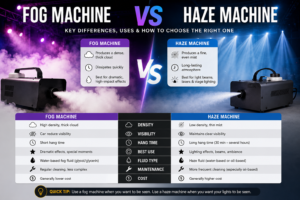
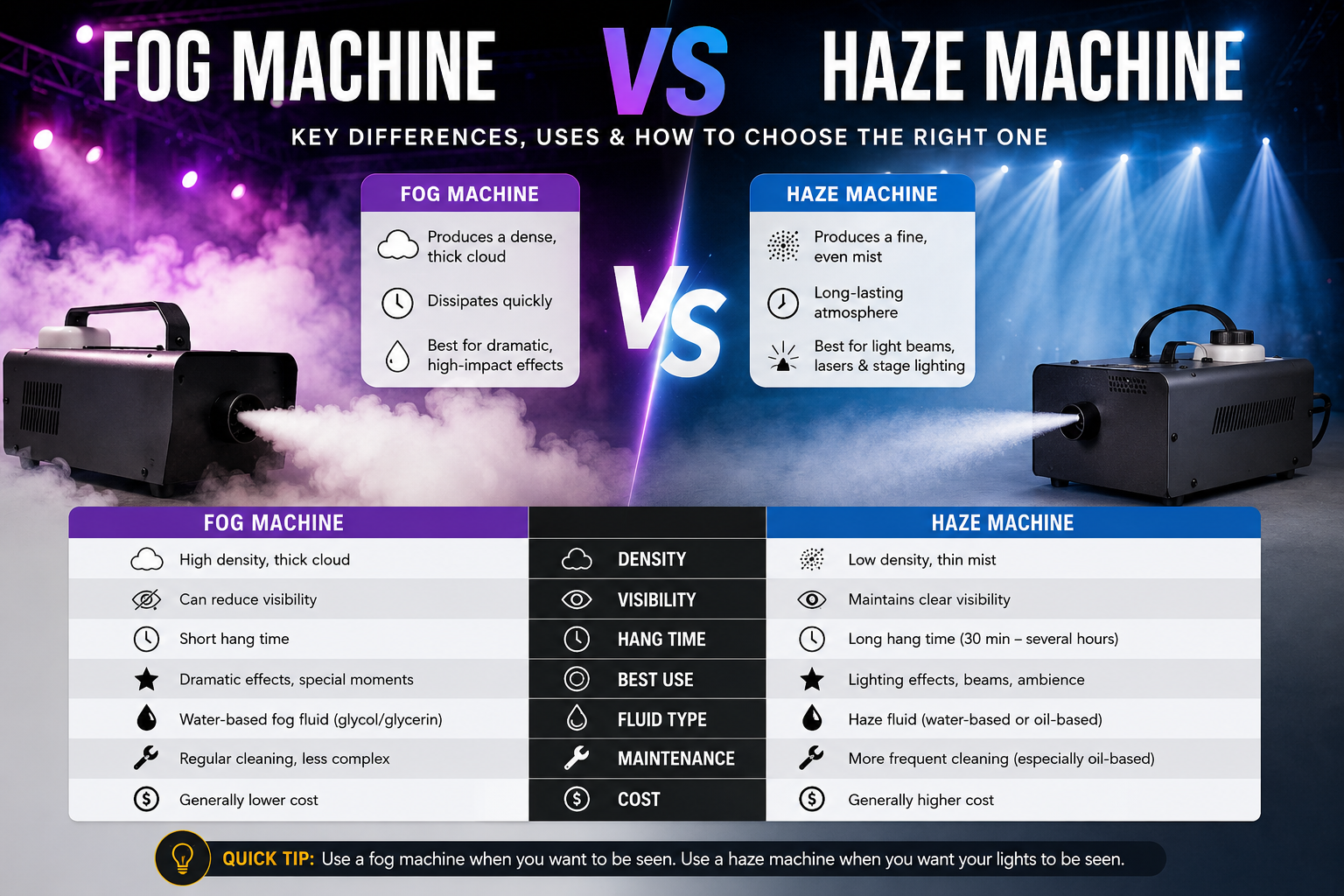
A theatrical fog machine produces a dense, fast-dissipating cloud designed to fill a space or create a low-lying effect across a floor. A haze machine, by contrast, produces a fine, long-lasting atmospheric layer designed to make light beams visible without obscuring the performers or set. Confusing the two or buying the wrong one for your venue can mean wasted budget, disappointed clients, and lighting effects that simply don’t land.
In this guide, we’ll break down exactly how each machine works, where each one shines, how they compare across density, visibility, maintenance, and cost, and how to choose the right option for your production, venue, or lighting rig. Whether you’re outfitting a haunted house, a concert stage, a house of worship, or a corporate event, you’ll walk away knowing precisely which atmospheric effect machine belongs in your gear closet.
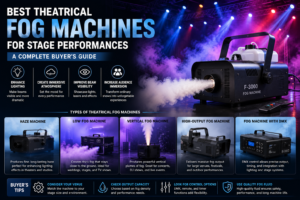
Want to learn more about professional stage fog systems? Explore our comprehensive Theatrical Fog Machines guide to discover how different fog machine types work, their applications in theaters, concerts, TV studios, theme parks, and live events, along with expert tips for selecting the right fog effects equipment for your venue.
What Is a Fog Machine?
Definition
A fog machine sometimes called a stage smoke machine is a device that heats fog fluid into vapor and releases it as a dense, visible cloud. Fog machines are built to create bold, high-density atmospheric effects, from ground-hugging “low fog” that creeps across a stage floor to thick clouds that can fill an entire room in seconds.
How a Fog Machine Works
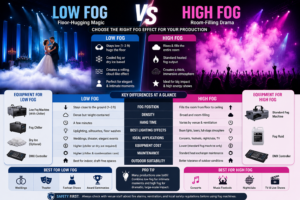
Most professional fog machines use a heat exchanger system. Fog fluid typically a mixture of water and glycol or glycerin is pumped into a heated block, vaporized, and expelled through a nozzle under pressure. The rapid cooling of the vapor as it hits the surrounding air creates the visible white cloud audiences recognize instantly. Specialty units, like low-fog machines, chill the vapor further (often with dry ice or a cooling tube) so the fog sinks and rolls along the floor instead of rising.
Characteristics of Fog
Fog is characterized by large water-based droplets, high visible density, and relatively rapid dissipation. It’s designed to be seen not to disappear quietly into the background. A single burst can noticeably reduce visibility across a stage within seconds.
Typical Applications
Fog machines are the standard choice for:
- Haunted houses and horror attractions
- Theatrical productions requiring dramatic entrances or scene transitions
- Concerts needing a dense visual “hit” for a chorus or drop
- Product reveals and launch events
- Halloween events and themed parties
Advantages
- Creates a bold, immediately visible effect
- Excellent for dramatic, high-impact moments
- Low-fog units produce a striking floor-hugging effect
- Widely available at accessible price points
- Effective even in larger or higher-ceiling venues
Limitations
- Dissipates quickly, requiring repeated bursts
- Can trigger smoke detectors if venues aren’t prepared
- Not ideal for continuous atmospheric beam visibility
- Can visually obscure performers if overused
- Often requires more fluid per event than haze
What Is a Haze Machine?
A haze machine is a specialized atmospheric device engineered to create a thin, even, long-lasting layer of fine particulate in the air. Unlike fog, haze is meant to be nearly invisible on its own its purpose is to give shape and dimension to light, not to be the visual centerpiece.
Definition
Haze machines produce a subtle, uniform atmosphere that allows lighting beams, gobos, and laser effects to become visible in the air without clouding the stage or reducing visibility of performers.
How a Haze Machine Works
Haze machines typically use one of two methods: heat-based vaporization (similar to fog machines but with specially formulated haze fluid) or oil-based/water-based dispersion through a compressor and fine-mist nozzle. The resulting particles are significantly smaller than fog droplets, which allows them to stay suspended in the air for extended periods often 30 minutes to several hours without settling or dissipating.
Characteristics of Haze
Haze is defined by its fine particle size, even distribution, minimal visible cloud, and long hang time. It doesn’t billow or roll; it simply hangs in the air, quietly doing its job of scattering light.
Typical Applications
Haze machines are the go-to choice for:
- Concerts and touring productions with heavy moving-light rigs
- Television and broadcast studios
- Corporate events and product showcases
- Churches and houses of worship
- Conferences and keynote presentations
- Professional lighting design showcases and laser shows
Advantages
- Long-lasting, even atmosphere
- Ideal for beam visibility with moving heads, lasers, and spotlights
- Doesn’t obscure performers or set pieces
- Requires fewer bursts throughout an event
- Professional, “invisible” look preferred in broadcast and corporate settings
Limitations
- Less dramatic as a standalone visual effect
- Typically costs more per unit and per fluid bottle
- Requires proper HVAC/ventilation planning to maintain even distribution
- Oil-based units need more careful cleaning to avoid residue buildup
- Less effective for ground-hugging or “reveal” effects
Fog Machine vs Haze Machine: Key Differences
Fog Density
Fog machines produce a thick, opaque cloud meant to be seen instantly. Haze machines produce a barely-there atmosphere meant to be felt through light, not seen directly.
Visibility
Fog reduces overall visibility in a space, sometimes dramatically. Haze preserves visibility while enhancing the visibility of light beams.
Duration
Fog dissipates within seconds to a couple of minutes. Haze can linger for 30 minutes or longer, especially in venues with stable HVAC systems.
Fluid Type
Fog machines typically use water/glycol or water/glycerin-based fog fluid. Haze machines use specially formulated haze fluid, which may be water-based or mineral-oil-based, engineered for fine particle output.
Warm-Up Time
Fog machines generally need 5–10 minutes to reach operating temperature. Haze machines, especially compressor-based units, often have little to no warm-up time and can run continuously.
Maintenance
Fog machines need regular descaling of the heating element due to mineral buildup. Haze machines, particularly oil-based models, require attention to nozzle cleaning and filter maintenance to prevent clogging.
Indoor vs Outdoor Performance
Fog performs well both indoors and outdoors, though outdoor wind can disperse it quickly. Haze is best suited to indoor, climate-controlled environments where airflow is manageable, since outdoor wind disrupts the even atmosphere haze depends on.
Compatibility with Lighting Effects
Fog pairs well with dramatic uplighting, silhouette effects, and low fog floor washes. Haze pairs best with moving head fixtures, beam lights, and lasers where a clean, visible light path is the goal.
Fog Machine vs Haze Machine Comparison Table
| Feature | Fog Machine | Haze Machine |
| Output Density | High, dense, opaque | Low, fine, subtle |
| Particle Size | Larger water-based droplets | Fine micron-sized particles |
| Hang Time | Seconds to a few minutes | 30 minutes to several hours |
| Best Lighting Effect | Uplighting, silhouettes, low fog floor effects | Moving heads, beams, lasers, spotlights |
| Fluid Type | Water/glycol or water/glycerin fog fluid | Specialized haze fluid (water or oil-based) |
| Warm-Up Time | 5–10 minutes (heater-based units) | Minimal to none (compressor-based units) |
| Maintenance | Heater descaling, fluid line cleaning | Nozzle and filter cleaning, residue control |
| Typical Applications | Theater, haunted houses, DJ sets, festivals | Concerts, TV studios, churches, corporate events |
| Operating Cost | Lower upfront, moderate fluid use | Higher upfront, ongoing fluid cost per hour |
When Should You Choose a Fog Machine?
Theater Productions
A theatrical fog machine is invaluable for scene transitions, dramatic entrances, and creating an otherworldly atmosphere during pivotal moments. Dense fog reinforces storytelling in ways subtle haze simply can’t.
Weddings
Couples often use low fog machines for a “cloud” first-dance effect, where dense fog rolls across the floor at ankle height, creating a dreamlike visual without filling the whole room.
Haunted Houses
Fog is essential for haunted attractions, where reduced visibility, dramatic reveals, and an eerie atmosphere are the entire point of the experience.
DJ Performances
DJs frequently use fog bursts timed to drops and builds, giving the crowd a visceral, high-energy visual payoff synced to the music.
Festivals
Outdoor festival stages benefit from fog’s strong, immediately visible output, which can compete with open-air conditions and large crowd sightlines.
Product Launches
A sudden fog reveal adds drama and spectacle to product unveilings, drawing attention to the exact moment a product is revealed on stage.
Dense fog benefits each of these environments because the goal is a bold, attention-grabbing visual moment rather than sustained, subtle atmosphere.
When Should You Choose a Haze Machine?
Concerts
Touring concert productions rely on haze machines to make moving head lights, beams, and laser effects fully visible throughout an entire set, without repeatedly clouding the stage.
Television Studios
Broadcast lighting depends on consistent, camera-friendly atmosphere. Haze creates depth and dimension on camera without introducing distracting cloud bursts.
Corporate Events
Corporate productions favor haze because it enhances lighting design professionally and subtly, supporting brand messaging without overwhelming the room.
Churches
Many houses of worship use haze machines to enhance worship lighting and beam effects during services, creating an uplifting atmosphere without the theatrical drama of fog.
Conferences
Keynote stages use haze to make spotlight and beam effects visible for large audiences, reinforcing key moments in a presentation.
Professional Lighting Shows
Lighting designers showcasing moving fixtures or laser choreography depend on haze for consistent beam visibility across an entire performance.
Haze creates superior beam visibility because its fine, evenly distributed particles scatter light efficiently, revealing crisp beam lines and gobo patterns that fog’s thicker particles simply blur out.
Which Machine Produces Better Lighting Effects?
Moving Head Lights
Haze is the clear winner here, giving moving head beams a clean, laser-like visibility that fog’s density can muddy.
Beam Lights
Beam fixtures depend almost entirely on atmosphere to be visible at all — haze is essential for consistent, sustained beam definition.
Lasers
Laser shows require an even, fine atmosphere; haze machines are the industry standard for professional laser visibility.
Wash Lights
Fog can enhance wash lighting for short, dramatic bursts, while haze provides more even, sustained color saturation across a space.
LED Pars
Both can work with LED pars, but haze offers a subtler enhancement for continuous washes, while fog adds punch for accent moments.
Spotlights
Haze allows spotlights to create visible light columns that read clearly to an audience, an effect fog typically only achieves briefly.
In short: for continuous beam-based lighting design, haze wins. For dramatic, momentary visual impact, fog wins.
Maintenance Comparison
Cleaning Requirements
Fog machines need periodic cleaning of the heat exchanger and nozzle to prevent mineral scale buildup from fog fluid. Haze machines, especially oil-based models, require regular wiping of internal components to prevent oil residue accumulation.
Fluid Consumption
Fog machines often consume fluid faster during high-output bursts. Haze machines use fluid more steadily but continuously over long run times.
Heater Maintenance
Heater-based fog units benefit from routine descaling using manufacturer-recommended cleaning fluid to prevent clogs and reduced output.
Pump Maintenance
Both machine types benefit from running cleaning fluid through the pump system periodically, particularly before long storage periods.
Long-Term Reliability
Fog machines are mechanically simpler and often more durable with basic care. Haze machines, particularly compressor-driven units, may require more frequent filter replacement but offer excellent longevity when properly maintained.
Maintenance Recommendations:
- Run manufacturer-approved cleaning fluid through both machine types every 15–20 hours of use
- Store machines with fluid lines flushed to prevent residue hardening
- Replace filters and nozzles per manufacturer schedules
- Keep machines in climate-stable storage to protect internal components
- Log usage hours to anticipate maintenance intervals proactively
Buying Guide: Fog Machine or Haze Machine?
Venue Size
Larger venues may need higher-output fog machines for visibility across distance, while mid-size and smaller venues often do well with compact haze units.
Budget
Fog machines generally have a lower entry cost, making them attractive for smaller productions and one-time events. Haze machines represent a higher investment but pay off for recurring use in beam-heavy lighting design.
Production Type
Dramatic, story-driven, or seasonal productions (theater, haunted houses) lean toward fog. Ongoing, beam-focused productions (concerts, corporate, worship) lean toward haze.
Lighting Setup
If your rig is built around moving heads, beams, or lasers, haze is essential. If your rig relies on uplighting or dramatic floor effects, fog is the better match.
DMX Compatibility
Look for DMX fog machine or haze machine models if you need precise, cued control synced to your lighting console — a must for professional productions.
Portability
Rental companies and touring productions should prioritize compact, road-case-friendly units with reliable fluid tanks and easy-to-clean components.
Safety Requirements
Confirm compatibility with your venue’s fire suppression and smoke detection systems, and always check local fire code requirements before running either machine indoors.
Buyer’s Checklist
- [ ] Confirm venue size and required throw distance
- [ ] Identify primary goal: dramatic visual impact (fog) or beam visibility (haze)
- [ ] Check DMX compatibility with existing lighting console
- [ ] Assess indoor ventilation and HVAC stability
- [ ] Compare fluid costs for expected usage hours
- [ ] Verify smoke detector and fire code compliance
- [ ] Evaluate portability needs for touring or rental use
- [ ] Review manufacturer maintenance requirements
- [ ] Set a realistic budget for machine plus ongoing fluid costs
- [ ] Test the machine in your actual lighting setup before committing
Common Mistakes When Choosing Between Fog and Haze
- Buying a fog machine when beam visibility is the priority. Fog’s density often obscures the very beams you’re trying to highlight.
- Assuming fog and haze produce the same effect. They serve fundamentally different visual goals and aren’t interchangeable.
- Choosing the wrong fluid type. Using fog fluid in a haze machine (or vice versa) can damage the unit and produce poor results.
- Ignoring venue ventilation. Haze depends on stable airflow; strong HVAC systems can clear it too quickly, wasting fluid and effect.
- Overlooking maintenance requirements. Skipping regular cleaning shortens the lifespan of both machine types significantly.
- Purchasing equipment without DMX support. Manual-only units limit your ability to cue effects precisely with your lighting design.
Expert recommendation: Match the machine to your lighting design goal first, then refine your choice based on venue size, budget, and maintenance capacity. Many professional venues ultimately invest in both machines to cover the full range of atmospheric needs.
Frequently Asked Questions
What is the difference between a fog machine and a haze machine?
A fog machine produces a dense, fast-dissipating cloud designed to be visually dramatic, while a haze machine produces a fine, long-lasting atmosphere designed to make light beams visible without obscuring the space.
Which is better for theaters?
Theaters typically use fog machines for dramatic scene effects and haze machines for beam visibility during lighting-heavy productions — many venues use both.
Which creates better light beams?
Haze machines create noticeably better, more consistent light beam visibility due to their fine, evenly distributed particles.
Does a haze machine use different fluid?
Yes, haze machines use specially formulated haze fluid, which differs from standard fog fluid in particle size and composition.
Which machine lasts longer? Haze lingers in the air far longer than fog, often 30 minutes or more compared to fog’s few minutes.
Can fog and haze machines be used together?
Yes, many professional productions combine both haze for continuous beam visibility and fog for dramatic accent moments.
Which is better for concerts?
Haze machines are generally preferred at concerts for consistent moving light and laser visibility throughout a performance.
Are haze machines safe indoors?
Yes, when used with proper ventilation and manufacturer guidelines, haze machines are considered safe for indoor use in theaters, churches, and studios.
Which option is easier to maintain?
Fog machines are mechanically simpler, though both machine types require regular cleaning to maintain performance and longevity.
Which machine is best for weddings?
Low fog machines are popular for weddings due to their dramatic floor-hugging cloud effect during first dances.
Can both machines be controlled via DMX?
Yes, many professional-grade fog and haze machines offer DMX fog machine control for precise integration with lighting consoles.
How do I choose the right atmospheric effects machine?
Start by identifying your primary goal dramatic visual impact or beam visibility then factor in venue size, budget, lighting setup, and maintenance capacity.
Is haze more expensive than fog to operate?
Haze fluid and equipment often carry a higher upfront and ongoing cost, though usage is typically more efficient over long events.
Can I use a fog machine outdoors?
Yes, fog machines perform well outdoors, though wind can disperse the effect more quickly than indoors.
Do haze machines work well outdoors?
Haze is best suited to indoor, climate-controlled spaces, since outdoor wind disrupts the even atmosphere it depends on.
Conclusion
The fog machine vs haze machine decision ultimately comes down to your production goals. Fog machines deliver bold, dramatic, high-density effects perfect for theatrical moments, haunted houses, weddings, and festival stages. Haze machines deliver a subtle, long-lasting atmosphere that makes moving heads, beams, and lasers visible without clouding the space ideal for concerts, broadcast studios, corporate events, and houses of worship.
Neither machine is universally “better” each is built for a different purpose. The right choice depends on your venue size, lighting rig, budget, and the atmosphere you’re trying to create. Many professional venues and touring productions ultimately invest in both, using each machine for the moments it does best.