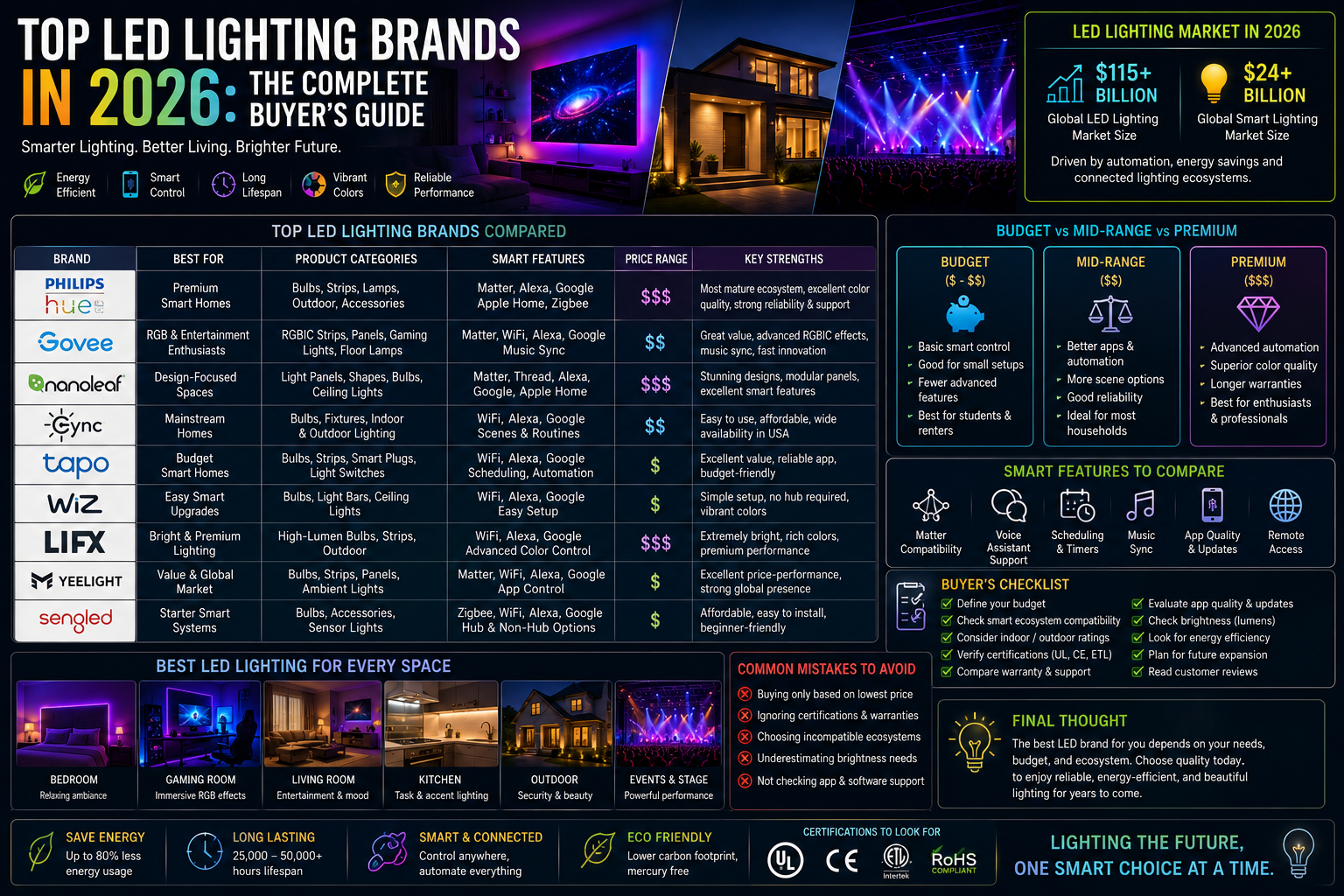
The global LED industry is no longer just about replacing incandescent bulbs. In 2026, lighting has become part of the connected home, the modern office, the smart city, and even the entertainment experience. Industry analysts estimate the global LED lighting market will exceed $115 billion in 2026, while smart lighting alone is expected to reach more than $24 billion, driven by automation, energy savings, and connected ecosystems.
That explosive growth has created an overwhelming number of options for consumers and businesses alike. Choosing among the best LED light brands is no longer as simple as picking the brightest bulb on the shelf. Buyers now need to think about software updates, Matter compatibility, warranty support, ecosystem lock-in, energy efficiency, and long-term reliability.
This guide compares the leading brands across residential, commercial, architectural, and entertainment lighting applications so homeowners, contractors, facility managers, and smart home enthusiasts can make informed purchasing decisions.
Why Choosing the Right LED Lighting Brand Matters
A light fixture may look identical on the outside, but internally the difference between premium and low-quality products can be dramatic. The LED chip quality, driver design, thermal management, and software support all influence long-term performance.
Product Quality
Premium manufacturers invest heavily in driver stability, color consistency, and heat dissipation. Cheap LEDs often suffer from flickering, color shifts, and premature failure because heat is the enemy of LED lifespan. A poorly designed product that traps heat is like forcing an athlete to run a marathon while wearing a winter coat.
Energy Efficiency
Most quality LEDs use significantly less electricity than legacy technologies while maintaining excellent brightness levels. Many premium manufacturers publish lumens-per-watt data and efficiency certifications, making it easier to compare products objectively.
Durability
Reliable brands regularly achieve lifespans between 25,000 and 50,000 hours under normal operating conditions. Commercial fixtures may exceed that with proper thermal design and quality drivers.
Smart Features
Modern smart lighting is no longer a novelty. Voice assistants, occupancy sensing, automation routines, adaptive lighting, and scene synchronization have become standard expectations.
Warranty and Support
A five-year warranty says far more about manufacturer confidence than marketing slogans ever could. Support responsiveness becomes especially important for commercial and professional installations.
Safety Certifications
Look for certifications such as UL, CE, ETL, RoHS, IEC, and regional efficiency standards to ensure compliance and safety requirements are met.
Discover everything you need to know about Color Changing LED Lights, from choosing the right RGB, RGBW, and smart lighting solutions to professional event, stage, and architectural applications. Explore our expert guides covering installation, lighting technologies, buying tips, and creative ideas to help you create stunning, customizable lighting for any space or project.
How We Evaluated the Best LED Light Brands
The evaluation process focused on ten weighted categories:
| Criteria | Weight |
| Product quality | 20% |
| Innovation | 15% |
| Smart ecosystem support | 15% |
| Product range | 10% |
| Reliability | 10% |
| Build quality | 10% |
| Warranty | 5% |
| Customer support | 5% |
| Industry reputation | 5% |
| Value for money | 5% |
Brands scoring highly across multiple categories performed better than companies excelling in only one niche area.
Top LED Lighting Brands in 2026
Brand Comparison Table
| Brand | Best For | Product Categories | Smart Features | Price Range |
| Philips Hue | Premium smart homes | Bulbs, strips, lamps, outdoor | Matter, Alexa, Google, Apple | Premium |
| Govee | RGB entertainment | RGB strips, panels, gaming lights | Matter, music sync | Mid-range |
| Nanoleaf | Design-focused spaces | Panels, shapes, smart bulbs | Matter, Thread | Mid-premium |
| GE Cync | Mainstream homes | Bulbs and fixtures | WiFi automation | Mid-range |
| TP-Link Tapo | Budget smart homes | Bulbs, strips, plugs | Alexa, Google | Budget |
| WiZ | Easy smart upgrades | Lamps and bulbs | WiFi setup | Budget-mid |
| LIFX | Bright premium lighting | High-lumen bulbs | Advanced color control | Premium |
| Yeelight | Value smart lighting | Smart bulbs and strips | Matter support | Budget |
| Sengled | Starter smart systems | Bulbs and accessories | Zigbee and WiFi | Budget |
Philips Hue
Philips Hue remains the benchmark against which many smart LED systems are measured. Its ecosystem includes bulbs, gradient strips, outdoor products, entertainment synchronization products, and advanced automation features.
The biggest strengths are reliability, mature software, and broad ecosystem support. Hue products integrate exceptionally well with major smart home platforms and continue receiving long-term software updates.
The downside is obvious: price. Hue products frequently cost considerably more than competitors offering similar brightness levels.
Ideal buyers include premium smart home users, Apple Home users, and homeowners planning long-term ecosystem investments.
Govee
Govee has become one of the most aggressive innovators in RGB lighting. The company dominates gaming rooms, media spaces, and immersive entertainment environments.
Music synchronization features remain among the strongest in the industry. Govee has expanded Matter compatibility and ecosystem support throughout 2026 while continuing partnerships around immersive experiences.
Its weakness is ecosystem maturity compared to Hue. Professional installers may also prefer more enterprise-focused solutions.
Nanoleaf
Nanoleaf transformed decorative wall lighting into a mainstream category. Its modular panels remain highly recognizable among gamers, creators, and modern interior designers.
The company has expanded Matter-compatible products including ceiling lighting and advanced adaptive color systems in 2026.
Buyers focused on aesthetics and design flexibility will find Nanoleaf especially appealing.
GE Cync
GE Cync targets users wanting mainstream smart lighting without premium pricing. Installation is simple and the ecosystem integrates well with popular voice assistants.
The product range is narrower than larger competitors but pricing remains attractive for everyday smart homes.
TP-Link Tapo
Tapo has emerged as one of the strongest value options in smart homes. The company combines affordable pricing with reliable applications and broad smart home compatibility.
Budget-conscious buyers frequently discover that Tapo delivers 80 percent of premium functionality at a fraction of premium prices.
WiZ
WiZ focuses on simplicity. Products connect directly via WiFi without requiring dedicated hubs, making installation beginner friendly.
This approach works particularly well for renters and first-time smart lighting users.
LIFX
LIFX is famous for exceptional brightness and vibrant color reproduction. Many of its bulbs outperform competitors in lumen output while maintaining strong color accuracy.
Content creators and photographers often appreciate these strengths.
Yeelight
Yeelight continues to grow internationally thanks to competitive pricing and strong ecosystem support.
The company appeals particularly to users already invested in Asian smart home ecosystems.
Sengled
Sengled remains one of the safest entry-level recommendations for smart lighting beginners. Products are widely available and installation is straightforward.
Professional Stage and Event Lighting Manufacturers
Entertainment lighting represents an entirely different category from residential smart bulbs. Stage lighting manufacturers prioritize DMX compatibility, thermal stability, beam control, and serviceability.
Brands serving concert venues, theaters, television studios, and rental houses focus on moving heads, wash fixtures, profile spots, and LED PAR systems rather than consumer smart home integrations.
Budget vs Mid-Range vs Premium LED Brands
| Category | Typical Features | Best For | Considerations |
| Budget | Basic smart control | Apartments and rentals | Fewer advanced features |
| Mid-range | Better apps and automation | Most households | Moderate ecosystem depth |
| Premium | Advanced automation and support | Enthusiasts and professionals | Higher upfront costs |
Budget lighting works well for experimentation. Premium systems behave more like infrastructure investments than gadgets.
Residential vs Commercial LED Lighting Brands
Homeowners usually prioritize aesthetics, app quality, and smart integrations. Offices prioritize maintenance costs, efficiency, and lifecycle economics.
Hospitality environments require color consistency and ambience. Stage venues prioritize output, beam control, and reliability under demanding conditions.
Architectural lighting occupies its own category entirely, where fixture integration and visual design often matter more than app features.
Smart Features to Compare
Matter compatibility has become one of the most important buying considerations in 2026. The Connectivity Standards Alliance reports over 1,200 certified Matter devices from hundreds of participating companies, although feature support remains inconsistent between ecosystems.
Important features include:
- Matter compatibility
- Alexa integration
- Google Home support
- Apple Home support
- Bluetooth versus WiFi connectivity
- Automation scheduling
- Presence detection
- Music synchronization
- Scene management
- Mobile application quality
The best ecosystem is often the one that matches devices you already own.
How to Choose the Best LED Lighting Brand
Use this practical checklist before purchasing:
Buyer’s Checklist
- Determine your budget range.
- Decide whether you need smart functionality.
- Check indoor or outdoor ratings.
- Verify compatibility with your smart ecosystem.
- Compare warranty duration.
- Confirm local product availability.
- Research software update history.
- Verify certification requirements.
- Compare replacement product availability.
- Estimate future expansion requirements.
Choosing lighting is increasingly similar to choosing a smartphone ecosystem. Switching later can become expensive.
Common Mistakes When Choosing an LED Brand
The most common mistake remains buying purely on price. Cheap LEDs often become expensive after repeated failures and replacements.
Another common issue is ecosystem fragmentation. Mixing incompatible ecosystems can create frustrating automation limitations.
Buyers frequently ignore warranty conditions and software support lifecycles. A smart bulb without future updates eventually becomes less smart.
Ignoring safety certifications is another avoidable mistake, particularly in commercial environments where compliance requirements matter.
Future Trends in LED Lighting Beyond 2026
Matter adoption remains one of the largest trends shaping purchasing decisions. New releases across the industry increasingly advertise Matter support as a headline feature.
AI-enhanced automation is also arriving rapidly. Lighting systems increasingly learn occupancy habits, preferred brightness levels, and circadian rhythms.
Human-centric lighting is moving from luxury offices into homes. Adaptive color temperatures designed around sleep cycles and productivity patterns are becoming common.
Sustainability is another major driver. Manufacturers are under growing pressure to improve recyclability and reduce material waste.
Wireless controls and energy optimization systems will likely dominate commercial projects throughout the remainder of the decade.
Conclusion
The phrase best LED light brands does not have a universal answer because lighting needs vary dramatically between homes, offices, entertainment venues, and hospitality environments.
Philips Hue continues leading premium smart lighting. Govee dominates immersive RGB experiences. Nanoleaf owns the design-focused segment. Tapo and WiZ deliver impressive value. Professional lighting manufacturers remain unmatched for entertainment and production environments.
Before investing, compare ecosystem compatibility, warranty terms, software support history, and future expansion plans rather than focusing exclusively on initial price.
The best lighting investment is rarely the cheapest product on day one. It is the system still working reliably five years later.
Frequently Asked Questions
Which are the best LED light brands in 2026?
Philips Hue, Govee, Nanoleaf, LIFX, TP-Link Tapo, WiZ, Yeelight, and Sengled are among the strongest options.
Which LED brand offers the best smart lighting?
Philips Hue remains the most mature ecosystem overall.
What is the most reliable LED lighting company?
Philips Hue and several commercial lighting manufacturers maintain strong reputations for reliability.
Are premium LED brands worth the money?
For long-term users and smart homes, premium brands often justify their higher prices through software support and reliability.
Which LED brands support Matter?
Philips Hue, Govee, Nanoleaf, and several newer smart lighting brands now support Matter in some form.
Which LED brand is best for gaming rooms?
Govee and Nanoleaf are especially popular among gamers.
Which brands work best for professional events?
Professional stage manufacturers specializing in DMX and moving fixtures remain the preferred choice.
What should I look for in a warranty?
Focus on warranty duration, replacement procedures, and regional support availability.
Are all LED brands energy efficient?
No. Efficiency varies significantly between products and manufacturers.
How long do quality LEDs last?
Most quality products achieve between 25,000 and 50,000 operating hours.