Introduction
The decision to buy color changing LED lights looks simple until you discover that two products with nearly identical photos can perform completely differently once installed. One strip might deliver smooth gradients, accurate reds, vibrant blues, and years of reliable service, while another fades within months, develops dead pixels, or produces washed-out colors that make your room feel more like a warehouse than a cozy living space. The seller matters almost as much as the product itself because lighting quality depends heavily on component sourcing, manufacturing standards, warranty policies, and after-sales support.
Today’s market is exploding with options. The global LED lighting market is expected to exceed $115 billion in 2026, while smart lighting alone is forecast to reach $24.4 billion this year, driven by connected homes, entertainment spaces, and commercial installations. That growth gives buyers incredible choice, but it also creates confusion. This guide explains where to buy RGB LED lights, how to evaluate suppliers, what separates premium products from cheap alternatives, and how to choose the right lighting solution for homes, events, businesses, and creative projects.
Why Buying High-Quality Color Changing LED Lights Matters
Cheap LED products often create expensive problems. A lower purchase price can quickly disappear when lights fail early, produce inconsistent colors, or require replacement after only a few months of use. Professional installers frequently say that lighting projects succeed or fail long before installation begins; the difference is usually the quality of the supplier and the quality of the components hidden inside the housing.
Better Brightness and Color Accuracy
Premium LEDs use better chips, improved diffusion materials, and more precise manufacturing tolerances. The result is richer colors, smoother transitions, and fewer visible hot spots. A quality RGB system can create subtle mood lighting for a bedroom one moment and vibrant entertainment lighting the next without losing brightness or creating uneven color patches.
Color Rendering Index and consistency matter more than many buyers realize. Two strips rated at the same wattage can look dramatically different because one uses higher-quality emitters and superior color calibration. If you’re investing in gaming rooms, hospitality spaces, photography studios, or retail environments, accurate color reproduction directly affects the atmosphere you create.
Longer Lifespan
The lifespan difference between premium and budget lighting can be enormous. Well-built LEDs often operate for tens of thousands of hours before significant degradation becomes noticeable. Cheap drivers, poor thermal management, and weak solder joints are usually responsible for premature failures rather than the LED chips themselves.
Think of quality LEDs like a reliable car engine. You may pay more initially, but years later the investment still delivers value while lower-cost alternatives require constant replacement and maintenance.
Energy Efficiency
High-quality LEDs consume dramatically less power than traditional lighting technologies while delivering comparable brightness. Residential LEDs typically use at least 75% less energy and can last up to 25 times longer than incandescent lighting solutions.
For homeowners this means lower electricity bills. For businesses operating hundreds of fixtures, it can transform operating costs. Average households switching to efficient LED lighting can save hundreds of dollars over time through reduced energy consumption alone.
Improved Safety
Reliable manufacturers invest heavily in electrical protection, heat management, and certification testing. Poorly manufactured power supplies and controllers can overheat, flicker excessively, or fail under continuous operation.
This becomes especially important for outdoor installations, commercial buildings, event venues, and children’s bedrooms where systems often run for long periods.
Reliable Warranty and Support
A strong warranty is often a reflection of manufacturer confidence. Reputable suppliers commonly provide multi-year protection and technical assistance. If a controller fails or compatibility issues appear, support teams can help troubleshoot rather than leaving buyers searching internet forums for answers.
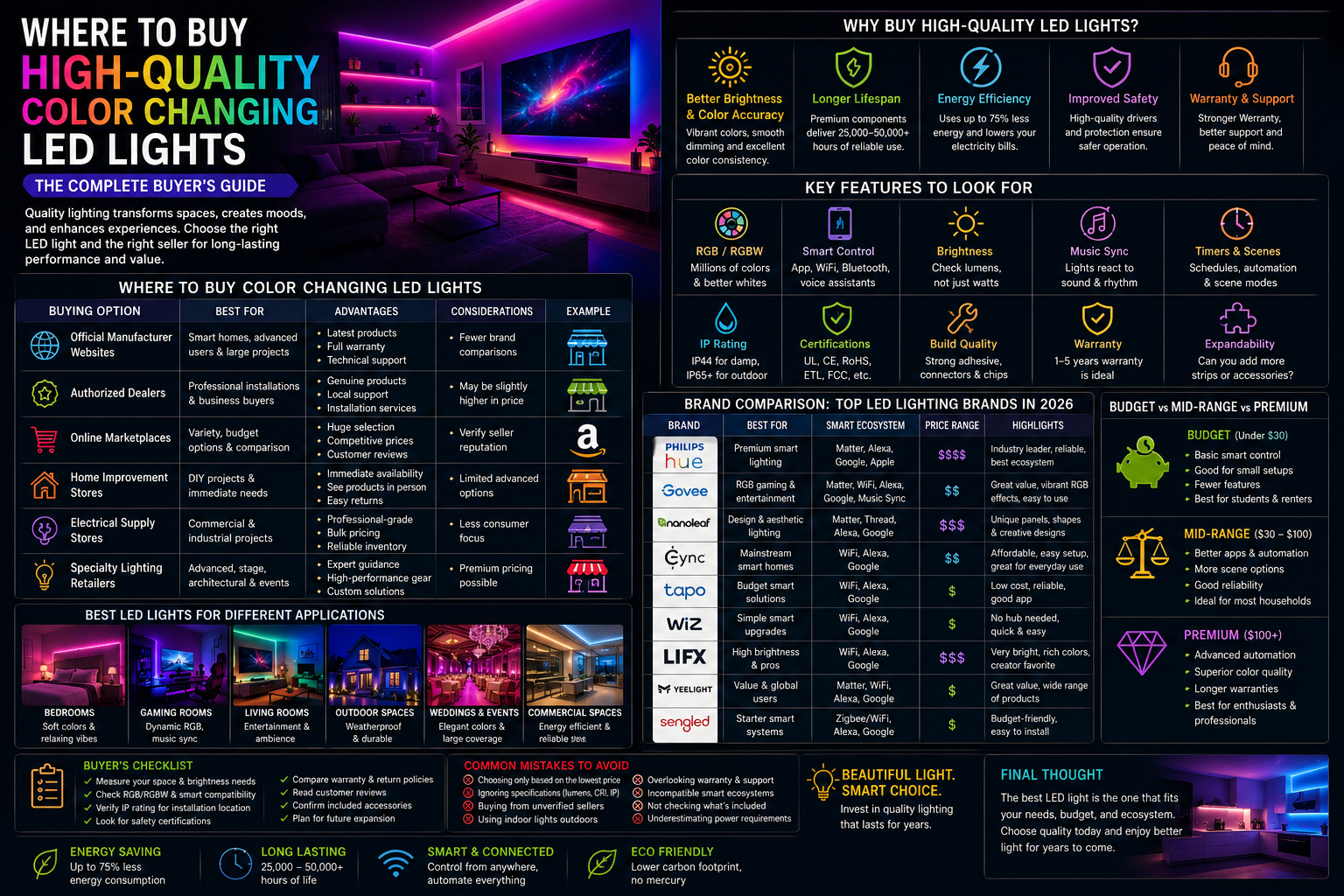
Where to Buy Color Changing LED Lights
The best place to purchase lighting depends on your project size, technical requirements, and support expectations.
Official Manufacturer Websites
Buying directly from manufacturers provides access to the newest product releases, firmware updates, accessories, and compatibility information. This route works particularly well for advanced smart home ecosystems and professional installations.
Advantages include:
- Access to newest models
- Full warranty coverage
- Technical support teams
- Product authenticity
- Expansion accessories
Manufacturers also tend to publish installation guides, controller documentation, and compatibility information for voice assistants and automation platforms.
Authorized Dealers
Authorized dealers occupy a useful middle ground between manufacturers and retailers. They typically offer genuine products while providing regional customer support and installation services.
Contractors and commercial buyers often prefer authorized dealers because they can source multiple product categories while maintaining warranty protection.
Online Marketplaces
When people search for color changing LED lights online, marketplaces usually appear first. They provide exceptional variety, competitive pricing, and customer reviews.
The challenge is separating reliable sellers from opportunistic resellers. Look for:
- Detailed technical specifications
- Verified customer reviews
- Clear warranty information
- Transparent return policies
- Seller history and ratings
- Certification documentation
If product listings avoid technical details, that should raise immediate concerns.
Home Improvement Stores
Physical stores offer immediate availability and the ability to inspect products before purchase. Packaging quality, connector strength, and accessory compatibility become easier to evaluate in person.
For first-time buyers, in-store guidance often prevents mistakes involving connectors, power supplies, or mounting hardware.
Electrical Supply Stores
Professional electricians frequently purchase from electrical supply distributors because they stock commercial-grade products with stronger reliability standards.
These stores are particularly valuable for:
- Commercial LED lighting
- Architectural installations
- Industrial facilities
- Large projects
- Specialized power supplies
Specialty Lighting Retailers
Specialty retailers focus entirely on lighting solutions rather than treating lighting as another shelf category. Their staff typically understand DMX controllers, smart home protocols, stage lighting, architectural design, and advanced RGB systems.
Event planners, designers, theaters, and entertainment venues often obtain the best results from specialist suppliers.
Seller Comparison Table
| Seller Type | Best For | Advantages | Considerations |
| Manufacturer Websites | Smart ecosystems and large projects | Full warranty and latest products | Fewer brand comparisons |
| Authorized Dealers | Professional installations | Local support and service | Prices may be higher |
| Online Marketplaces | Variety and price comparison | Huge selection and reviews | Must verify seller reputation |
| Home Improvement Stores | DIY projects | Immediate availability | Limited specialist inventory |
| Electrical Supply Stores | Commercial applications | Professional-grade products | Less consumer-focused |
| Specialty Lighting Retailers | Advanced installations | Expert guidance and customization | Premium pricing possible |
What to Look for Before Buying
A proper buying checklist prevents expensive mistakes.
Buyer’s Checklist
- Verify brightness in lumens rather than watts.
- Check CRI ratings when color accuracy matters.
- Decide between RGB and RGBW systems.
- Confirm smart platform compatibility.
- Verify indoor or outdoor ratings.
- Look for recognized safety certifications.
- Review warranty duration.
- Examine return policies carefully.
- Confirm included accessories.
- Read recent customer reviews.
Product Quality
Premium housing materials, quality adhesive backing, reinforced connectors, and efficient drivers dramatically improve reliability.
Brightness
Lumens matter more than wattage. Brightness requirements vary dramatically between accent lighting and task lighting.
Color Accuracy
High-quality LEDs produce cleaner reds, deeper blues, and smoother transitions. Lower-end systems often struggle with white balance and pastel shades.
RGB vs RGBW
RGB uses red, green, and blue diodes to create color combinations. RGBW adds a dedicated white LED, producing cleaner whites and greater flexibility.
If your installation requires everyday illumination rather than decoration alone, RGBW often represents the better investment.
Smart Features
Modern systems may support:
- Voice assistants
- Scheduling
- Automation routines
- Music synchronization
- Matter compatibility
- Smartphone control
The rapid growth of connected homes continues driving smart lighting adoption worldwide.
Waterproof Ratings
Outdoor systems should include suitable IP ratings.
- IP20: indoor use only
- IP65: splash resistance
- IP67: temporary immersion resistance
- IP68: continuous exposure environments
Safety Certifications
Look for recognized regional certifications and compliance marks appropriate to your market.
Warranty
Longer warranties generally indicate stronger confidence in manufacturing quality.
Customer Reviews
Pay attention to long-term ownership reviews rather than first impressions posted immediately after installation.
Return Policy
Lighting compatibility issues happen. Flexible return policies reduce purchasing risk.
Choosing the Right LED Lights for Different Applications
Different environments require different solutions.
Bedrooms
Bedrooms benefit from warm whites, dimming functionality, and subtle color transitions. Smart scheduling that gradually brightens in the morning can improve comfort and convenience.
Living Rooms
Living rooms often require a combination of task and ambient lighting. RGBW products offer flexibility because they provide decorative colors and functional white illumination.
Gaming Rooms
Gaming environments thrive on synchronized effects, low latency controls, and software integrations. Addressable strips often outperform standard RGB systems in these spaces.
Outdoor Spaces
Outdoor installations demand weather resistance and stronger mounting systems. Waterproof ratings should never be ignored.
Weddings
Wedding venues typically require elegant whites alongside soft color washes. Reliability becomes essential because replacement during an event is rarely possible.
Commercial Events
Trade shows, conferences, and exhibitions need scalable systems with easy control and expansion capability.
Stage Performances
Professional productions often depend on DMX-compatible systems capable of precise programming and synchronization.
Buying Direct from Manufacturers vs Retailers
Neither option is universally superior.
| Feature | Manufacturer | Retailer |
| Product Selection | Brand specific | Multiple brands |
| Warranty | Usually strongest | Depends on supplier |
| Pricing | Competitive for large orders | Better for comparison shopping |
| Customer Support | Technical specialists | General assistance |
| Technical Assistance | Extensive | Varies widely |
| Availability | Shipping required | Often immediate |
Manufacturers make sense for commercial projects and smart ecosystems. Retailers work well for comparison shopping and smaller installations.
Common Buying Mistakes to Avoid
The biggest mistake is shopping exclusively by price. Low-cost LEDs often use inferior drivers, weaker adhesives, and inconsistent chips.
Ignoring specifications creates similar problems. Buyers sometimes purchase strips that require separate controllers or power supplies without realizing those components are sold separately.
Smart compatibility issues are also common. A product supporting one ecosystem may not integrate with another without additional hardware.
Outdoor installations frequently fail because buyers overlook IP ratings. Rain, humidity, and dust can destroy indoor products surprisingly quickly.
Unverified sellers create another risk. Counterfeit products, missing warranties, and inaccurate specifications remain common problems in online marketplaces.
How to Compare LED Lights Before Buying
Use a structured evaluation process rather than marketing claims.
Product Evaluation Checklist
| Category | Questions |
| Brightness | Are lumen ratings sufficient? |
| Color Quality | Does the product specify CRI values? |
| Smart Features | Which ecosystems are supported? |
| Power Consumption | What is the wattage per meter or fixture? |
| Build Quality | Are connectors reinforced? |
| Installation | Is mounting hardware included? |
| Long-Term Value | Does warranty justify the price? |
Comparing products this way transforms the buying process from guesswork into informed decision making.
Questions to Ask Before Purchasing
Before finalizing an order, ask:
- Is the product compatible with my existing setup?
- Does it include a controller?
- Is a power supply included?
- What warranty is provided?
- Can the system expand later?
- Does it support voice assistants?
- Is it suitable for outdoor use?
- Are firmware updates available?
- Are replacement components available?
- What return options exist if compatibility issues appear?
Conclusion
The best place to buy color changing LED lights depends on your goals rather than a universal ranking. Manufacturer websites offer deep technical support and warranty coverage. Authorized dealers provide local expertise. Online marketplaces excel in variety. Electrical suppliers serve professional applications, while specialty retailers offer advanced guidance for demanding projects.
Quality should always outweigh headline pricing. Better thermal design, stronger warranties, accurate colors, smart compatibility, and certified safety standards provide value long after the purchase is complete. As LED adoption accelerates across homes and businesses worldwide, buyers who compare specifications carefully and purchase from trustworthy suppliers consistently achieve better long-term results. The smartest purchase is rarely the cheapest option on day one; it is the product that still performs beautifully years later.
FAQs
1. Where can I buy color changing LED lights?
You can purchase them from manufacturer websites, authorized dealers, marketplaces, electrical distributors, home improvement stores, and specialist lighting retailers.
2. Are online LED lighting stores reliable?
Many are reliable if they provide certifications, warranties, and transparent specifications.
3. Is buying directly from manufacturers better?
For technical projects and smart ecosystems, direct purchasing often provides stronger support and warranty protection.
4. What certifications should LED lights have?
Requirements vary by region, but recognized electrical safety certifications should always be present.
5. Are expensive LED lights worth it?
In many cases yes, because better components improve lifespan, color quality, and reliability.
6. How can I identify high-quality LED lights?
Review specifications, certifications, warranty terms, and independent customer feedback.
7. Should I buy RGB or RGBW LED lights?
RGBW products work best when you need both decorative colors and high-quality white illumination.
8. Do LED lights come with warranties?
Most reputable suppliers offer warranties ranging from one to several years.
9. Can I buy professional LED lighting online?
Yes. Many commercial and stage lighting systems are available online from specialist distributors.
10. What should I avoid when buying LED lights?
Avoid products with vague specifications, no certifications, and unclear seller histories.
11. Are waterproof LED lights necessary outdoors?
Absolutely. Outdoor conditions require suitable IP protection.
12. How do I compare LED lighting suppliers?
Compare warranty terms, technical support, certifications, reviews, and return policies.