Introduction
When people remember a great party, they usually remember how it felt, not just what they heard. That is why party LED lights and DJ lighting matter so much: they turn a basic room into a living, breathing experience. The right lighting can make a dance floor feel bigger, make music hit harder, and make guests stay longer because the atmosphere feels alive. Modern LED fixtures also run cooler, use less energy, and offer far more color control than older lighting technologies, which is a big reason they have become the default choice for mobile DJs, venues, and event producers.
If you are choosing LED lights for DJs, you are really choosing how you want the audience to feel. Do you want smooth elegant color washes for a wedding, or fast-moving beams and strobes for a packed club night? Today’s event lighting systems can do both, and many can even sync with music, respond to sound, or be programmed through DMX for full show control. That flexibility is what makes LED lighting so powerful for parties, corporate events, concerts, and private celebrations.
Color Changing LED Lights are a versatile lighting solution that can instantly transform the atmosphere of any space. With adjustable colors and dynamic lighting effects, they are widely used in homes, events, stage productions, and commercial venues. These energy-efficient lights offer endless customization options, making them ideal for creating unique moods and visual experiences. Explore our range of color changing LED lights to find the perfect lighting solution for your needs.
Why DJ Lighting Matters at Events and Parties
Good lighting does more than make a room brighter. It creates tension, release, rhythm, and focus, almost like a visual drumbeat. A DJ can use stage lighting for parties to build anticipation before a drop, spotlight the dance floor during peak moments, or soften the room during dinner and speeches. That is why lighting is not decoration; it is part of the performance language. Event lighting also helps people understand where to look, where to gather, and when the energy is rising. In a wedding reception, for example, uplighting can make the venue feel romantic and polished, while moving beams can raise the energy for the open dance set.
The best DJ light effects are the ones that support the event instead of fighting it. A corporate product launch may need clean washes and subtle accents, while a nightclub may need fast beam movement and sharp color changes. In both cases, the goal is the same: increase audience participation and make the room feel intentional. Modern LED fixtures make that easier because they can switch colors instantly, respond to music, and often be grouped into a larger control system. That combination of energy efficiency, flexibility, and visual impact is why LED has become the backbone of modern professional DJ lighting.
Types of LED Lights Used by DJs
LED Wash Lights
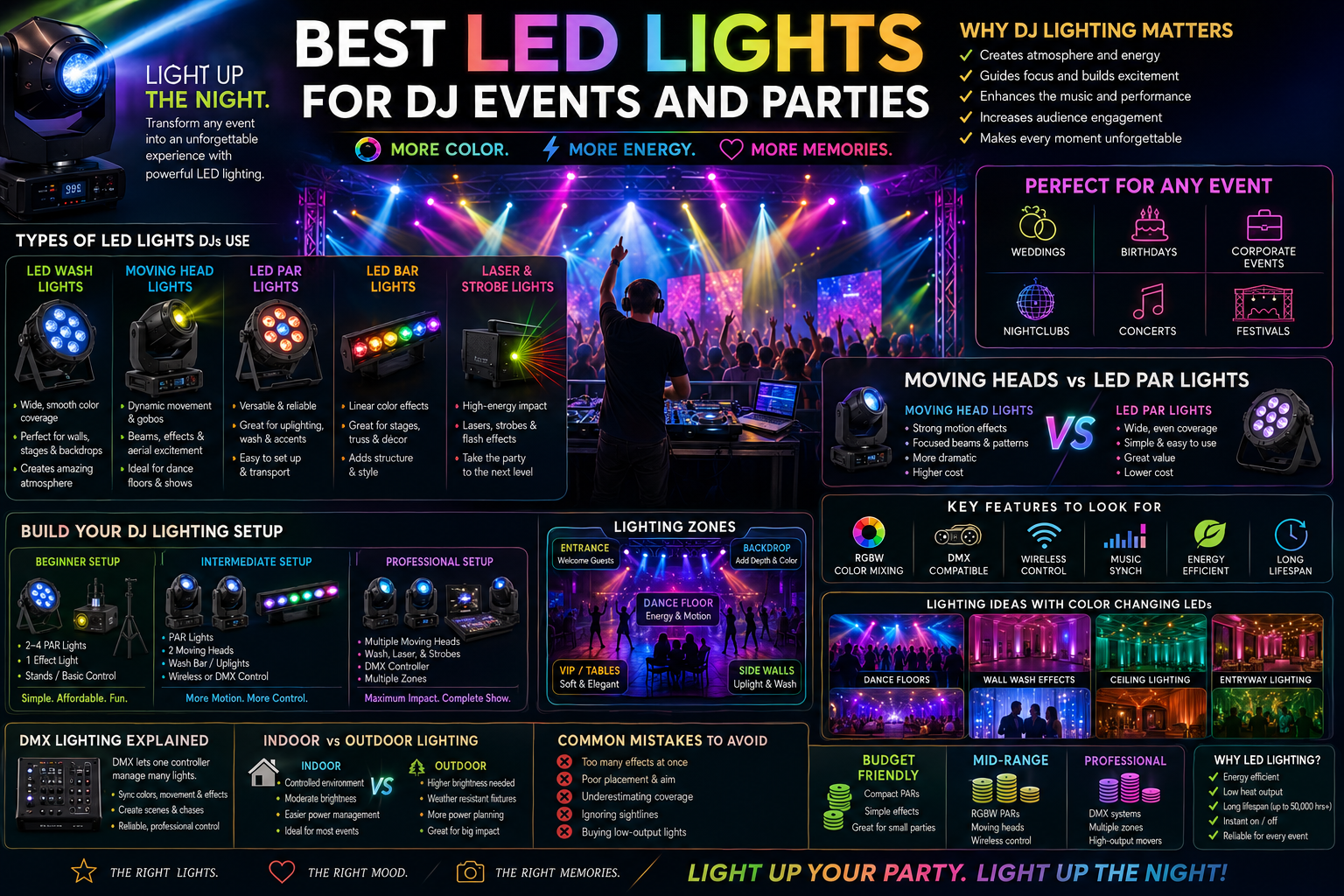
LED wash lights spread color across walls, stages, and dance floors with a soft, even look. They are the visual equivalent of a paint roller: wide coverage, smooth blend, and very little harshness. DJs and event crews use them for background color, venue wash, and general atmosphere because they make a space feel unified instead of chopped up. Products like the CHAUVET DJ SlimPAR Pro W USB are built for low-profile wash coverage and even include adjustable color temperatures for video-friendly use. That makes wash fixtures especially useful for weddings, corporate events, and stage backdrops where clean color matters as much as excitement.
Moving Head Lights
Moving head lights are the most dramatic tools in a DJ’s kit when the goal is movement, motion, and aerial excitement. They can pan, tilt, zoom, and project gobos or tight beams across the room, which makes them ideal for dance floors, concerts, and club nights. Official product pages from CHAUVET DJ and ADJ show how flexible this category has become, with fixtures designed for both compact mobile rigs and larger production use. A strong example is the CHAUVET Intimidator Beam LED 350, which is built for long-throw effects and fast pan/tilt movement. For DJs, moving heads are often the difference between “nice lighting” and a real show.
LED PAR Lights
LED PAR lights are the workhorses of dance floor lighting and venue uplighting. They are simple, reliable, and easy to place on the ground, on truss, or on stands. The ADJ Mini Par RGBW LED is a good example of how compact this class can be while still offering DMX connectivity and multiple color channels, while the ADJ PAR ZP120 RGBW adds dimming and strobe control for more flexibility. PAR lights are often the safest starting point for new DJs because they can handle many jobs: wall wash, accent lighting, stage fill, and decor color. In many event rigs, they become the backbone that the flashier lights sit on top of.
LED Bar Lights
LED bar lights are excellent for edges, lines, trusses, and architectural accents. Their shape makes them perfect for framing a stage, outlining a booth, or giving a clean linear glow across a backdrop. Many DJs use bar fixtures as the visual border of the setup because they create structure without taking up much space. CHAUVET DJ’s lighting guidance explains that linear wash lights can do double or triple duty as uplights, wash lights, and effect lights, which is exactly why bar-style fixtures show up so often in mobile rigs. They are not usually the loudest visual element, but they often make everything else look more polished.
Laser and Strobe Lights
When a party needs a shot of adrenaline, laser lights and strobes deliver the punch. Lasers create tight, sharp aerial looks, while strobes create impact moments that can make a drop feel explosive. CHAUVET DJ’s GigBAR Move + ILS combines moving heads, washes, a laser, and a strobe effect in one pre-mounted system, which shows how these effects are often packaged together for convenience. ADJ’s effect fixtures also show how sound-activated and low-power designs can keep a party going for hours without overheating or draining power too aggressively. Used carefully, these effects can transform a dance floor; used too often, they can become visual noise.
Best Party LED Lights for Different Event Types
The best LED party lights depend on the event, not just the budget. A house party does not need the same gear as a festival stage, and a wedding reception is very different from a nightclub. For house parties, compact RGB PARs, one or two sound-activated effects, and perhaps a small wash bar are often enough. For birthday parties, DJs usually want more color movement, a little strobe energy, and some kind of dynamic centerpiece that gives the room motion without overwhelming it. Wireless or battery-powered options are especially useful in small private spaces where cable runs need to stay minimal.
Wedding receptions usually call for elegance first and energy second. That means clean uplighting, warm-to-cool adjustable white tones, and motion effects reserved for the party portion of the night. Corporate events need a similar balance, but they often lean toward brand colors, cleaner sightlines, and fewer aggressive effects. Nightclubs, by contrast, benefit from moving heads, beams, lasers, and layered programming because the room is designed to feel immersive. Outdoor festivals need high-output fixtures, weather-aware planning, and a stronger emphasis on coverage, because open-air spaces swallow light much faster than indoor rooms.
Essential Features to Look for in DJ Lighting
RGB and RGBW color mixing matters because it determines how rich your color output will look. RGB fixtures are great for general party color, but RGBW adds a white channel, which usually improves pastels, whites, and cleaner mixed tones. That is especially useful for weddings, corporate events, and video-heavy productions where color accuracy matters. Products such as the ADJ Mini Par RGBW and CHAUVET DJ EVE P-160 RGBW show how much difference a white channel can make in real-world event work. If you want lights that feel more polished and less “toy-like,” RGBW is usually the smarter buy.
DMX control compatibility is the feature that separates casual effects from true professional DJ lighting. DMX lets you coordinate fixtures so they do not act like separate gadgets; instead, they behave like one controlled system. Wireless operation and mobile app control are also becoming more important, especially for mobile DJs who need quick setup times and fewer cables. The ADJ mydmx GO app is designed for wireless control on tablets, while CHAUVET DJ’s GigBAR Move + ILS adds wireless control inside a coordinated ecosystem. For scene programming and show playback, controllers like ENTTEC’s S-Play SP-1 make it possible to record, schedule, and trigger light shows for repeated events.
Music synchronization is another feature worth caring about, but it should not be mistaken for a replacement for actual programming. Sound-activated modes can be fun for fast setup or casual parties, and fixtures like ADJ’s Vertigo Hex LED and Quad Scan LED include built-in sound-activated effects. Still, the tighter your show design becomes, the more useful manual or DMX control will be. Sound activation is the fast lane; DMX is the steering wheel. That is the practical difference between lights that merely react and lights that truly perform.
Moving Head Lights vs LED PAR Lights
The moving head versus PAR debate is really a debate between motion and coverage. Moving heads create dramatic beams, gobos, and aerial movement, while PAR lights create broader washes and more stable, even coverage. If your event is small and your budget is limited, PAR lights usually give you the best value because they cover more surface for the money. If your event is larger, or if you want a more theatrical presentation, moving heads become much more valuable because they create visual drama that static fixtures cannot match. The smartest rigs often use both, with PARs handling the room and moving heads handling the excitement.
Here is a simple comparison to help you choose the right balance:
| Feature | Moving Head Lights | LED PAR Lights |
| Motion Effects | Strong pan, tilt, zoom, gobos, beams | Minimal or no motion |
| Coverage Area | Focused, directional, dramatic | Broad, even, room-filling |
| Installation | More setup and aiming | Faster and simpler |
| Cost | Usually higher | Usually lower |
| Best Use Cases | Clubs, concerts, dance floors | Uplighting, wash, décor, small events |
For most DJs, the real answer is not one or the other. A compact event rig can start with PAR lights and add one or two moving heads later, while a larger production rig can scale both categories at once. That mix gives you flexible event lighting systems without overspending too early.
How to Build a Complete DJ Lighting Setup
A beginner setup should focus on simplicity, reliability, and quick setup. Think two to four PAR lights, one compact effect light, and a stand or small truss if needed. That gives you enough color to fill a room without making the show feel cluttered. An intermediate setup usually adds a pair of moving heads, better control, and possibly a wash bar or uplighting package for the venue walls. A professional rig may include multiple zones, separate effects for the dance floor and backdrop, and DMX or wireless control so the whole system behaves like one instrument instead of a pile of fixtures.
A useful way to think about placement is to divide the room into lighting zones. The dance floor gets motion and energy. The backdrop gets color and texture. The entrance gets a welcome cue, while the VIP or head table gets calmer, more flattering light. For a small setup, imagine a triangle: one lighting source on each side of the booth and one accent behind the DJ. For a larger setup, picture layers: floor-level uplights, mid-height wash fixtures, and overhead moving heads. That layered approach makes even a modest room feel like a custom build.
Party Lighting Ideas Using Color Changing LEDs
Color changing LED lights work best when they support a theme instead of just cycling through every color available. For dance floors, fast color fades and movement can push energy upward as the crowd grows. For wall wash effects, a consistent color palette makes a venue look intentional and expensive, even when the fixtures themselves are simple. Ceiling lighting can add depth, especially when you want to create a tented, club-like, or immersive atmosphere. Entryways benefit from a more controlled look, with a clear color scheme that creates anticipation before guests even enter the room.
Photo booths and VIP areas are where subtlety often wins. Instead of blasting the space with every effect you own, use one or two tones that flatter skin, clothing, and photography. That is where RGBW fixtures shine because they can produce cleaner whites and more controlled mixed colors. The same principle applies to themed events: the lighting should feel like part of the décor, not a separate machine sitting in the corner. When LED lighting is used that way, it stops behaving like “lights” and starts behaving like atmosphere.
DMX Lighting Explained for DJs
DMX lighting is the control language that lets one controller talk to many fixtures at once. Instead of adjusting each light separately, you can set intensity, color, movement, strobe speed, and scene changes from one place. That is the big reason DMX matters: it turns a scattered collection of lights into a coordinated show. ENTTEC’s current software and hardware ecosystem is built around this idea, and CHAUVET DJ’s ShowXpress describes the same benefit, from simple PAR cans to complex moving lights. For DJs, DMX is the bridge between “party mode” and “production mode.”
For beginners, DMX can feel intimidating, but the basics are manageable. A simple show might use one scene for dinner, one scene for dancing, and one scene for the finale. Advanced users can chain fixtures, program chases, and build timed cues that match music transitions. ENTTEC’s guidance also highlights practical chain limits and cable discipline, including a recommended maximum of 32 devices on a DMX line and a maximum cable run of 300 meters, with termination used to reduce signal bounce-back. That is the kind of detail that keeps a show reliable when the room gets bigger.
Indoor vs Outdoor DJ Lighting
Indoor lighting and outdoor lighting solve different problems. Indoors, the main challenge is usually control: avoiding glare, shaping the room, and making sure the audience sees the right thing at the right time. Outdoors, the challenge becomes brightness, range, and weather awareness. LED fixtures do well in both settings because they are efficient and versatile, but outdoor work often demands stronger output and sometimes IP-rated fixtures like ADJ’s Hydro Flex L19, which is presented as an IP65-rated automated moving head. The bigger the open space, the more you need output and coverage to keep the show from disappearing into the night.
Here is a simple comparison:
| Feature | Indoor Lighting | Outdoor Lighting |
| Brightness Needs | Moderate to high | High to very high |
| Weather Resistance | Usually not essential | Strongly recommended |
| Power Requirements | Easier to manage | More planning needed |
| Setup Complexity | Lower | Higher |
For indoor events, clean washes, uplights, and a few motion fixtures usually go a long way. For outdoor events, you should think about wind, moisture, cable routing, and how far your light has to travel before it reaches the crowd. That is where professional planning matters as much as the fixtures themselves.
Common DJ Lighting Mistakes to Avoid
One common mistake is using too many effects at once. A room full of moving heads, strobes, lasers, and color changes can feel less exciting than a focused show because the audience does not know where to look. Another mistake is poor placement, especially when lights point directly into guests’ eyes instead of across the room or toward the dance floor. In many event setups, less is more, especially when the goal is elegance or visual clarity rather than chaos. Good lighting should lead the room, not attack it.
Other mistakes include underestimating coverage, ignoring sightlines, and buying low-output fixtures that disappear in a real venue. A tiny light may look fine in a bedroom test but struggle badly in a ballroom or club. Planning also matters: if you do not think about zones, scene changes, or control method before the event, you end up improvising under pressure. The fix is simple: design the room on paper, test your gear in advance, and choose fixtures based on the size and type of event rather than the excitement of the product page. That habit saves time, money, and embarrassment.
Budget Guide for Party LED Lights
A budget rig is about getting the biggest visual return from the fewest fixtures. In the lower price range, you are usually looking at compact PARs, simple effect lights, and maybe one or two sound-activated units. That kind of setup can still look great for house parties, birthdays, and small mobile DJ gigs. A mid-range setup adds better RGBW color quality, more control options, and at least one motion fixture, which opens the door to cleaner weddings and more polished event work.
At the professional level, the conversation changes. You are no longer just buying fixtures; you are building a repeatable production system. That may mean wireless control, stronger output, scene playback, and more durable housings. Products like the ADJ mydmx GO app, ENTTEC S-Play SP-1 controller, and higher-end moving heads show how professional rigs become more about coordination and speed than raw novelty. The more events you do, the more those control tools matter because they reduce setup time and keep the show consistent from one gig to the next.
| Budget Level | Typical Gear | Expected Performance |
| Budget-Friendly | Compact PARs, sound-activated effects | Good for small parties and home events |
| Mid-Range | RGBW PARs, one or two moving heads, wireless control | Strong for mobile DJs and weddings |
| Professional | DMX systems, controllers, multiple zones, high-output movers | Best for clubs, festivals, and production work |
Energy Efficiency and Reliability of LED DJ Lighting
One of the strongest reasons to choose LED is efficiency. The U.S. Department of Energy says LEDs emit very little heat, and good quality LED products can last far longer than older light sources; it also notes that LEDs are unaffected by being switched on and off, which helps in event environments where fixtures are constantly changing scenes. That matters in DJ work because lights may run for hours, then be toggled through many cues without pause. Lower heat also means less discomfort for guests and less stress on equipment in tight spaces.
Reliability is just as important as efficiency. Fixtures that run cool tend to be easier to manage, and long-life LED sources reduce maintenance and replacement headaches over time. That is especially useful for venues and mobile entertainers who need consistent results night after night. A fixture like the CHAUVET DJ Freedom Par Tri-6, with a 50,000-hour life expectancy, shows why LEDs are so attractive for repeated use. When you combine long lifespan with low power draw and fewer bulb changes, the long-term operating cost becomes much easier to live with.
Conclusion
The best LED lights for DJ events and parties are the ones that match the room, the crowd, and the mood you want to create. Party LED lights can make a simple gathering feel electric, while the right mix of professional DJ lighting, event lighting systems, and dance floor lighting can turn a performance into an experience people actually remember. Whether you choose PAR lights, moving heads, wash bars, lasers, or a hybrid system, the goal is the same: shape the room so the music feels bigger and the audience feels more connected. Modern LEDs make that easier because they are efficient, flexible, and built for creative control.
If you are building a lighting rig today, start with the event type, then choose fixtures that solve a real need instead of chasing every flashy effect at once. A smart setup can begin small and grow with your gigs, your venues, and your confidence. For related reading, explore guides on Using Color Changing LED Lights for Weddings, Stage Lighting with Color Changing LEDs, Smart Color Changing LED Lights Explained, and Benefits of Using Color Changing LED Lights. The right lighting system is not just another purchase; it is one of the fastest ways to raise the quality of every event you produce.
Frequently Asked Questions
What are the best party LED lights?
The best party LED lights are usually a mix of RGBW PAR lights, one or two moving heads, and at least one effect fixture for motion or bursts of energy. For small events, simple RGB PARs may be enough. For larger events, combining wash, beam, and effect fixtures creates a much fuller look.
What lighting do DJs use?
DJs commonly use LED PAR lights, moving heads, wash bars, lasers, strobes, and sometimes battery-powered uplights. Many also use DMX controllers or mobile apps so the lights can be programmed as a single show instead of running independently.
Are moving head lights worth it?
Yes, especially if you want motion, beams, gobos, or a more dramatic dance floor look. They cost more and take a little more setup, but they add a lot of visual energy that static lights cannot match.
What is DMX lighting?
DMX lighting is a control method that lets one controller manage multiple fixtures at once. It is useful for syncing colors, movement, strobe speed, and scene changes across an entire lighting setup.
How many lights does a DJ need?
A small DJ setup can work with two to four fixtures, while a larger event rig may use many more. The right number depends on venue size, ceiling height, audience size, and whether the goal is simple coverage or a full show.