Introduction
Outdoor color changing LED lights have become one of the easiest ways to turn a plain garden or patio into a space that feels alive after dark. Instead of relying on a single harsh floodlight, homeowners can use outdoor color changing LED lights to create layered scenes for relaxing, hosting, or simply making the yard safer and more inviting. That flexibility is a big reason these lights keep showing up in modern homes, from compact patios to full landscape designs. LEDs are also a practical choice because the U.S. Department of Energy says residential LEDs use at least 75% less energy and can last up to 25 times longer than incandescent bulbs.
A good outdoor lighting plan does more than make things look pretty. It can help define walkways, highlight plants, add drama to a deck, and create the kind of warm glow that makes people want to stay outside a little longer. When smart controls are added, those same lights can shift colors, dim automatically, and sync with routines from a phone or voice assistant. That is where outdoor lighting stops being a utility and starts acting like part of the home’s personality. Philips Hue and TP-Link’s smart ecosystems both show how outdoor lighting now blends ambiance with automation, voice control, and app-based scheduling.
Looking for the best color changing LED lights for your bedroom? The right LED lighting can create a relaxing atmosphere, enhance your décor, and provide customizable scenes for reading, sleeping, or unwinding. Explore our guide to discover the top options and features to consider before buying.
Why Choose Outdoor Color Changing LED Lights?
The biggest reason homeowners choose outdoor RGB LED lights is simple: they give you control. One evening, the garden can feel calm and soft with a warm amber tone. The next night, the patio can switch to blue, purple, or a custom scene for a party, holiday, or sports event. That kind of flexibility is hard to match with traditional outdoor lighting, which usually serves just one job. With modern smart outdoor lighting, the same fixture can handle decoration, safety, and entertainment without needing a full redesign.
There is also a practical side. Outdoor light that is too dim can make steps and paths risky, while lighting that is too bright can wash out the landscape and feel intrusive. Color changing LEDs let you tune the brightness and tone to the moment, which means the yard can feel softer during dinner and brighter when people are moving around. Because many outdoor LED products are designed for wet locations, they are built with real outdoor use in mind rather than indoor convenience. Philips Hue’s outdoor range, for example, includes products rated IP44, IP65, and IP67 depending on placement and exposure.
Benefits of Outdoor RGB LED Lighting
Improved Garden Ambiance
A garden at night should not feel like a black wall with a few shrubs in front of it. Good garden LED lighting gives plants shape, depth, and personality once the sun goes down. A tree lit from below looks more sculptural. A flower bed grazed by a soft color wash suddenly feels designed instead of accidental. This is why landscape lighting is often described as visual storytelling: the same space can feel romantic, playful, or dramatic depending on the color and angle of the light. That effect is practical too, because the eye naturally follows light, which makes important features easier to notice.
Enhanced Patio Entertainment Areas
Patios work best when they feel like outdoor rooms, and patio LED lights help create that room-like feeling. If you want a dining space that feels intimate, warmer tones usually work best. If the goal is a lively gathering area, deeper blues, magentas, or multi-color scenes can make the space feel festive without adding clutter. Smart outdoor lighting can even help separate zones, so a dining table, lounge chair area, and fire pit each feel distinct. Philips Hue’s outdoor ecosystem and TP-Link’s Matter-compatible outdoor devices both show how lighting can be tied to scenes, routines, and voice control, which is ideal for entertainment spaces.
Increased Property Appeal
Well-designed color changing landscape lighting does more than improve one evening’s mood. It can also make a home feel more polished from the street. A front garden with layered lighting, a softly lit entry path, and subtle color accents on architectural features often looks more expensive and better cared for than an unlit exterior. That does not mean everything should glow like a theme park. It means the lighting should support the architecture and landscape the way a frame supports a painting. In practical terms, that kind of curb appeal can matter whether someone is enjoying the home, staging it, or just trying to make the exterior feel finished.
Better Nighttime Visibility
One of the most underrated uses of outdoor smart lights is simple visibility. Path edges, steps, low walls, planters, and elevation changes become much easier to read when the right fixtures are placed in the right spots. This is especially useful in gardens where you may have guests, kids, or older family members moving around after dark. A soft glow can prevent the yard from feeling overlit while still making it safer. In other words, good outdoor lighting is like a guide rail for the eye: it keeps movement easy without shouting for attention.
Smart Lighting Automation
Smart control is where outdoor lighting becomes especially convenient. Many modern systems let you set schedules, adjust scenes from an app, and control lights with Alexa, Google Assistant, or Apple Home. TP-Link’s Matter-certified outdoor plug products support Apple Home, Alexa, Google Home, and SmartThings, while Philips Hue supports Alexa, Google Assistant, and Apple HomeKit through its ecosystem. That means your lights can turn on at sunset, switch to a party scene at night, or simulate occupancy when you are away. The result feels less like flipping switches and more like setting the mood once and letting the system handle the rest.
Energy Efficiency and Sustainability
The energy-saving case for LEDs is strong and still relevant. The U.S. Department of Energy says LEDs use at least 75% less energy than incandescent bulbs, and some guidance from the same agency says they can use up to 90% less energy while lasting up to 25 times longer. That matters outdoors because exterior fixtures often run for many hours every night. Over time, lower power use and longer life can reduce both electricity bills and replacement work. Outdoor color changing LED lights are not just a style upgrade; they are often a smarter operating choice than older lighting technologies.
“Residential LEDs use at least 75% less energy, and last up to 25 times longer.”
Best Types of Outdoor Color Changing LED Lights
LED Strip Lights
LED strip lights are one of the most flexible options for patios, decks, pergolas, railings, and steps. They work best when you want a continuous line of light rather than a single bright beam. That makes them great for outlining a deck edge, tracing the underside of a handrail, or washing a pergola in color. Their strength is atmosphere, not brute-force brightness. The downside is that installation needs planning, because strips look best when they are hidden or tucked into architectural seams rather than left exposed like a temporary decoration. Outdoor versions should be rated for weather exposure, and Philips Hue’s outdoor strip products illustrate how integrated, low-voltage options are now common in this category.
Landscape Spotlights
Landscape spotlights are the classic choice for trees, statues, shrubs, and textured walls. If strip lights are the eyeliner, spotlights are the stage light. They create focal points and depth by directing light exactly where you want it. For example, a spotlight aimed at a tree canopy can create a dramatic silhouette, while a narrow beam on a stone feature can reveal details that disappear at night. They are usually better than strips when the goal is to showcase one object rather than define an edge. The tradeoff is that they require more aiming and can feel harsh if placed too close or pointed too directly at eye level.
Pathway Lights
Pathway lights are built for direction and safety. They are ideal for walkways, garden paths, and driveways where consistent visibility matters more than a dramatic color effect. Many modern options still allow color changing or white-tone tuning, which means they can be practical during normal use and playful for events. A row of pathway lights can make a garden feel organized and welcoming, especially if the fixtures are spaced evenly and the brightness is kept modest. For most homeowners, this category is one of the best starting points because it offers a strong balance of function and style.
Smart Outdoor Bulbs
Smart outdoor bulbs are useful when you already have porch lights, wall sconces, or fixture housings in place. Instead of replacing the whole setup, you upgrade the bulb and gain app control, scene changes, schedules, and sometimes voice assistant support. This makes them a practical low-friction choice for front entries and covered patios. The big advantage is convenience, because the fixture stays familiar while the lighting behavior becomes much more dynamic. The main limitation is compatibility, since not every outdoor fixture can accept a smart bulb and not every outdoor bulb is suited for fully exposed areas.
In-Ground LED Lights
In-ground LED lights are best when you want a refined, architectural look. They can be installed along driveways, garden borders, patio edges, and landscape accents where you want light to come from below without visible hardware standing out. The effect is clean and modern, almost like the light is emerging naturally from the ground. These fixtures are especially effective for guiding movement and creating subtle drama around trees or facades. Because they sit closer to moisture, soil, and foot traffic, proper waterproofing and installation depth matter more here than they do with most other fixture types.
Garden Lighting Ideas Using Color Changing LEDs
A great garden lighting plan starts by asking what you want people to notice first. Do you want the eye to travel to a tree canopy, a sculpted shrub, a fountain, or a stone wall? Color changing lighting works best when it supports that focal hierarchy instead of fighting it. A simple rule is to light the tallest or most textural feature first, then use softer light to fill in edges and pathways. That makes the garden feel layered and alive, the way a good painting uses foreground, middle ground, and background.
One strong approach is to highlight trees and plants from below using narrow spotlights, then add gentle color washes around borders or planters. Another is to use seasonal themes without overdoing them. For spring, soft greens and whites can feel fresh. For summer evenings, blue and purple can create a cooler lounge vibe. For holidays, red and green work well in small doses, especially around entry paths or garden ornaments. The key is restraint: the best gardens rarely need every fixture to shout at once. They need rhythm, just like music.
Water features are another place where color changing LEDs shine. A small pond, fountain, or waterfall can look much more dramatic when the light is reflected on moving water. In these settings, slower scene changes usually feel better than fast color cycling. If you have a pergola, trellis, or garden arch, lighting those structures can create depth and a sense of enclosure without making the yard feel smaller. The result is a garden that feels intentional after dark, not just visible.
Want to understand how smart color changing LED lights work? These advanced lighting systems let you adjust colors, brightness, schedules, and lighting scenes through mobile apps, voice assistants, or automation. Read our guide to learn about smart LED features, benefits, and how to choose the right system for your home.
Patio Lighting Ideas with RGB LED Lights
Patios become much more useful when different zones have different lighting moods. An outdoor dining area usually benefits from warmer, calmer light that keeps food and faces looking natural. A lounge corner can handle richer colors and dimmer scenes, especially if the goal is relaxation rather than task lighting. Around a fire pit, lighting should support safety and conversation without overpowering the flame, which already acts like a natural focal point. The idea is to make the patio feel like a composed room outdoors, not a random collection of bright fixtures.
Pergolas and gazebos are perfect for patio LED lights because the structure gives you built-in mounting points and natural lines to follow. Strip lights along beams can create a subtle glow, while spotlights aimed outward can soften the perimeter. Outdoor kitchens benefit from brighter, more neutral light near prep surfaces, then more decorative color in surrounding areas. That split between task lighting and mood lighting keeps the space useful without turning it sterile. Philips Hue’s outdoor range and TP-Link’s outdoor smart ecosystem both show how these spaces can now be controlled as scenes rather than as individual bulbs.
Choosing the Right Outdoor Color Changing LED Lights
The right light depends on the job, and that is where many homeowners overbuy or under-plan. A decorative strip under a deck is not the same as a pathway light near a busy walkway, and a spotlight for a tree is not the same as a bulb for a covered porch. Think first about purpose, then about brightness, then about control. Once those three pieces are clear, the rest of the decision becomes much easier. That simple order prevents the most common mistake: buying a product because it looks good online, then discovering it does not suit the actual outdoor space.
Brightness Requirements
Brightness should match the use case. For accent lighting, less is usually more because the goal is to shape the scene rather than flood it. For pathways and steps, you need enough light to show edges clearly without glare. For outdoor kitchens or work areas, brighter and more focused light is helpful. If everything is equally bright, nothing feels special, and the outdoor space loses depth. That is why layered lighting is so effective: it lets each fixture do one thing well instead of forcing one light to solve every problem.
Smart Features
The best smart outdoor lights should feel easy to use, not complicated. Look for WiFi or Matter compatibility if you want app control, scenes, and voice assistant support. TP-Link’s current Matter-enabled outdoor products work with Apple Home, Alexa, Google Home, and SmartThings, while Philips Hue supports Alexa, Google Assistant, and Apple HomeKit through its ecosystem. If you want the lights to react to time of day, sunset, motion, or routines, confirm those automations before buying. A smart feature is only useful if it fits the way you actually live.
Installation Requirements
Some outdoor lights are plug-and-play, while others need low-voltage wiring, transformers, or more permanent mounting. A patio strip light may be simple to mount under a ledge, but in-ground fixtures and landscape spotlights often require more careful placement. Think about where the power source is located, how the cable will be hidden, and whether a fixture needs future access for cleaning or repair. Outdoor lighting should look seamless once installed, which means the planning happens before the first screw is tightened.
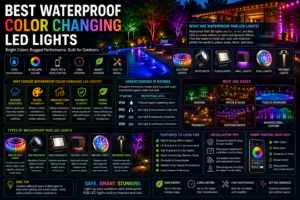
Understanding Waterproof Ratings for Outdoor LED Lights
Water resistance is not a detail to skim over; it is one of the most important choices in outdoor lighting. A light can look beautiful in a product photo and still fail quickly if it is installed in a place it was never designed to handle. IP ratings help you compare protection levels in a more precise way than vague words like “weatherproof.” In outdoor lighting, that difference matters because rain, dust, sprinklers, humidity, and occasional splashes all create different levels of exposure. RS Online’s IP rating guide notes that IP65 is generally suitable for outdoor use, while higher ratings are used for tougher conditions.
IP65
IP65 is commonly used for outdoor lighting exposed to rain, dust, and splashes. It is a strong fit for wall lights, garden fixtures, and many patio applications where the product is protected from direct submersion but still faces the elements. In simple terms, IP65 is the safe starting point for many above-ground outdoor installations. If a light is going to live in a normal garden or patio environment, this rating often gives a practical balance between protection and cost.
IP67
IP67 adds more water protection and is commonly associated with temporary immersion conditions. That makes it useful for locations where a fixture may encounter deeper splashes, pooling water, or harsher exposure than a standard patio light. It is a smart choice for certain in-ground or low-mounted applications where moisture risk is higher. For homeowners, this rating usually means extra peace of mind, especially in gardens with heavy rain or poor drainage.
IP68
IP68 is the highest of the three ratings in this comparison and is designed for continuous submersion under specified conditions. For outdoor lighting, that usually means specialized use rather than everyday wall or deck fixtures. It is relevant for some water features, pools, or highly exposed landscape applications, but it is not necessary for most patios or garden accent lights. The smarter move is to match the rating to the environment instead of paying for more protection than the fixture will ever need.
| IP Rating | Protection Level | Best Use Case |
| IP65 | Dust-tight and resistant to water jets | Patios, wall lights, garden fixtures, standard outdoor use |
| IP67 | Higher protection with temporary immersion resistance | In-ground accents, wetter garden zones, harsher exposure |
| IP68 | Designed for continuous submersion under specified conditions | Pools, water features, specialized outdoor installations |
For most homeowners, IP65 is the minimum sensible baseline, while IP67 or IP68 should be reserved for areas with more moisture exposure or submersion risk. If a fixture is going near the ground, close to water, or in a location that collects rain, upgrading the rating is usually worth it. The right decision here is less about chasing the highest number and more about avoiding failure later. That is the whole point of choosing outdoor lighting with care.
Smart Features to Consider
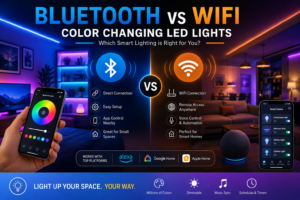
WiFi Connectivity
WiFi is the most convenient choice when you want to control lights from anywhere through an app. It is especially useful for homeowners who already have strong outdoor wireless coverage and want remote access without extra hubs. TP-Link’s outdoor smart ecosystem shows how WiFi-based control can be paired with Matter support and ecosystem compatibility, while Philips Hue offers app-based control through its Bridge and outdoor system. If your garden or patio is far from the router, signal strength should be checked before installation.
Bluetooth Control
Bluetooth is handy for quick setup and nearby control, especially in smaller yards or temporary setups. It is often easier to get started with than a network-heavy solution, but range can be limited. For a porch, balcony, or small patio, Bluetooth may be enough. For a larger landscape or multi-zone yard, WiFi or a hub-based system usually gives a better long-term experience.
Voice Assistant Compatibility
Voice control sounds like a luxury until you use it a few times, then it becomes second nature. Saying “turn on the patio lights” or “set the garden to blue” is faster than opening a phone every time. Philips Hue supports Alexa, Google Assistant, and Apple HomeKit, and TP-Link’s Matter-compatible outdoor products work with Apple Home, Alexa, Google Home, and SmartThings. If hands-free convenience matters, this feature is one of the biggest quality-of-life upgrades you can buy.
Scheduling and Automation
Schedules are where smart outdoor lighting really starts to feel intelligent. Lights can come on at dusk, dim after midnight, brighten before sunrise, or switch off when the patio is usually empty. Philips Hue highlights routines like “Wake Up” and “Away Mode,” and TP-Link’s outdoor smart devices also support control patterns that mimic presence or automate usage. That means your lights can do useful work even when you are not thinking about them.
Scene Presets
Scene presets let you save favorite looks for ordinary evenings, dinner parties, holidays, and late-night relaxing. This matters because no one wants to rebuild the lighting from scratch every time guests arrive. A good preset system feels like changing the soundtrack in a room: the space is the same, but the mood changes instantly. That is one of the simplest ways to make a patio or garden feel more premium.
Music Synchronization
Music synchronization is not essential, but it can be fun for entertaining spaces. It works best when the lighting is subtle enough to enhance the atmosphere rather than become the center of attention. If you use it sparingly, the effect can feel impressive without becoming distracting. For outdoor parties, it can turn a normal patio into something a little more memorable. Philips Hue explicitly lists entertainment features that sync with music, movies, or games through its ecosystem.
Best Colors for Different Outdoor Settings
| Outdoor Area | Recommended Colors | Purpose |
| Garden Paths | Warm white, soft amber, gentle green | Safety, visibility, calm direction |
| Patios | Warm white, soft orange, muted blue | Dining comfort, relaxation, balanced ambiance |
| Pools | Blue, aqua, cool white | Water reflection, resort-like mood |
| Outdoor Dining Areas | Warm white, soft gold | Natural food appearance, comfortable conversation |
| Entertainment Spaces | Purple, blue, red, multicolor scenes | Energy, novelty, event atmosphere |
Color choice changes the emotional feel of the space more than many homeowners expect. Warm tones usually feel more welcoming and natural for eating or relaxing, while cooler tones create a crisp and modern mood. Stronger colors such as blue, purple, and red work well in entertainment zones where the goal is excitement rather than subtlety. The trick is not to match every light to the same color; it is to make each area serve its own purpose. That is how outdoor lighting feels designed instead of accidental.
Outdoor LED Strip Lights vs Landscape Spotlights
| Feature | LED Strip Lights | Landscape Spotlights |
| Installation | Easier on edges and hidden surfaces | Requires aiming and fixture placement |
| Coverage Area | Linear, continuous glow | Focused, directional beam |
| Decorative Impact | High for outlines and accents | High for focal points and drama |
| Brightness | Usually softer and more ambient | Often stronger and more concentrated |
| Cost | Often lower for accent runs | Often higher per fixture, depending on quality |
Strip lights are best when you want to define shape, edges, or built-in architecture. Spotlights are best when you want to showcase trees, walls, statues, or textured landscape elements. In many real yards, the best solution is not choosing one over the other. It is using strips for structure and spotlights for emphasis, which creates a layered design that feels balanced after dark. That combination is common in high-end outdoor lighting because it works like a camera lens: one element frames the shot, the other gives it focus.
Installation Guide for Outdoor LED Lighting
- Plan the lighting layout. Decide which areas need safety lighting, accent lighting, and decorative color changes.
- Measure installation areas. Check walkway lengths, railings, wall spans, and fixture spacing before buying.
- Select appropriate fixtures. Match the product type and IP rating to the actual exposure level.
- Install power supplies. Keep transformers, plugs, and controllers in safe, accessible locations.
- Mount lighting fixtures. Hide wiring where possible and keep fixtures level and secure.
- Configure smart controls. Connect the system to your app, hub, or voice assistant.
- Test lighting scenes. Walk the space at night and adjust brightness, angle, and color.
Safety matters just as much as style. Outdoor lighting should be installed with weather exposure, cable protection, and maintenance access in mind. Fixtures near water, soil, or foot traffic need extra attention because small installation errors can become big problems later. If a setup feels overly complicated, break it into zones instead of trying to wire the whole yard in one go. That usually leads to cleaner results and fewer headaches.
Common Outdoor Lighting Mistakes to Avoid
One common mistake is using indoor-rated lights outdoors. Another is ignoring the IP rating and assuming every “weatherproof” product can handle the same conditions. Homeowners also often make spaces too bright, which flattens the landscape and creates glare instead of atmosphere. Poor placement can hide the best parts of a garden or make the patio feel awkwardly lit. Power planning matters too, because a beautiful layout is not much help if the cable routing or supply setup is unreliable.
Maintenance access is another overlooked issue. Outdoor lights still need cleaning, occasional adjustment, and sometimes replacement, so do not bury them so deeply that service becomes a project. It is also smart to leave room for future upgrades if you think you may later add more fixtures or smart controls. Think of the first installation as the beginning of the lighting system, not the final version. That mindset helps you build a setup that grows with the home instead of fighting it.
Energy Efficiency and Long-Term Savings
The financial case for outdoor LED lighting is strongest over time. LEDs generally use far less electricity than older incandescent lighting, and their long lifespan means fewer replacements and less labor. For homeowners who keep exterior lights on every night, those savings add up steadily. A path light that runs for hours each evening is exactly the kind of fixture where a long-life, low-energy LED makes sense. The benefit is not just lower bills; it is also less disruption from constant maintenance.
There is also a design benefit to efficiency. Once you stop worrying about every light being expensive to run, you can create better layers of illumination without guilt. That means you can light steps, accent plants, and wash walls separately instead of using one bright lamp to do everything. In practice, efficient lighting often leads to better lighting because it gives you room to design properly. That is a rare case where saving energy and improving aesthetics happen at the same time.
Frequently Asked Questions
What are the best outdoor color changing LED lights?
The best choice depends on the space. Strip lights are great for edges and architectural accents, spotlights work well for trees and focal points, and pathway lights are ideal for safety and direction.
Are outdoor RGB lights waterproof?
Some are water-resistant and some are designed for wetter conditions, but not all are fully waterproof. Check the IP rating before buying, because IP65, IP67, and IP68 each mean different levels of protection.
What IP rating is best for garden lighting?
IP65 is a very common starting point for general outdoor use. If the fixture will be closer to water, soil, or submersion risk, IP67 or IP68 may be more appropriate.
Can outdoor LED lights be controlled with a smartphone?
Yes. Many smart outdoor lighting systems support app control, scheduling, and scene changes. Philips Hue and TP-Link both provide current smart outdoor options with app-based and ecosystem-based control.
Are LED strip lights suitable for patios?
Yes, especially for deck edges, pergolas, railings, and under-seat accents. Just make sure the strip is rated for outdoor use and installed where the cable and controller stay protected.
Conclusion
Outdoor color changing LED lights give gardens and patios a rare combination of beauty, flexibility, and practical value. They can brighten paths, frame trees, soften dining spaces, and turn an ordinary patio into a space that feels ready for dinner, relaxation, or entertaining. Because modern outdoor color changing LED lights are often smart, weather-resistant, and energy-efficient, they fit both style goals and everyday home use. The result is lighting that works like a well-trained host: it sets the mood, keeps guests comfortable, and disappears into the experience when it is doing its job well.