Lighting is the silent host at every event. Before the speeches, before the first dance, and before the crowd even settles in, the room has already started telling a story. That is why event lighting ideas matter so much: they shape the mood, direct attention, and turn a plain venue into a memorable experience. With modern RGB lighting for events, planners can shift a room from warm and romantic to bold and high-energy in seconds. LED technology also makes this approach practical, since LEDs are far more efficient than older lighting options and continue to be a core part of the industry’s shift toward smarter, more immersive spaces.
Enhance any environment with Color Changing LED Lights that offer brilliant illumination and dynamic color effects. Perfect for parties, concerts, architectural lighting, and commercial spaces, these LEDs allow users to create captivating visual experiences. With multiple color modes and easy control options, they bring both functionality and style to any lighting setup.
Why Lighting Is Essential for Event Ambiance
Lighting is often the first design element guests feel, even before they consciously notice it. A venue can be beautiful on paper, but without the right lighting it may feel flat, cold, or disconnected from the event’s purpose. That is why planners treat event ambiance lighting as a strategic tool rather than a decorative afterthought. Color and light help create emotional cues, and event-focused design articles continue to stress that lighting shapes mood, attention, and the overall experience in real time. Some event and color-psychology sources also note that a large share of how people judge a space comes down to color, which is exactly why planners use event décor lighting so carefully.
First Impressions
First impressions work like a door opening into the event story. If guests step into a room washed in soft amber, they expect warmth and intimacy; if they enter a space filled with crisp blue light and sharp accents, they expect structure, professionalism, or a modern brand experience. In weddings, that first glow can feel romantic and welcoming. In a corporate environment, the same tool can make a venue feel polished, branded, and ready for business. Event planners use that instant reaction to create alignment between the physical space and the emotional promise of the event.
Emotional Impact
Lighting also has a direct effect on how guests move and feel. Soft lighting can slow the pace and encourage conversation, while stronger color accents can energize a room and make people more likely to mingle. That is one reason mood lighting for events has become such a big part of modern design: it quietly guides behavior without feeling forced. The psychology of color matters here too. Research summaries and event-design commentary repeatedly associate warm colors with energy and cool colors with calm, which gives planners a practical way to shape the emotional arc of the night.
What Is RGB Lighting and How Does It Work?
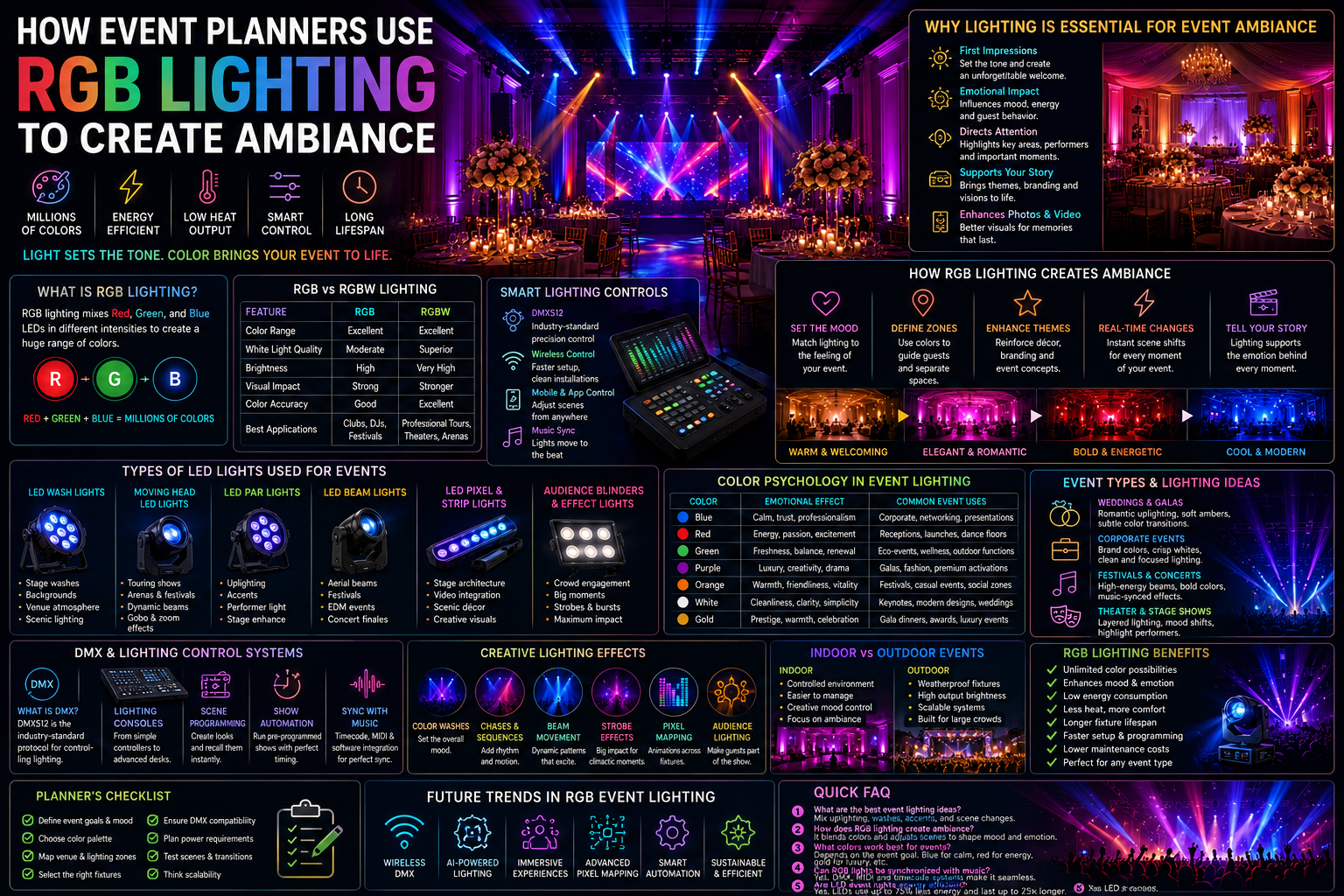
RGB lighting is built on a simple idea with powerful results: mix red, green, and blue light in different amounts, and you can create a wide range of colors. In event production, that means one system can support many moods, themes, and brand palettes without changing the physical setup. When paired with LED technology, LED event lighting becomes even more useful because it is efficient, fast to respond, and easy to control. The U.S. Department of Energy notes that LEDs can use at least 75% less energy and last up to 25 times longer than incandescent lighting, which is a major reason event teams increasingly rely on them for repeat-use installations.
RGB Technology Explained
At its core, RGB lighting uses three channels: red, green, and blue. Each channel can be dimmed or raised independently, which allows a fixture to output bright saturated colors or subtle blended tones. In event work, this is where the magic begins. A single color-changing fixture can act like a chameleon, supporting a wedding entrance, a product launch reveal, or a dramatic concert moment simply by changing the programmed scene. That flexibility is why planners and production teams consider RGB LED lights such a dependable foundation for modern events.
RGB vs RGBW Lighting
RGB and RGBW are similar, but they are not identical. RGB fixtures combine red, green, and blue channels, while RGBW fixtures add a dedicated white channel, which can improve white-light quality and make some looks feel cleaner and more natural. That matters in events where the room must shift from colorful atmosphere to realistic presentation light, such as in keynote sessions or elegant dinners. When a planner needs rich color plus a believable white wash, RGBW often gives more control. In practice, this means better flexibility for venue lighting solutions and smoother transitions between scene changes.
Smart Lighting Controls
The control side is just as important as the fixture itself. DMX512-A remains the standard lighting-control protocol for entertainment lighting, and its open, channel-based structure gives designers precision over color, intensity, and movement. USITT’s standards work also shows how the industry has kept evolving, including remote device management over DMX512 networks for addressing and status reporting. Put simply, smart control turns lighting from a static asset into a live storytelling system. That is why smart event lighting is now a core part of advanced event production lighting setups.
How Event Planners Use RGB Lighting to Create Ambiance
Planners use RGB lighting the way a painter uses color on a canvas. The venue is the canvas, and the lighting becomes the brush that changes mood, depth, and focus. This is where event lighting design becomes less about decoration and more about experience design. Recent event-industry writing keeps pointing toward immersive, high-touch environments, where light works alongside décor, projection, and staging to shape how guests feel the moment they walk in.
Setting the Event Mood
Mood is the first job of RGB lighting. A soft blush tone can make a wedding feel tender and romantic, while a deep navy or purple palette can make a gala feel sophisticated and exclusive. For corporate events, clean whites and brand colors can help the room feel focused and on-message. This is not about flooding a venue with color for the sake of it. It is about choosing a palette that supports the emotional goal of the night and then letting the lighting carry that feeling from entrance to exit.
Defining Event Zones
RGB lighting also helps divide a venue into clear zones without building physical walls. A welcome area might use softer tones, the stage might use brighter emphasis, and a lounge might use warmer, more relaxed lighting. This zoning helps guests understand where to go and how to behave in each space. It also gives planners a chance to make a large venue feel more intimate, or a small room feel more dynamic. In other words, lighting becomes a map as much as a design choice.
Enhancing Event Themes
The best themes feel complete because every detail points in the same direction. RGB lighting supports that consistency by reinforcing the décor, florals, furniture, and brand graphics already in the room. For example, a winter gala can lean into icy blues and silver-white tones, while a tropical launch might use saturated greens, oranges, and pinks to feel playful and fresh. The real advantage is continuity: lighting can echo the theme across the entire venue, so every corner feels intentional instead of random.
Event Lighting Ideas for Different Event Types
Different events need different energy. A wedding should not feel like a conference, and a product launch should not feel like a lounge dinner. That is why planners build their wedding lighting ideas, corporate event lighting, and show-specific looks around the purpose of the gathering. Industry trend pieces in 2025 keep highlighting immersive experiences, wireless flexibility, and lighting that works both in person and on camera, which is exactly where RGB systems shine.
Weddings and Gala Dinners
For weddings, RGB lighting is often used to create romance, softness, and elegance. Think gentle amber during dinner, subtle uplighting around the perimeter, and a brighter, more playful look on the dance floor later in the night. Gala dinners usually lean more refined: gold, champagne, soft white, and rich jewel tones can make the room feel expensive without becoming loud. The key is restraint. When the palette feels curated instead of overdone, the event feels luxurious, like a perfectly tailored suit rather than a costume.
Corporate Events and Product Launches
Corporate events need clarity and brand alignment. That means lighting often serves two goals at once: helping people see presentations clearly and reinforcing brand identity through color. A company with a strong blue brand, for example, may use blue uplighting in networking areas and brighter neutral light on stage so faces look natural on camera. Product launches can go further by using dynamic RGB transitions for reveals, countdowns, and hero moments. Recent industry coverage also points to broadcast-friendly lighting and changing color temperature as important in hybrid and filmed events.
Festivals and Concerts
Festivals and concerts are where RGB lighting really gets to flex. Fast changes, pulsing effects, and synchronized color movement can energize the crowd and amplify the performance. High-energy spaces often use bold color shifts, layered beams, and scene changes tied to music cues, making the audience feel part of the show rather than just spectators. This is also where immersive lighting trends become obvious: the venue itself becomes part of the performance, and the light is doing more than decorating the stage. It is helping generate adrenaline.
Understanding Color Psychology in Event Lighting
Color psychology is one of the most useful parts of event lighting design because it helps planners choose colors with intention. A Royal Society of Chemistry event article cites research suggesting that 62–90% of our assessment of an environment can be based on color alone, which explains why palette choice matters so much. Broadly speaking, warm colors tend to feel energetic and expressive, while cooler tones tend to feel calm and composed. That does not mean every event must follow the same formula, but it does mean color should always support the event’s emotional purpose.
| Color | Emotional Effect | Common Event Uses |
| Blue | Calm, trust, professionalism | Corporate events, networking lounges, brand presentations |
| Red | Energy, passion, excitement | Receptions, launches, dance floors, high-impact reveals |
| Green | Freshness, balance, renewal | Eco-themed events, wellness spaces, outdoor functions |
| Purple | Luxury, creativity, drama | Galas, fashion events, premium brand activations |
| Orange | Warmth, friendliness, vitality | Festivals, casual celebrations, social zones |
| White | Cleanliness, clarity, simplicity | Keynotes, weddings, modern minimalist designs |
| Gold | Prestige, warmth, celebration | Gala dinners, award nights, luxury receptions |
Use the table as a guide, not a rulebook. The same color can feel different depending on saturation, brightness, texture, and what surrounds it. A deep blue wall wash can feel formal and trustworthy, while a softer blue haze can feel dreamy and romantic. That is why planners test looks in the actual venue instead of assuming color will behave the same everywhere. Lighting is context, not just hue.
Smart RGB Lighting Systems for Events
Modern event lighting is no longer about flipping a switch and hoping for the best. Today’s systems are built for programming, scene changes, remote monitoring, and coordination across multiple fixtures. That is a huge advantage for planners because it reduces manual work on-site and makes transitions smoother. It also supports bigger creative ideas, since fixtures can now be grouped, timed, and adjusted like parts of a single performance.
DMX, Wireless Control, and Music Sync
DMX gives designers precise control, while wireless systems cut down on visible cabling and simplify setup in temporary venues. Mobile apps have made control more accessible for smaller teams, and music sync features help lighting follow the beat instead of feeling disconnected from the room. This is especially useful for dance floors, launches, and performances where timing matters. A well-tuned lighting cue can feel like a drum hit you can see. That is why programmable lighting effects are now a major part of premium event production lighting packages.
Future Trends in Event RGB Lighting
The direction of the industry is clear: smarter, lighter, more immersive, and more adaptive. Recent 2025 industry articles highlight AI-driven lighting, projection mapping, wireless control, and immersive environments where the room becomes part of the story. At the same time, sustainability continues to matter, and LEDs remain central because of their long life and strong energy performance. In practice, future-facing planners are looking for lighting that can do more with less: less power, less clutter, less manual labor, and fewer limits on creativity.
One trend worth watching is the blending of lighting and experience design. Instead of treating light as a background layer, event teams are using it as a primary storytelling medium, especially in hybrid events and camera-heavy productions. Another trend is interaction, where guest movement, live music, or even app-based inputs can change the scene. That kind of responsiveness turns a venue into a living environment. It is no longer just a room with lights. It is a space that reacts.
Conclusion
RGB lighting gives event planners a powerful way to shape emotion, define space, and turn ordinary venues into unforgettable experiences. When used well, event lighting design does far more than brighten a room; it supports storytelling, reinforces branding, and elevates every guest interaction. Because LEDs are efficient, programmable, and adaptable, they have become the backbone of modern LED event lighting and a smart choice for planners who want both impact and control.
The real win is not just color. It is intention. When planners match the right palette, the right fixtures, and the right control system to the purpose of the event, the result feels seamless and memorable. That is the difference between simply lighting a venue and truly transforming it. Explore related ideas like Using Color Changing LED Lights for Weddings, Best LED Lights for DJ Events and Parties, Stage Lighting with Color Changing LEDs, and Color Changing LED Lights for Concerts and Live Shows as you plan your next production. Professional RGB lighting solutions can help you create the kind of atmosphere guests remember long after the lights go down.
Frequently Asked Questions
1. What are the best event lighting ideas for a modern venue?
The best ideas usually combine RGB uplighting, accent washes, stage highlights, and programmable scene changes. These layers give the venue depth and allow the mood to shift throughout the event.
2. How does RGB lighting create ambiance at events?
It changes the color and feel of a room by mixing red, green, and blue light into different looks. That flexibility lets planners create warmth, excitement, elegance, or focus on demand.
3. What colors work best for wedding lighting ideas?
Soft amber, blush, warm white, and gentle gold are popular because they feel romantic and flattering. Some weddings also use subtle purples or blues for evening transitions and dance-floor energy.
4. Is RGB lighting suitable for corporate event lighting?
Yes. It is especially useful for brand-colored backdrops, stage emphasis, keynote lighting, and networking areas. The key is to keep the look clean and controlled so the room feels polished.
5. Are LED event lights energy efficient?
Yes. The U.S. Department of Energy says LEDs use at least 75% less energy than incandescent lighting and can last up to 25 times longer. That makes them a smart choice for recurring events and large productions.