Waterproof RGB LED lights are everywhere right now because they solve two problems at once: they create dramatic color effects and they survive harsh environments. That makes them a smart fit for gardens, patios, pools, events, commercial façades, and any place where weather can ruin ordinary lighting. The strongest products today are not just colorful; they are sealed, efficient, and designed for outdoor life, which is exactly why buyers keep looking for waterproof color changing LED lights that can handle real-world conditions. Current manufacturer guidance also shows that outdoor smart lighting has moved well beyond basic decoration, with options that combine weather resistance, app control, and voice control in the same system.
The tricky part is that not all “waterproof” lights mean the same thing. One product may be fine for a covered patio, while another is built for direct rain, puddles, or temporary immersion. That is why IP ratings matter so much, and why smart buyers pay attention to the enclosure, the power supply, the wiring, and the installation location instead of chasing color effects alone. The best waterproof LED lighting is a balance of brightness, sealing, durability, and control, not just a pretty glow.
What Are Waterproof RGB LED Lights?
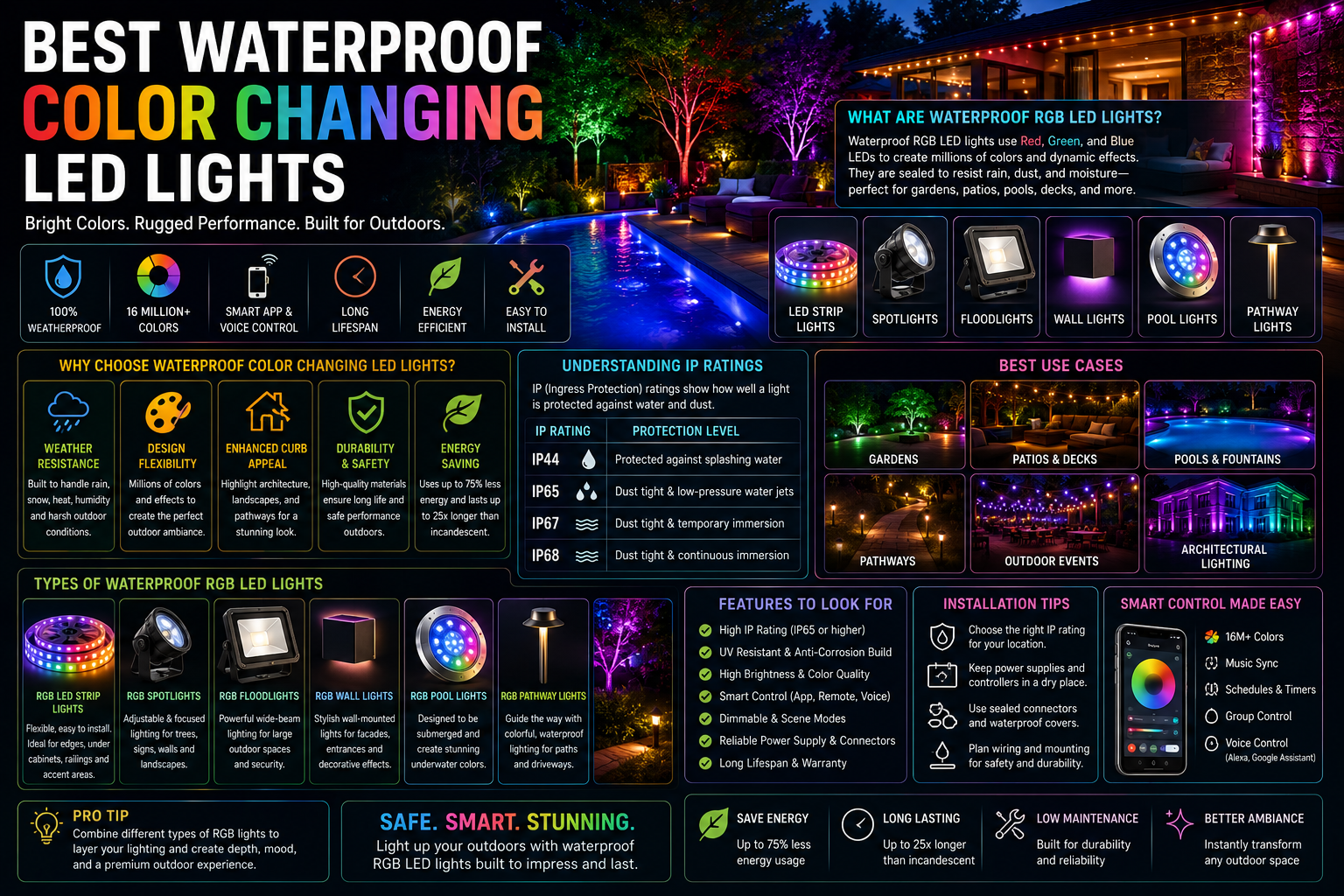
Waterproof RGB LED lights are LED fixtures or strips that produce red, green, and blue light so they can mix colors and create dynamic scenes. In practice, that means you can shift from warm party lighting to cool accent lighting, or set a single color to match an event, season, or brand palette. The RGB system is the color engine, while the waterproof design is the protective shell that keeps moisture and dirt from damaging the electronics. Modern outdoor product pages from brands like Govee and Philips Hue show that this category now includes strip lights, wall lights, spotlights, floodlights, and permanent exterior lighting systems.From homes and events to commercial spaces and stage productions, Color Changing LED Lights: The Complete Guide covers everything you need to know to make the right choice.
RGB LED Technology Explained
RGB LEDs use separate red, green, and blue channels that blend into a wide range of colors. Think of it like mixing paint, except the “paint” is light and the result changes instantly when you adjust the channel levels. That is why outdoor RGB LED lights are so popular for decorating decks, gardens, and storefronts: one fixture can play many roles without needing a full rewire or a box of replacement bulbs. Many current outdoor smart systems also add preset scenes and app-based color control, making them much easier to tailor for holidays or daily use.
How Waterproof LED Lights Are Built
A waterproof LED light is usually built with sealed housings, protected connectors, silicone or resin-coated components, and carefully managed cable entry points. The goal is simple: keep water, dust, and debris away from the driver and LED circuitry. That design matters because moisture rarely kills a light in one dramatic moment; more often, it creeps in slowly through weak seals, poor joints, or exposed adapters. Manufacturer product pages for outdoor strips and permanent outdoor lights show the same pattern: the lighting section may be outdoor-rated, while the power adapter or control box may still require indoor protection.
Indoor vs. Outdoor LED Lights
Indoor LED lights are made for controlled environments, so they often have little or no weather sealing. Outdoor LED lighting, by contrast, must cope with rain, UV exposure, temperature swings, and sometimes direct water contact. That difference sounds small until you compare lifespan and failure rates in the field; a beautiful indoor strip under a patio edge can still fail if the driver or connector gets wet. For that reason, outdoor RGB LED lights are worth the extra cost whenever the installation is exposed, even partially, to weather.
Common Waterproof LED Configurations
The most common waterproof LED configurations are strip lights, spotlights, floodlights, wall lights, pathway lights, and pool-rated fixtures. Strip lights work best when you want a continuous glow along edges or architectural lines, while spotlights are better for highlighting trees, walls, and columns. Pool and fountain lights need more serious sealing, and marine installations usually demand the toughest hardware because water, salt, and vibration all work against the fixture. Current outdoor catalogs from Philips Hue and Govee reflect this variety clearly, which is useful because it reminds buyers that “waterproof LED lights” is a category, not a single product type.
Benefits of Waterproof Color Changing LED Lights
The biggest reason people choose waterproof color changing LED lights is that they combine style with resilience. You get a decorative effect that can shift with the moment, but you also get a product designed to survive outside the home, around water, or near high-humidity spaces. That matters for homeowners who want low-maintenance atmosphere and for contractors who need fewer callbacks after installation. In energy terms, LEDs remain a strong choice too: the U.S. Department of Energy says residential LEDs use at least 75% less energy and can last up to 25 times longer than incandescent lighting.
Weather Resistance
Weather resistance is the first and most obvious benefit. Rain, dust, windblown grit, and temperature changes can all shorten the life of standard lighting, especially when seals are weak or wiring is exposed. Outdoor-rated products are built to stay in service through seasons, which is why IP ratings are central to the buying decision. When a product is properly rated and installed, it is far more likely to keep performing through storms, humid nights, and daily outdoor exposure.
Outdoor Design Flexibility
Color-changing outdoor LED lighting gives you design freedom that fixed white lights cannot match. You can tune a landscape for subtle evening ambiance, turn a patio into a party zone, or match a storefront to a brand color without changing hardware. That flexibility is especially valuable for event planners and commercial properties because one lighting system can handle many moods across the year. Philips Hue’s outdoor range and Govee’s scene-heavy outdoor products show how much the market has leaned into this versatility.
Smart Lighting Capabilities
Smart waterproof LED lights are appealing because they let you control color, brightness, schedules, and scenes from an app or voice assistant. Official product pages now commonly mention Matter, Alexa, Google Assistant, Apple Home, and Siri support, which makes these lights fit naturally into a modern smart home. That means fewer remotes on the table and more automated lighting that turns on at dusk, shifts for events, or dims for quiet evenings. In other words, the light becomes less like a fixture and more like a tool. Take your event or venue lighting to the next level with insights from Smart Color Changing LED Lights Explained and learn how connected lighting creates more immersive experiences.
Understanding IP Ratings for Waterproof LED Lights
If you only remember one technical detail from this guide, make it this: IP ratings matter more than marketing language. The IEC explains that IP ratings grade the resistance of an enclosure against intrusion from dust or liquids, which is exactly what outdoor lighting needs to survive. In plain English, the IP code tells you how hard the shell works to protect the electronics. That is why the phrase “waterproof” is not enough on its own; the rating is the real clue.
IP65 Explained
IP65-rated lighting is a strong fit for most exposed outdoor décor jobs. Govee describes its IP65 outdoor strip as “dust-tight and protected from low-pressure water jets,” which is why IP65 is widely used for patios, eaves, decks, and garden accents. It is a practical choice when you need protection from rain and splash, but not full submersion. For many homeowners, IP65 is the sweet spot between price and protection.
IP67 Explained
IP67 steps up the sealing for situations where water contact can be more serious. Official manufacturer and technical documentation commonly describe IP67 as dust-tight and capable of handling temporary immersion under defined conditions. That makes it a better fit for poolside accents, exposed landscape zones, and installations where pooled water or short-term immersion is possible. If your light could be splashed heavily, briefly flooded, or accidentally submerged, IP67 is a safer choice than IP65.
IP68 Explained
IP68 is the toughest of the three ratings covered here and is designed for continuous immersion under manufacturer-specified conditions. Motorola’s official support page describes IP68 as suitable for continuous immersion in water under conditions specified by the manufacturer, while IEC-aligned documentation says IP ratings measure resistance to liquids and dust. For buyers, this means IP68 is best reserved for the harshest wet environments, such as submerged features or demanding marine-style use cases. The important detail is that IP68 is not a magic promise; depth, duration, and real-world installation still matter.
| IP Rating | Protection Level | Best Applications |
| IP65 | Dust-tight, protected from low-pressure water jets | Patios, decks, pergolas, outdoor kitchens, eaves |
| IP67 | Dust-tight, handles temporary immersion under specified conditions | Poolside accents, exposed gardens, wet landscape areas |
| IP68 | Dust-tight, suitable for continuous immersion under manufacturer-specified conditions | Submerged fixtures, demanding water-feature or marine-style applications |
For most residential outdoor RGB LED lights, IP65 is enough under cover, IP67 is better for exposed wet zones, and IP68 should be reserved for true immersion situations. A good buying rule is simple: choose the rating for the worst weather your light will realistically face, not the best day you hope it will see. That one decision prevents a lot of expensive mistakes later.
Best Types of Waterproof RGB LED Lights
Different jobs call for different fixtures, and that is where many buyers go wrong. A waterproof LED strip is fantastic for linear accent work, but it is not the same thing as a marine light or a pool fixture. Matching form factor to environment is what separates a clean install from a frustrating one, especially when weather and water are involved. The good news is that current outdoor product ranges now cover nearly every use case, from deck edges to permanent façade lighting.
Waterproof LED Strip Lights
Waterproof LED strip lights are the most flexible option for many homeowners and designers. They work beautifully along decks, patios, pergolas, outdoor kitchens, and railing lines because they create a continuous band of light rather than isolated points. That linear effect can make an outdoor space feel larger, cleaner, and more polished, almost like drawing a glowing outline around the architecture. Just remember that the strip may be outdoor-rated while the power supply is not, so the entire system still needs careful planning.
Waterproof LED Spotlights
Spotlights are the sculptors of the lighting world. Instead of washing a whole area, they pick out trees, statues, stone walls, and architectural details one at a time. That makes them ideal when you want drama without overlighting the space, which is often the better choice in gardens and premium landscape designs. Philips Hue’s outdoor lineup shows how popular this category has become for accent and façade work.
Pool and Fountain Lights
Pool and fountain lights live in the toughest neighborhood of all: water, chemicals, and constant moisture. That is why buyers should treat pool lighting as a specialized category rather than a standard outdoor accessory. These lights need the right sealing, the right mounting method, and the right power precautions, because a pool installation is not just decorative; it is a safety-sensitive electrical job. If the product is not explicitly intended for water features, skip it.
Waterproof Smart LED Bulbs
Waterproof smart bulbs are useful in exterior fixtures, porches, and covered entryways where the bulb itself needs weather tolerance but the fitting may already provide some protection. They are less versatile than strips for dramatic design, but they are easier to use in standard lamp-style or wall-mounted outdoor fixtures. Smart bulb systems also make it simple to automate schedules and scene changes without replacing the entire fixture. Philips Hue’s smart outdoor range reflects how buyers increasingly expect this kind of control in everyday lighting.
Marine-Grade LED Lights
Marine-grade LED lights are the heavy-duty option for docks, boats, and waterfront installations. These spaces add salt, spray, vibration, and continuous moisture, which is a far more punishing environment than a normal backyard. Marine products need stronger sealing, corrosion resistance, and more disciplined cable management than typical patio lighting. If a light is going near saltwater or a dock, marine-grade hardware is the smarter long-term investment.
How to Choose the Best Waterproof RGB LED Lights
Choosing the right light is less about chasing the brightest spec sheet and more about matching the product to the environment. Start with the location, because a covered porch, exposed wall, pool deck, and seawall each demand a different level of protection. Then think about brightness, power delivery, control method, and how often you will actually use the color effects. A careful purchase here usually saves more money than a cheaper model that fails early.
Here is a practical buyer’s checklist:
- Location: fully exposed, partially covered, splash zone, or submerged.
- IP rating: IP65 for rain and splash, IP67 for temporary immersion risk, IP68 for continuous immersion.
- Brightness: decorative glow or task-level brightness.
- Control: app, remote, voice, or full automation.
- Power supply: indoor or outdoor-rated, and properly protected.
- Material quality: UV resistance, corrosion resistance, and durable seals.
- Installation style: strips, spots, bulbs, or permanent fixtures.
Installation Location
The same light can be brilliant in one place and wrong in another. Under eaves, an IP65 strip may be enough; on an open deck edge, you may want IP67; near a pool or water feature, IP68-style protection becomes much more relevant. Think in terms of exposure, not just geography. A “dry” outdoor area can still get wet during storms, cleaning, or wind-driven rain.
Brightness Needs
Brightness depends on the job. Accent lighting needs less output, while entertainment spaces and commercial façades need stronger light levels to stay visible after dark. Products like Philips Hue outdoor floodlights and Govee permanent outdoor lights show that modern buyers often want both decorative color and useful white light in the same system. That is where RGBW becomes especially attractive.
Power Supply Considerations
A waterproof strip is only as reliable as the weakest part of the system, and the power supply is often that weak link. Many outdoor products note that the strip or fixture is weather-rated while the adapter is indoor-only, which means you must protect the electrical feed carefully. This is one of the most common reasons outdoor lighting fails early, even when the LEDs themselves are perfectly good. Always read the installation notes, not just the headline rating.
Smart Features
Smart features are no longer a luxury add-on. Govee’s outdoor products now list Matter, Alexa, and Google Assistant support, while Philips Hue officially supports Alexa and Apple Home & Siri, with Google Assistant setup guidance as well. That means buyers can build scenes, automate schedules, and control outdoor color from the same ecosystem they already use indoors. In practice, smart control turns lighting from a manual chore into a one-tap routine.
Budget Planning
A sensible budget should include more than the price of the light itself. You may also need mounting clips, connectors, weatherproof junctions, a stronger power supply, and possibly professional installation. It helps to think in total cost of ownership, because a slightly more expensive outdoor-rated system often lasts much longer and causes fewer service calls. That is especially true for commercial buyers and landscape contractors.
RGB vs RGBW Waterproof LED Lights
RGB and RGBW lights look similar at first glance, but they are not built for exactly the same purpose. RGB focuses on colorful effects, while RGBW adds a dedicated white channel, which usually improves neutral white light quality and everyday usability. If you only want vivid color scenes, RGB may be enough. If you want the same lighting to work for parties, security, and general outdoor visibility, RGBW usually gives you more range.
| Feature | RGB | RGBW |
| Color Performance | Strong, vivid colors | Strong colors with better versatility |
| White Light Quality | Usually mixed white | Dedicated white channel for cleaner white |
| Brightness | Good for effects | Often better for everyday use |
| Cost | Usually lower | Usually higher |
| Best Outdoor Uses | Decorative accents, events, highlights | Patios, pathways, security-friendly spaces |
A simple rule works well here: choose RGB for pure atmosphere and RGBW for atmosphere plus function. That recommendation lines up neatly with how current outdoor product lines are being marketed, especially in systems that balance holiday scenes with warm white daily lighting. Whether you’re planning events, stage production, or venue lighting, RGB vs RGBW LED Lights helps you choose the right balance of color and white-light performance.
Smart Features to Look For
Smart features can make waterproof outdoor lighting feel effortless instead of fiddly. The most useful systems let you change colors, dim lights, switch scenes, and automate timing from a phone app. The best ones also work across major voice ecosystems so you do not have to remember which remote belongs to which zone. That convenience becomes more valuable as the installation gets larger.
WiFi Connectivity
Wi-Fi is the easiest path for many home setups because it supports app control from anywhere the network reaches. It is especially useful for permanent outdoor lights, where you may want remote access without walking outside every time. Wi-Fi also tends to unlock broader automation features than basic remote-only lighting. Many current outdoor smart products use Wi-Fi as their core control method.
Bluetooth Control
Bluetooth is handy for quick setup and short-range control. It is not always as powerful as Wi-Fi for remote access, but it can be faster to pair and easier for simple installations. Some buyers prefer Bluetooth for smaller patios or temporary event setups because it keeps the system simple. In the right use case, simple is a feature, not a limitation.
Voice Assistant Integration
Voice control has become one of the clearest quality-of-life upgrades in smart lighting. Philips Hue officially supports Alexa and Apple Home & Siri, and Govee’s outdoor lights mention Matter, Alexa, and Google Assistant. That means you can ask for a scene change, a brightness adjustment, or an on/off toggle without digging for your phone. For hands-free convenience, that is hard to beat.
Scheduling and Automation
Scheduling is one of those features people ignore until they use it once. After that, they rarely want to go back. Outdoor lights can come on at dusk, shut off late at night, or change color for recurring events, which is especially useful for homeowners who travel or businesses that need consistent branding after hours. Automation saves both time and energy because the lights only run when they need to.
Scene Presets
Scene presets are a fast way to make outdoor lighting feel polished. Instead of manually building every color combination from scratch, you can jump straight to holiday, party, security, or relaxation settings. Govee’s outdoor pages emphasize large preset libraries, which shows how much buyers value instant visual results. For most users, presets are the difference between “nice product” and “actually fun to use.”
Music Synchronization
Music sync is a popular feature for parties and seasonal displays because it makes the lights feel alive. It is less important for serious landscape lighting, but it can be a major plus for event planners and entertaining spaces. If the system supports it well, the light show becomes part of the atmosphere rather than background decoration. That makes the feature worth paying for when the space is used socially.
Installation Tips for Waterproof LED Lights
A clean outdoor lighting install starts before the first clip goes into the wall. The environment decides the hardware, the hardware decides the wiring path, and the wiring path decides whether the system lasts. Good installation is less glamorous than color effects, but it is what separates a reliable setup from one that quietly fails after the first heavy rain. Follow the basics carefully and you will save time, money, and headaches later.
- Assess environmental conditions.
- Choose the appropriate IP rating.
- Plan power connections and cable routes.
- Secure fixtures with weather-safe mounting.
- Protect every exposed connector.
- Configure smart controls and automations.
- Test the system in real conditions.
Safety matters just as much as appearance. Keep indoor-only adapters indoors, avoid burying a weak connection under decorative trim, and do not assume that a waterproof strip makes the whole system waterproof. If the system includes mains power, hire a qualified electrician or at least follow local electrical rules strictly. Water and electricity do not forgive sloppy shortcuts.
Common Mistakes to Avoid
The most expensive mistake is choosing the wrong IP rating for the wrong environment. A second common error is treating an outdoor strip as if every component in the box is equally weatherproof, when the adapter or controller may not be. Buyers also underestimate power needs, ignore cable protection, or install decorative lighting in places where sun, salt, or splash will destroy it too quickly. Each of these mistakes is preventable with a few minutes of planning.
The practical solution is to think in systems, not pieces. Look at the strip or fixture, the controller, the power supply, the connectors, and the mounting method as one complete outdoor lighting solution. Once you do that, the product choice becomes much easier, because you are no longer buying a “light”; you are buying reliability in a specific environment. That shift in mindset is exactly what experienced contractors use when they specify outdoor lighting.
Maintenance and Longevity
The good news about LED lighting is that it usually needs much less maintenance than older lamp technologies. The U.S. Department of Energy says LEDs last up to 25 times longer than incandescent lighting, and many are also dimmable, which helps reduce stress on the system. Even so, outdoor installations still need occasional cleaning, seasonal inspection, and a quick check of seals, clips, and connectors. A few minutes of care can extend useful life by years.
Cleaning should be gentle and boring, which is a compliment. Use a soft cloth, remove dirt before it bakes on, and inspect for moisture around connection points after major storms. If a section flickers, the problem is often not the LEDs themselves but a connector, adapter, or control box issue. In outdoor lighting, the weakest link usually tells the story.
Create a more immersive outdoor atmosphere with Outdoor Color Changing LED Lights for Gardens and Patios and discover lighting ideas for gardens, patios, and evening relaxation zones.
Cost Considerations and Long-Term Value
Upfront cost is only one part of the story. Outdoor smart lighting systems can cost more initially because they include better sealing, stronger materials, controllers, and sometimes more advanced software features. But the long-term value often makes up for it through reduced replacement frequency, lower energy use, and less maintenance. The DOE notes that LEDs can save a meaningful amount of electricity compared with incandescent lighting, and that reduction compounds over time in larger installations.
Initial Purchase Costs
Cheaper products can be tempting, but the low price often hides weak seals, short lifespans, or poor outdoor readiness. A well-built IP-rated outdoor light generally costs more because the materials and testing are more demanding. For most buyers, that premium is justified when the light is going anywhere near weather, splash, or humidity. The product may not look wildly different on day one, but it usually behaves very differently by month twelve.
Installation Costs
Installation can be modest for a small strip-light project and significantly higher for pools, façades, or marine spaces. The more exposed the location, the more likely you are to need weatherproof mounts, better cable routes, and professional labor. That is why commercial buyers should compare total installed cost rather than sticker price alone. A cleaner install usually pays for itself in fewer repairs.
Energy Savings
LED efficiency is one of the biggest hidden wins in outdoor lighting. The Department of Energy says residential LEDs use at least 75% less energy than incandescent lighting, and the agency’s consumer guide says LEDs can use up to 90% less energy in some applications. That matters even more when lights run for many hours each week, as landscape and façade lighting often do. Less electricity means lower operating costs and less heat stress on the fixture.
Maintenance Savings
Maintenance savings can be just as important as energy savings. When a lighting system lasts longer and fails less often, you spend less on replacement parts, labor, and troubleshooting. That is one reason waterproof RGB LED lights are attractive to contractors and property managers: they do not just look good, they reduce repeated service calls. In large properties, that difference becomes very noticeable.
Frequently Asked Questions
What are waterproof RGB LED lights?
They are color-changing LED lights designed with weather-resistant sealing so they can be used outdoors or in wet environments. The RGB channels mix colors, while the waterproof construction protects the electronics.
What IP rating is best for outdoor LED lights?
For many exposed outdoor uses, IP65 is a solid starting point, IP67 is better where water exposure is heavier, and IP68 is reserved for immersion or the harshest wet conditions.
Are IP65 lights waterproof?
IP65 lights are not meant for submersion, but they are commonly described as dust-tight and protected from low-pressure water jets, which makes them suitable for many outdoor applications.
Can waterproof LED strip lights be submerged?
Only if the product is explicitly rated for that use. Many outdoor strips are splash- and rain-resistant, but not all are safe for immersion, so the IP rating and manufacturer instructions matter.
What is the difference between IP67 and IP68?
IP67 is typically used for temporary immersion under specified conditions, while IP68 is intended for continuous immersion under manufacturer-defined conditions.
Are waterproof RGB lights suitable for pools?
Some are, but only products designed for wet or submerged use should go near pools or water features. Pool lighting should be chosen with special attention to sealing, installation rules, and electrical safety.
How long do waterproof LED lights last?
LEDs can last up to 25 times longer than incandescent lighting according to the U.S. Department of Energy, though real lifespan depends on heat, sealing, installation quality, and usage patterns.
Can outdoor LED lights be controlled by smartphone?
Yes. Many current smart outdoor lighting products offer app control, and some also add voice control through systems like Alexa, Google Assistant, and Apple Home.
Are waterproof RGBW lights worth it?
They usually are if you want both decorative color and a cleaner white light for everyday use. RGBW often gives you more flexibility than RGB alone.
Do waterproof LED lights consume a lot of electricity?
No. LEDs are known for high efficiency, and the U.S. Department of Energy says residential LEDs use at least 75% less energy than incandescent lighting.
Conclusion
The best waterproof color changing LED lights are the ones matched to the real environment, not just the most colorful box on the shelf. If you want the right result, start with the IP rating, then think about the fixture type, the power supply, the smart features, and the amount of weather exposure the installation will face. That approach helps homeowners, contractors, event planners, and commercial buyers choose lighting that looks good on day one and still performs months or years later. Current product lines from Govee and Philips Hue show how far outdoor smart lighting has come, especially in systems that blend weather resistance, automation, and color control.
If you are comparing waterproof RGB LED lights for a garden, patio, pool edge, or commercial exterior, keep the IP rating and installation quality at the top of the list. That is where durability lives, and durability is what turns a fun lighting idea into a dependable outdoor lighting solution. From there, the rest is the enjoyable part: choosing colors, setting scenes, and making the space feel alive.