Introduction
RGB vs RGBW LED lights is one of the most common comparisons people make when shopping for color changing LED lights, and for good reason. Both systems can turn a plain room into something dramatic, playful, or modern, but they do not behave the same way when you want clean white light, better brightness, or more flexible control. Current smart lighting products from brands like LIFX, Philips Hue, Govee, and Signify show that both formats remain widely used in homes, gaming rooms, retail spaces, and architectural projects.
The simplest way to think about it is this: RGB lights are built for color, while RGBW lights add a dedicated white channel for better white output and often better everyday usefulness. That extra white chip changes the light’s whole personality, especially when you need something that feels less like a party effect and more like real room lighting.
Want to learn more about color-changing lighting technology? Check out our comprehensive Color Changing LED Lights Guide, which covers RGB, RGBW, smart controls, installation tips, and real-world applications for homes, events, and commercial spaces.
What Are RGB LED Lights?
RGB LED lights use three color channels: red, green, and blue. By blending those three channels in different intensities, the light can create a wide range of colors, including the illusion of white. This is the classic additive color model used in screens, projectors, and many lighting systems, where combining light rather than pigments creates new visible colors.
In practice, RGB LED lights are popular wherever mood matters more than task lighting. You see them in LED strip lights behind TVs, in gaming rooms, around shelves, on stages, and in decorative event lighting because they are great at producing vivid accent colors and dramatic scene changes. Many consumer smart lighting ranges still rely on RGB-style color engines because they are fun, visually flexible, and easy to pair with app control or voice assistants.
What Are RGBW LED Lights?
RGBW LED lights work the same way as RGB lights, but they add a dedicated white LED chip. That fourth channel matters because white light does not need to be faked by mixing red, green, and blue. Instead of approximating white, the fixture can produce a cleaner white output directly, which is why RGBW products are often preferred when the light needs to look more natural and less tinted. Signify describes its four-channel RGBW option as providing “beautiful white light and saturated color,” which gets to the heart of the difference very well.
That extra white channel can be tuned in different ways depending on the product. Some RGBW systems lean toward warm white, which feels cozy and relaxed, while others offer cool white, which feels brighter and more focused. Philips Hue notes that warm light suits relaxation, while cooler bluish light suits concentration, and other lighting guidance points out that cooler white often appears brighter to the eye because it contains more blue content.
RGB vs RGBW LED Lights – Key Differences
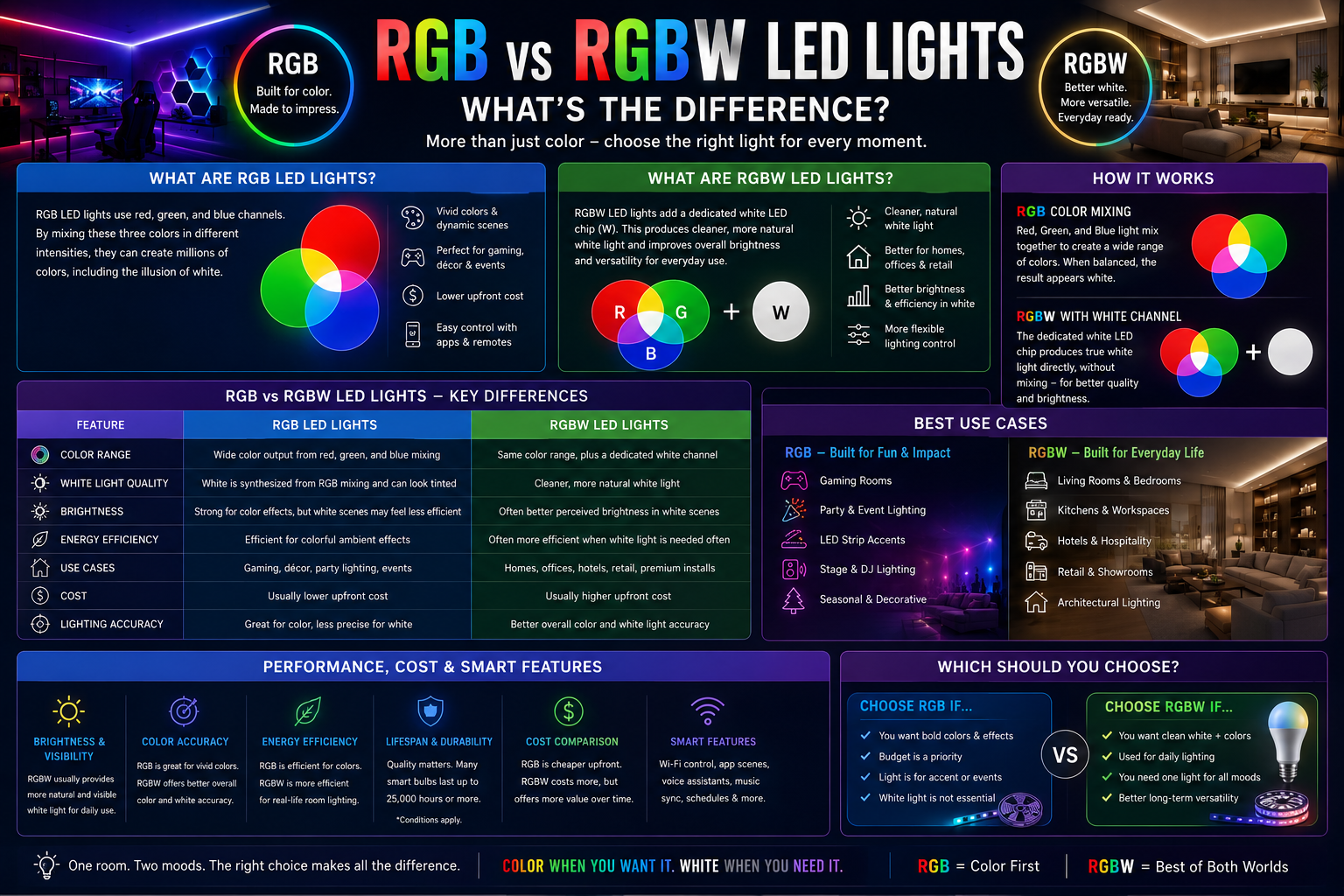
| Feature | RGB LED Lights | RGBW LED Lights |
| Color Range | Wide color output from red, green, and blue mixing | Same color range, plus a dedicated white channel |
| White Light Quality | White is synthesized from RGB mixing and can look tinted | Cleaner, more natural white light |
| Brightness | Strong for color effects, but white scenes may feel less efficient | Often better perceived brightness in white scenes |
| Energy Efficiency | Efficient for colorful ambient effects | Often more efficient when white light is needed often |
| Use Cases | Gaming, décor, party lighting, events | Homes, offices, hotels, retail, premium installs |
| Cost | Usually lower upfront cost | Usually higher upfront cost |
| Lighting Accuracy | Great for color, less precise for white | Better overall color and white light accuracy |
The table above reflects the usual real-world tradeoff. RGB lighting is the simpler, cheaper, color-first option, while RGBW adds versatility by making white light more practical. That is why commercial lighting guides and consumer smart-lighting catalogs often separate “white and color” products from color-only products.
Color range
RGB lights and RGBW lights both offer a huge range of colors because they use additive color mixing. In both cases, the user can push the light toward reds, blues, purples, oranges, or soft pastels. The difference is that RGBW does not have to borrow the RGB channels to produce white, so it can preserve color performance while still giving you a proper white option.
White light quality
This is where RGBW usually pulls ahead. RGB white can look slightly pink, green, or bluish depending on the calibration, while a dedicated white channel usually gives a cleaner result. Signify’s RGBW guidance explicitly separates four-channel RGBW from traditional RGB and associates it with better white light output, and Govee’s RGBICWW products also highlight dual white LEDs as a way to improve brightness and white control.
Brightness
Brightness is not just about raw lumens; it is also about how useful the light feels in the room. A cool white scene often appears brighter than a warm white one because of color temperature and spectral makeup, and a dedicated white channel can help RGBW lights feel more usable for daily lighting. For example, current smart-light products from LIFX advertise bright output and wide warm-to-cool white ranges, showing how modern systems aim to serve both color and functional lighting needs.
Energy efficiency
RGB lights are efficient when you mostly want colors or ambient effects. RGBW can be more efficient in everyday use because the white channel handles white scenes directly instead of forcing the controller to blend three color channels just to imitate white. In commercial lighting, that matters because the system can deliver the right effect with less compromise in white scenes and more flexibility across different environments.
Use cases
RGB lights fit best where the goal is excitement, atmosphere, or visual impact. RGBW lights fit better where the lighting has to switch between playful color and practical white output during the same day. That is why RGB shows up so often in gaming rooms, parties, and décor, while RGBW is more common in homes, offices, hospitality, retail, and architectural lighting.
How RGB and RGBW Technology Works
RGB Color Mixing Explained
RGB lighting uses additive color mixing, which means light is built by blending wavelengths together rather than subtracting them. When red, green, and blue light overlap in the right proportions, the eye perceives a new color. When all three are balanced, the result looks white to human vision, which is why RGB lights can produce a white-like effect even without a dedicated white diode.
This is one of those ideas that feels simple once it clicks. Think of RGB like a three-ingredient recipe: the final dish can be delicious, but it is still not the same as having a fourth ingredient that was made specifically for that flavor. That is exactly why RGBW exists.
Role of White LED in RGBW
The white chip in RGBW is not a gimmick. It gives the system a direct path to produce white light, which improves the look of neutral scenes, work lighting, and general room lighting. Signify’s product guide says the four-channel RGBW option provides beautiful white light and saturated color, which is exactly why RGBW is so common in premium and architectural fixtures.
That also explains the popularity of products that offer both color and white lighting in one fixture. Philips Hue sells “White and color ambiance” bulbs, and Govee’s newer outdoor RGBICWW products highlight dual white LEDs as part of the design. The market is clearly moving toward systems that do both jobs well instead of forcing users to choose only decoration or only illumination.
LED Controllers and Signal Processing
Modern LED controllers decide how much power goes to each channel, and that matters because the controller determines how smoothly a scene shifts from color to white and back again. Good controllers also make app control, remote control, dimming, and scene automation feel natural instead of clunky. Signify’s lighting documentation notes that its luminaires can work with compatible controllers and that newer systems focus heavily on consistency and accuracy across color temperatures.
This is where smart home lighting becomes a real advantage. LIFX and Philips Hue both show current consumer demand for Wi-Fi control, app-based scene creation, schedules, and voice integration with assistants like Alexa and Google Assistant. Some products also support Matter, which makes integration easier across ecosystems.
When Should You Choose RGB LED Lights?
Choose RGB LED lights when your priority is color effects first and everyday white lighting is not the main job. That includes gaming setups, party rooms, seasonal décor, shelf lighting, and event installations where the whole point is to create a scene that feels lively and dramatic. If you are trying to make a room feel like a concert backdrop or a neon lounge, RGB often gives you enough visual punch at a lower cost.
RGB also makes sense when you are working with a tighter budget or a short-term install. If the light is only needed for an event, a themed room, or accent glow behind a screen, the simpler design can be the smarter buy. In that scenario, the extra white channel of RGBW may be nice, but not necessary.
When Should You Choose RGBW LED Lights?
Choose RGBW when the light must do more than look cool. Homes, offices, hotels, retail stores, and architectural spaces often need to shift from colorful accent lighting to proper white illumination, and RGBW handles that transition much better. It is the better choice when you want one system for mood lighting during the evening and practical lighting during the day.
RGBW is also a good fit when color quality and white quality both matter. A product like Philips Hue’s White and color ambiance lineup or LIFX’s color bulbs shows the direction the category has moved: people want expressive color, but they also want usable white light that does not look like an afterthought. That is why RGBW feels more future-proof for many buyers.
Performance, Cost, and Smart Features
Brightness and visibility
In pure color mode, both RGB and RGBW can look strong. But when the room needs a white scene, RGBW usually feels more natural and more visible because the white chip is doing the work directly. Current products from LIFX and Philips Hue reinforce this trend by pairing vivid color with warm-to-cool white ranges and higher brightness targets for everyday room use.
Color accuracy
RGB is excellent for saturated color effects, but its white is still an approximation. RGBW improves accuracy because it gives the controller one more channel to work with, and commercial lighting guides from Signify explicitly link RGBW with better white output and more precise color performance. If you care about clean neutral light, RGBW has the edge.
Energy efficiency
RGB lights are efficient for decorative scenes. RGBW is often more efficient for real-life room use because the white channel reduces the need to simulate white through mixed color output. In a practical sense, that means RGBW may offer better value when the light stays on for longer periods and has to look good in more than one mode.
Lifespan and durability
Most LED systems last a long time, but exact lifespan depends on heat management, drivers, and build quality. Philips Hue notes that some of its smart bulbs are commonly rated at 25,000 hours, and it also explains that real-world lifespan depends on conditions such as temperature and electrical supply. That reminder matters because the chip is only one part of the story; the whole fixture determines durability.
Cost comparison
RGB is usually cheaper upfront because the hardware is simpler. RGBW costs more because it includes another channel and more complex control logic, but that extra cost often buys better white light, more flexibility, and less compromise in everyday use. So the real question is not just “which is cheaper?” It is “which one saves you frustration later?”
Smart features in modern systems
Modern RGB and RGBW products are no longer just light strips with a remote. Current smart lighting systems often include Wi-Fi control, Bluetooth setup, app-based scenes, voice assistants, music sync, schedules, and automation. LIFX highlights Wi-Fi direct, no-hub setup, Alexa and Google Home support, and Matter compatibility, while Philips Hue and Govee continue to build app-first ecosystems around lighting control.
Common Misconceptions
A common myth says RGBW is always better than RGB. Not true. If you only want colorful ambient lighting and you do not care much about white scenes, RGB can be the better value. Another myth says RGB lights cannot produce white light. They can, but it is a mixed white, not a dedicated white output, and that is why it can look less clean.
Some people also think RGB lights are outdated. They are not. RGB is still everywhere because it solves a real need very well: bold, flexible color at a lower cost. On the other hand, RGBW is not only for professionals either. Consumer products from Philips Hue, LIFX, and Govee show that white-channel lighting has become mainstream in smart homes too.
Which Is Better – RGB or RGBW LED Lights?
There is no universal winner in the RGB vs RGBW LED lights debate. RGB is better when you care most about color effects, budget, and simple decorative lighting. RGBW is better when you want a system that can shift into real white lighting without looking artificial. The “best” choice depends on whether your room is meant to entertain, illuminate, or do both.
For gaming rooms, party spaces, and accent installations, RGB is often enough. For bedrooms, living rooms, offices, hospitality spaces, and premium smart homes, RGBW usually offers a better balance of beauty and usefulness. That is the practical rule most buyers can follow without getting lost in technical jargon.
Conclusion
When you compare RGB vs RGBW LED lights, the difference comes down to one extra channel and the flexibility it unlocks. RGB is excellent for vivid color and lower cost, while RGBW gives you cleaner white light, better everyday usability, and often a more polished result in homes and commercial spaces. If your lighting needs are mostly decorative, RGB is a smart buy. If your lighting must also work as real room lighting, RGBW is usually the better long-term choice.
The easiest way to decide is to picture your space at two moments: one when you want a dramatic color scene, and one when you need plain white light. RGBW handles both moments more gracefully, while RGB focuses on the first one. That simple test usually tells you which system fits your home, business, or event best.
Frequently Asked Questions
1. What is the difference between RGB and RGBW LED lights?
RGB lights use red, green, and blue channels to create colors. RGBW lights add a dedicated white channel, which improves white light quality and makes the fixture more versatile.
2. Do RGBW lights produce better white light?
Yes. RGBW lights usually produce cleaner and more natural white light because they do not have to simulate white by mixing red, green, and blue.
3. Are RGB LED lights bright enough for rooms?
They can be bright enough for ambient or decorative room lighting, but they are usually less ideal than RGBW for everyday white room lighting. Products that advertise strong white ranges and higher lumen output tend to be better suited for functional use.
4. Which is more energy efficient, RGB or RGBW?
It depends on how you use them. RGB can be very efficient for color effects, while RGBW can be more efficient when you use the white channel often because it does not need to mix three colors to imitate white.
5. Can RGB lights produce white color?
Yes, but the white is created by blending red, green, and blue together. That can look good, but it is not the same as a dedicated white LED channel.
6. Are RGBW lights worth the extra cost?
They often are if you want one lighting system for both color scenes and real white lighting. If the light is only for decoration, RGB may be the better-value option.
7. Where should I use RGB LED lights?
RGB LED lights work best in gaming setups, party rooms, decorative shelves, accent walls, and event lighting where color effects matter more than task lighting.
8. Which is better for home lighting?
For most homes, RGBW is the more practical choice because it gives you both color and usable white light. For simple accent lighting, RGB is still a solid option.