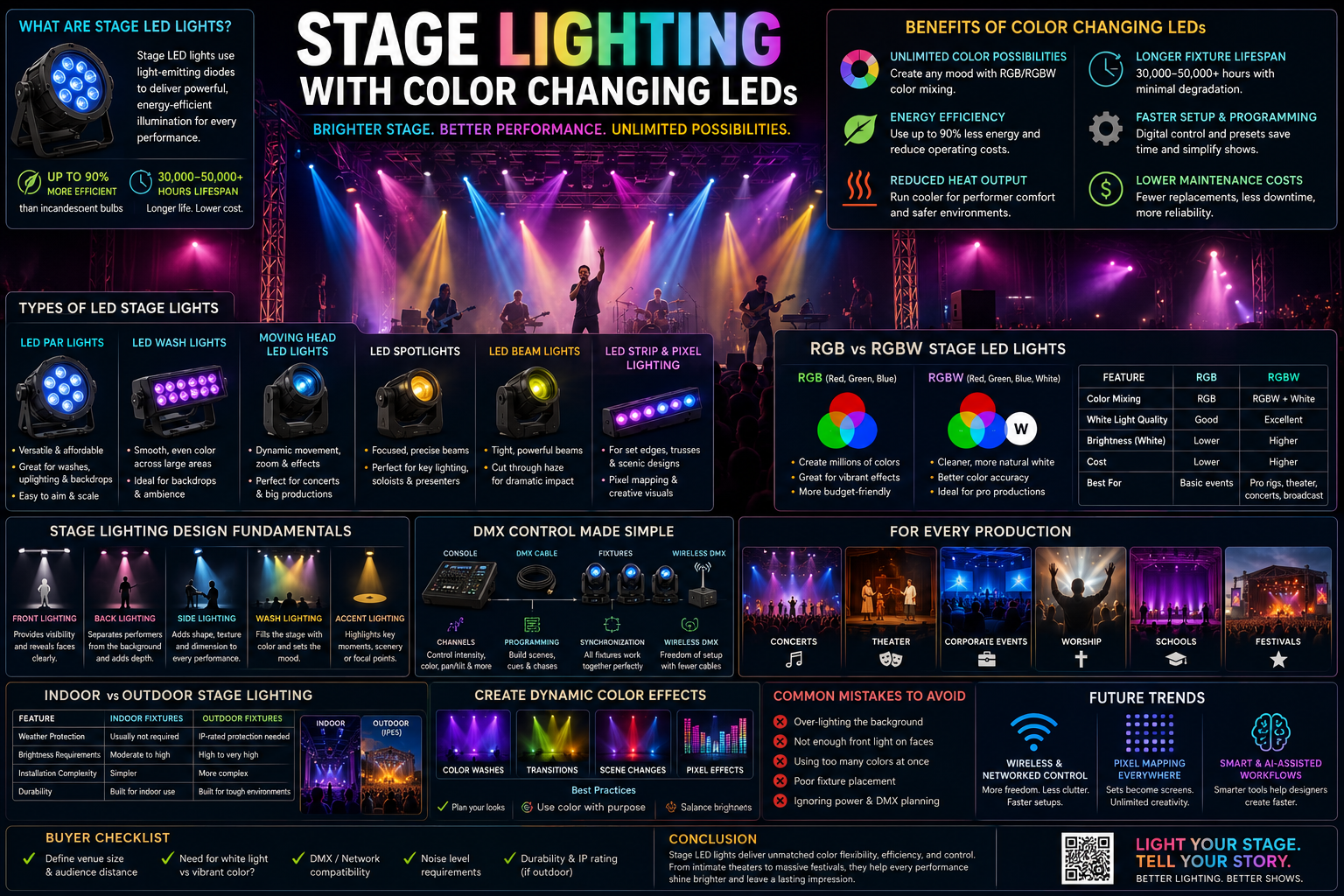
Stage lighting does much more than help people see a performer. It shapes mood, directs attention, hides distractions, and turns a simple platform into a living visual story. That is exactly why stage LED lights have become such a powerful part of concerts, theater, corporate presentations, worship services, and live event lighting. Modern LED fixtures bring color flexibility, lower energy use, reduced heat, and far more creative control than older lamp-based systems. In practice, that means lighting designers can work faster, build richer looks, and spend less time fighting maintenance problems.
Color Changing LED Lights provide flexible and creative lighting for a wide range of applications. From enhancing home interiors to creating stunning stage effects, these lights deliver vibrant colors and smooth transitions. Their energy-efficient design and customizable settings make them a popular choice for events, entertainment venues, and decorative lighting projects.
What Are Stage LED Lights?
Stage LED lights are lighting fixtures that use light-emitting diodes instead of traditional lamps to produce illumination for performance spaces. In the simplest terms, an LED is a semiconductor device that emits light when electricity flows through it, and modern LED lighting products can produce light far more efficiently than incandescent sources. Energy Star notes that LED lighting can be up to 90% more efficient than incandescent bulbs, while the U.S. Department of Energy says good-quality LED products commonly last 30,000 to 50,000 hours or longer. That long life and high efficiency are a big reason LED stage lighting has moved from “new and exciting” to the default choice in many professional rigs.
How Color Changing LED Technology Works
Color changing LED stage lights usually combine red, green, and blue emitters, known as RGB mixing, to create a wide range of colors. ETC explains that the primary colors of light are red, green, and blue, and that mixing them can create white light as well as many other hues. When a fixture adds a dedicated white emitter, it becomes RGBW, which often improves white-light quality and expands practical color control for stage use. That matters because stage lighting is not only about flashy color; it also has to deliver clean faces, natural skin tones, and reliable visibility from the first row to the back wall.
Benefits of Using Color Changing LEDs for Stage Lighting
The biggest advantage of color changing LEDs is creative freedom. Instead of swapping gels or relying on a limited palette, a designer can move through subtle ambers, saturated blues, bright whites, and dramatic reds with a few cues on a console. Chauvet’s professional theater and wash-light pages emphasize that LED fixtures are built for powerful, even fields of light and versatile color work, while ETC’s design guidance shows that color is one of the core controllable properties that helps define mood and information on stage. In real productions, that means one rig can handle a keynote in clean white, a worship set in warm gold, and a concert encore in deep magenta without changing fixtures.
Unlimited Color Possibilities
With RGB stage lighting and RGBW stage lights, color becomes a design material instead of a fixed limitation. A lighting designer can wash the stage in cool cyan for a modern corporate opening, shift to rich purple for a nightclub feel, or build a sunrise look for theater. ETC’s color-focused design articles explain that light color is one of the key controllable properties used to support mood and storytelling, and the same principle is visible in professional RGBW fixtures built for touring, broadcast, and theater. The practical win is simple: more expressive range with fewer physical changes.
Energy Efficiency
LEDs are far more efficient than older stage fixtures that depended on heat-heavy lamp technology. Energy Star states that LED lighting products produce light up to 90% more efficiently than incandescent light bulbs, and the Department of Energy notes that LEDs use up to 90% less energy and last up to 25 times longer than incandescent bulbs. For venues that run rehearsals, load-ins, services, or multi-show schedules, that can translate into a real operating advantage. Less power draw also means less strain on distribution, which is a practical bonus when a production has to scale up quickly.
Reduced Heat Output
Heat is a silent enemy in stage production. Traditional fixtures often raise the temperature of the performance space, make performers uncomfortable, and increase the burden on cooling systems. The Department of Energy says LEDs emit very little heat compared with incandescent sources, which release most of their energy as heat. That matters in theaters, houses of worship, and broadcast sets where people may stand under the lights for long periods and expect comfort as well as visibility.
Longer Fixture Lifespan
Longer life means fewer replacements, fewer interruptions, and lower labor costs. Energy.gov says good-quality LED lighting products are typically rated for 30,000 to 50,000 hours or more, and LED life is not negatively affected by switching them on and off. In a touring rig or a busy venue, that is a huge advantage because fixtures are often used aggressively and expected to keep performing show after show. Over time, the savings are not only about lamps; they are also about labor, downtime, and the cost of climbing ladders to replace worn components.
Faster Setup and Programming
Modern fixtures are designed to work with digital control, preset scenes, and intelligent effects. ETC’s lighting-system guidance explains that a stage lighting system includes fixtures, cabling, power distribution, and a lighting control desk, while its DMX guidance calls DMX512 the most commonly used last-mile data protocol for theatrical control. That makes programming much faster than old-school patch-and-gel workflows because one fixture can store multiple looks, respond to channel changes, and sync with other units. In a live event setting, speed is money, and LED control workflows save both.
Lower Maintenance Costs
Lower maintenance is one of the most overlooked reasons venues switch to LED. Because fixtures run cooler and last longer, they tend to need fewer lamp changes and less downtime. The Department of Energy specifically notes that LED bulbs last substantially longer than incandescent bulbs, reducing labor costs tied to replacement, and professional theater manufacturers repeatedly highlight reduced cost and higher output in their LED product lines. For a venue manager, that means fewer emergency calls and more predictable upkeep budgets.
Types of LED Stage Lights
Different fixtures solve different problems, and the best professional stage lighting rigs usually combine several types rather than relying on one “all-purpose” light. ETC’s stage-lighting series places PARs, profiles, and moving lights among the most common types, while Chauvet and ETC both show how modern LED fixtures are built around specific use cases such as wash, spot, and moving effects. Understanding the strengths of each fixture type helps you avoid overbuying in one category and underbuilding in another.
LED PAR Lights
LED PAR lights are workhorses. They are often used for stage washes, venue uplighting, and background color because they provide straightforward coverage and easy control. ETC’s type guide places PAR fixtures among the fundamental lighting categories, and these units remain popular because they are easy to aim, affordable to scale, and flexible enough for both small and medium productions. If you need broad color fields without a lot of mechanical complexity, a PAR fixture is usually a smart starting point.
LED Wash Lights
LED wash lights are built to cover large areas with smooth, even color. Chauvet describes wash lights as tools for powerful, even fields of light with consistent optics and rugged builds, and many of its RGBW wash fixtures are aimed at touring, theater, and broadcast use. Wash lights are especially useful when you want the stage to feel enveloped in a color rather than hit with a tight beam. They are ideal for backdrops, scenic pieces, and emotional atmosphere.
Moving Head LED Lights
Moving head lights add motion, zoom, and often advanced pixel control. ETC includes moving lights among the core types of stage fixtures, and Chauvet’s moving wash products show how RGBW LEDs, zoom ranges, and pixel mapping can be combined in one unit. These fixtures are the best choice when the production needs motion, aerial effects, fast scene changes, or touring flexibility. The trade-off is higher complexity, which also means more programming skill and a larger budget.
LED Spotlights
LED spotlights are the choice when a performer needs to be isolated and clearly visible. They are often used for key lighting, solo moments, presenters, and special attention cues. In stage design terms, spot fixtures help define focus and keep the audience’s eye exactly where it needs to be. Because they can be more directional than washes, they are especially valuable in theater, broadcast, and spoken-word events.
LED Beam Lights
LED beam lights create tight, high-impact shafts of light that cut through haze and look dramatic in concerts and festivals. They are not always the best choice for general visibility, but they shine when the goal is visual energy and audience excitement. In practice, beam fixtures are often used as one layer in a larger system that also includes wash and front light. That layered approach keeps the show exciting without sacrificing clarity.
LED Strip and Pixel Lighting
LED strip and pixel lighting are ideal for scenic design, set edges, truss dressing, and creative motion graphics. Chauvet’s batten and curve fixtures show how individually controllable LEDs can be used for pixel mapping and dynamic visuals, which adds a lot of production value to otherwise static scenery. This type of lighting works best when you want the set itself to become part of the visual storytelling. The limitation is that pixel effects are not a substitute for proper stage visibility, so they should complement rather than replace key fixtures.
RGB vs RGBW Stage LED Lights
RGB fixtures are simple and effective for many color effects, while RGBW fixtures add a dedicated white emitter for better white-light performance and usually more nuanced mixing. ETC explains that red, green, and blue are the primary colors of light, and Chauvet’s RGBW product pages show how adding a white channel is common in professional fixtures designed for tours, theater, and broadcast. A practical way to think about it is this: RGB is a smaller paint box, while RGBW gives you a cleaner white brush and often a broader range of usable looks.
| Feature | RGB Fixtures | RGBW Fixtures |
| Color Mixing | Mix red, green, and blue to create many colors | Mix red, green, blue, and a dedicated white channel |
| White Light Quality | Can create white, but often less refined | Usually produces cleaner, more natural white output |
| Brightness | Strong color output, but white may be less efficient | Often stronger real-world versatility because of the white emitter |
| Cost | Usually cheaper | Usually more expensive |
| Best Applications | Small events, simple color washes, budget-friendly rigs | Theater, concerts, broadcast, worship, and any rig needing high-quality whites |
In most event settings, RGB is enough when the goal is simple, saturated color. RGBW becomes the better choice when you need both bold color and convincing white light for faces, speeches, or camera work. That is why many professional wash fixtures and touring products now lean toward RGBW designs.
Stage Lighting Design Fundamentals
A strong lighting design is built in layers, not in one single blast of light. ETC’s design articles consistently describe front light as the starting point for visibility, then side and back light as the tools that give shape and depth. When those layers are balanced with color and intensity control, the stage starts to feel dimensional instead of flat. That is the difference between lighting that merely functions and lighting that tells a story.
Front Lighting
Front lighting is the audience’s clearest view of the performer. ETC recommends starting with the lights that provide visibility, and front light is the layer that helps faces read cleanly and evenly. Without enough front light, even the most colorful rig can leave expressions hidden in shadow. The best rigs use front light as support, not as a blunt instrument that washes away all texture.
Back Lighting
Back lighting helps separate the performer from the background. ETC defines back light as light shone from behind to push the subject out of the background and define form. In concerts and theater alike, this is one of the easiest ways to make a stage look deeper and more cinematic. It also adds a natural edge glow that helps silhouettes read in larger rooms.
Side Lighting
Side lighting creates shape, dimension, and texture. ETC and Chauvet both emphasize side positions as essential in stage design because they reveal the body and preserve movement. This is especially important for dance, physical theater, and worship environments where body language matters as much as facial expression. Side light can be the difference between a performer looking flat and looking sculpted.
Wash Lighting
Wash lighting fills the stage with color or neutral illumination. Chauvet describes wash lights as fixtures that create powerful, even fields of light, and their RGBW wash products are built exactly for that purpose. Wash lighting is where color changing LEDs shine brightest because you can move from one emotional tone to another without touching a gel frame. Used well, wash light makes the whole stage feel intentional.
Accent Lighting
Accent lighting draws attention to a set piece, logo, lectern, or performer moment. It is the spotlight in the sentence, the underline in the paragraph. In professional rigs, accents help reinforce storytelling by giving the eye a target inside the larger composition. Even when the room is full of color, a strong accent keeps the visual language readable.
Stage Lighting for Different Types of Productions
Different events demand different balances of brightness, control, and color expression. ETC’s theater and educational lighting pages, along with Chauvet’s stage-specific solutions, show that a school stage, a touring concert, and a house of worship all need very different fixture choices. The smartest approach is to match the fixture mix to the room’s purpose instead of chasing the most dramatic-looking light on paper.
Concerts, Theater, Corporate Events, Worship, Schools, and Festivals
For concert stage lighting, moving heads, pixel effects, and bright wash fixtures create energy and motion. For theater, you usually want cleaner front light, quiet operation, precise control, and strong color rendering for skin tones and costumes. Corporate events tend to need crisp white key light with just enough color to support branding, while worship spaces often want flexible looks that can shift from teaching to music without making the room feel harsh. Schools and festivals usually benefit from fixtures that are durable, simple to operate, and flexible enough to serve multiple uses across the year.
Understanding DMX Control for Stage LED Lights
ETC describes DMX512 as the most commonly used last-mile data protocol for theatrical control, and that is why almost every professional LED rig depends on it in some form. DMX lets a console control intensity, color, movement, and effects across many fixtures with repeatable precision. Once you understand the basics, it stops feeling like mysterious “light magic” and starts feeling like a very organized language for communication between the console and the rig.
Channels, Programming, Synchronization, and Wireless DMX
Each fixture uses a set number of DMX channels depending on what it controls, and more advanced fixtures require more channels because they handle more functions. ETC’s training and control pages show that even small systems can support many channels and multiple universes, while wireless DMX systems such as LumenRadio’s CRMX are widely used when cable runs become difficult or impossible. In a practical show environment, DMX programming lets you build cues, synchronize fixtures, and recall looks instantly, which is exactly what makes live production feel polished rather than improvised.
How to Create Dynamic Color Effects and Avoid Common Mistakes
Color effects work best when they are intentional. ETC’s lighting-design series stresses that the designer should begin with visibility, then add shape, color, and mood, which is a useful reminder that effects are not the same as design. A stage washed in every color at once can feel noisy and confusing, while a carefully timed transition can feel like a scene change in music form. The goal is to guide emotion, not overwhelm the audience.
Color Washes, Transitions, Scene Changes, and Best Practices
Use color washes to create atmosphere, transitions to shift emotional temperature, scene changes to support storytelling, and synchronized effects to underline musical hits or spoken beats. Chauvet’s pixel-mapping fixtures and ETC’s color guidance show how modern LED systems can move from subtle ambience to animated motion in the same production. The most common mistake is treating color as decoration instead of communication. Another common mistake is forgetting audience sightlines, front-light balance, and power planning, which can make even expensive fixtures look amateurish.
Future Trends, Choosing Fixtures, Conclusion, and FAQs
The next wave of LED stage lighting is about smarter control, more flexible deployment, and better integration across the whole production system. Wireless DMX is expanding because it reduces cable clutter and setup time, and product lines such as LumenRadio’s CRMX and outdoor wireless systems show how reliable wireless control has become in demanding environments. Chauvet and ETC also continue to push intelligent, high-output LED fixtures, lighter moving heads, and products built for faster production workflows. The trend line is clear: more control, fewer barriers, and more creative possibility.
Choosing the Best Stage LED Lights
The best fixture choice always starts with the room. Venue size, brightness output, color accuracy, DMX compatibility, durability, and budget all matter, but they do not matter equally in every situation. ETC’s educational guides and theater-focused product pages consistently show that smaller venues often need simplicity and low noise, while larger events need output, zoom, and flexibility. A smart buyer also thinks about how the rig will be used over the next few years, not just whether it looks good on the first installation day.
Practical Buyer Checklist
A useful buying checklist looks like this: first, define the room size and the viewing distance; second, decide whether you need white-light quality, saturated color, or both; third, confirm DMX or network control compatibility; fourth, check whether the fixture is quiet enough for theater or worship; fifth, verify ruggedness and IP rating if the lights will face outdoor or touring conditions. Chauvet’s IP65-rated RGBW wash fixtures and ETC’s compact control solutions show how different use cases call for different build styles. Choosing well is less about chasing the newest feature and more about matching the fixture to the job.
Indoor vs Outdoor Stage LED Lighting
| Feature | Indoor Fixtures | Outdoor Fixtures |
| Weather Protection | Usually not required | Often needs IP-rated protection |
| Brightness Requirements | Moderate to high, depending on room | Typically higher to fight ambient light |
| Installation Complexity | Usually simpler | Often more complex because of weather and power routing |
| Durability | Built for repeated indoor use | Built for tougher environmental exposure |
Outdoor production adds a new layer of planning because weather, moisture, and transport all increase risk. Chauvet’s IP65-rated products and LumenRadio’s outdoor wireless solutions show how outdoor-ready systems are built to keep performing in harsher conditions. Indoor rigs can be more focused on beam control, silence, and color quality, while outdoor rigs need ruggedness and visibility under changing conditions.
Common Stage Lighting Mistakes to Avoid
One of the biggest mistakes is under-lighting the faces and over-lighting the background. Another is using too many colors at once and turning a clear design into visual static. A third mistake is poor fixture placement, especially when lights flatten performers or create unwanted glare in the audience’s sightline. ETC’s planning guides repeatedly emphasize starting with visibility, then adding side and back light, which is a good reminder that the best designs are layered, not random. Power planning and DMX planning matter too, because a beautiful design that cannot be controlled reliably is not truly professional.
Future Trends in LED Stage Lighting
Smart lighting systems are becoming more connected, more automated, and easier to integrate into broader show networks. Wireless DMX is already mainstream in many production environments, and pixel mapping is now common in fixtures designed for touring and event production. As for AI-assisted programming, the trend is still emerging rather than settled, but industry voices are openly discussing how AI could eventually support video mapping, camera switching, and even lighting direction. The likely future is not a robot replacing the designer; it is a smarter toolkit that helps the designer build faster and experiment more freely.
Conclusion
Stage LED lights have changed modern production because they combine color flexibility, energy efficiency, lower heat, longer life, and stronger creative control in one system. Whether you are building concert stage lighting, refining theater LED lighting, or upgrading live event lighting for corporate use, the right LED fixtures make the entire experience sharper and easier to manage. The real advantage is not just brightness; it is the ability to shape emotion, support storytelling, and save time every time the lights come up. If the goal is to improve both performance quality and operating efficiency, LED stage lighting is hard to beat.
Frequently Asked Questions
1) What are stage LED lights?
Stage LED lights are performance lighting fixtures that use light-emitting diodes to produce visible light for concerts, theater, worship, schools, corporate events, and other live productions. They are popular because they are efficient, cool-running, and easy to control.
2) Why are LED lights used in stage productions?
They are used because they offer fast color changes, lower power use, reduced heat, and long operating life. That makes them more flexible and more economical than many older lighting systems.
3) What is the difference between RGB and RGBW stage lights?
RGB fixtures mix red, green, and blue light, while RGBW fixtures add a dedicated white emitter. RGBW is often better when you need cleaner white light and more refined overall mixing.
4) What is DMX lighting control?
DMX512 is the common digital control standard used to communicate with stage fixtures, dimmers, and intelligent lights. It lets one console manage intensity, color, motion, and effects across a whole rig.
5) Can stage LED lights be used outdoors?
Yes, but outdoor use usually requires weather-rated fixtures, stronger brightness, and more careful cabling and control planning. IP65-rated fixtures are a common solution for outdoor stage and event work.
6) How long do stage LED lights last?
Good-quality LED lighting products often last 30,000 to 50,000 hours or more, depending on the fixture and conditions. LEDs also tolerate frequent switching better than many older lamp types.
7) What are LED PAR lights used for?
LED PAR lights are commonly used for stage washes, uplighting, and broad color coverage. They are one of the most versatile and accessible fixture types in event production.
8) What are the best stage LED lights for concerts?
Concerts usually benefit from moving heads, RGBW wash lights, beam fixtures, and pixel-capable battens or curves. The best choice depends on the size of the venue, the show style, and how much motion and color animation the production needs.
9) How many stage lights are needed for a performance?
There is no single number because it depends on stage size, audience distance, and the kind of show you are lighting. ETC’s design guidance suggests thinking in lighting zones and layering front, side, and back light rather than counting fixtures alone.
10) What is the biggest advantage of color changing LEDs?
The biggest advantage is creative flexibility. A single fixture can shift from subtle white light to saturated color, which helps one rig support many different moods and event types.