Color changing LED lighting has moved far beyond simple party effects. Today, it is a practical design tool for homes, offices, retail spaces, and entertainment setups, which is exactly why the best color changing LED lights are chosen so carefully. ENERGY STAR notes that LED lighting products can produce light up to 90% more efficiently than incandescent bulbs, and its guidance also emphasizes comparing lumens rather than watts when judging brightness.
That is the real reason this buying guide matters. The wrong choice can leave you with weak color output, bad white light, poor control options, or an installation that becomes more trouble than it is worth. A good LED setup should match your purpose, your room size, your control preferences, and your budget, while still giving you the flexibility to change the mood like a lighting chameleon. For color-tunable products, the U.S. Department of Energy also recommends checking CRI near the lowest dimming setting and treating 80 CRI as a useful rule of thumb when color quality matters.
Curious about how modern lighting creates dynamic colors and smart experiences? Explore our complete Color Changing LED Lights Guide to learn about RGB and RGBW technology, smart controls, installation methods, and practical applications across homes, events, retail, and commercial environments.
Why Choosing the Right Color Changing LED Lights Matters
Choosing the right color changing LED lights is not just about picking the prettiest packaging. Performance differences can be huge from one product to another, especially when you compare brightness, color accuracy, dimming smoothness, and control stability. ENERGY STAR explains that certified bulbs deliver the same amount of light with fewer watts, and its labeling guidance encourages shoppers to compare the lumen rating because that is the real brightness number.
Long-term value also matters. A cheap light that looks great on day one can become a headache if it flickers, loses color quality, or cannot connect properly to your smart home system. The best buying decision usually saves money over time because it reduces replacements, lowers energy use, and gives you a better daily experience. Think of it like buying shoes: the pair that looks flashy in the store is not always the pair that will still feel good after a long walk.
Determine Your Lighting Purpose First
Before comparing brands or features, decide what the lights are actually for. The smartest shoppers start with the use case, because lighting for a bedroom, a retail display, and a stage show are completely different animals. A soft ambient glow in a home does not need the same power, durability, or control flexibility as a fixture built for an event rig. That is why purpose should drive the purchase, not the other way around.
Home Lighting
For homes, the goal is usually comfort, style, and convenience. Bedrooms often benefit from softer tones and gentle automation, while living rooms may need a balance of accent lighting and everyday brightness. Kitchens usually call for more functional light, and home theaters need lighting that can create atmosphere without washing out the screen. In practice, homeowners often get the best results from smart bulbs, LED strips, or compact panels that can shift from everyday white light to vivid accent colors when needed.
Commercial Lighting
Commercial spaces need lighting that supports the brand and improves the customer experience. Offices may want subtle scene changes for focus and relaxation, while retail stores often use color to highlight displays and create a stronger visual identity. Hotels and restaurants usually care about mood as much as brightness, because lighting is part of the atmosphere people remember. In these settings, reliability and control matter as much as color options, because a beautiful light that fails during service is not really a good business tool.
Event and Entertainment Lighting
Weddings, concerts, DJ sets, and stage productions need a very different kind of lighting behavior. Here, the light is part of the performance, so you want stronger output, richer effects, and tighter control over timing and transitions. Event lighting often needs more advanced DMX-style control, stronger mounting options, and better durability than a simple home strip. If the lighting is supposed to move with the music or support a show cue, you should think like a lighting designer rather than a shopper.
Understand the Different Types of Color Changing LED Lights
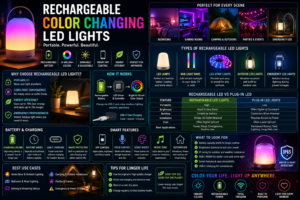
Not all RGB LED lights are built the same way. Some are designed for accent lighting, some for main-room illumination, and some for dynamic entertainment effects. Super Bright LEDs’ current guidance shows that color-changing strip lights commonly include RGB, RGBW, RGB + tunable white, and even app-controlled options using Bluetooth or Wi-Fi controllers. That means the category is broad, and the best choice depends on where and how you plan to use it.
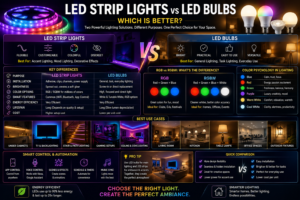
LED Strip Lights
LED strip lights are the flexible all-rounders of the color lighting world. They are ideal for under-cabinet accent lighting, TV backlighting, cove lighting, shelves, bars, and creative architectural edges. Their biggest strength is flexibility, because they can follow curves, hide in tight spaces, and create long clean lines of light. Their limitation is that they are usually best at accent or decorative lighting unless you choose a higher-output model designed for stronger illumination.
Smart LED Bulbs
Smart bulbs are the easiest path for people who want color control without a complicated installation. They fit into standard lamp sockets and are excellent for bedrooms, living areas, and simple smart home setups. Philips Hue notes that its smart lights can communicate through Bluetooth or Zigbee, and that Bluetooth can be enough for small setups while a bridge unlocks more advanced control and automation.
LED Light Panels
LED panels work well when you want a modern design statement. They are often used in gaming rooms, creative spaces, and decorative walls where geometric light patterns matter just as much as brightness. Compared with strips, they usually deliver a more structured and polished look. Their downside is that they can be less flexible in placement, and they often cost more than basic strip or bulb options.
Outdoor RGB Lights
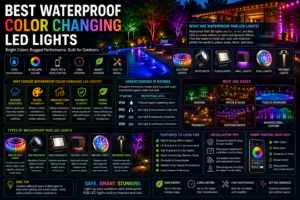
Outdoor RGB lights are built for weather exposure, landscaping, patios, fences, and building facades. Their key advantage is durability, but that durability should never be guessed; it should be backed by a proper ingress-protection rating. Outdoor products need to handle moisture, dust, and temperature swings much better than indoor lights, so they are the right choice whenever the installation sits outside or in a damp environment.
Professional Event Lighting Fixtures
Professional fixtures are the heavy hitters. They are built for larger venues, live productions, and situations where the lighting has to be seen from a distance and synchronized with other equipment. These products usually offer stronger output, richer effects, and more advanced control options. The tradeoff is cost and complexity, so they make sense when the lighting is part of a serious production, not just a room upgrade.
RGB vs RGBW – Which One Should You Choose?
This is one of the most important decisions in any LED light buying guide. RGB lights use red, green, and blue diodes to mix colors, while RGBW systems add a dedicated white channel for better white light performance. Super Bright LEDs notes that RGB strips do not create a pure white the way products with separate white emitters can, which is why RGBW is often the better pick when you want both color effects and usable white light.
| Feature | RGB | RGBW |
| Color Effects | Strong, vibrant color mixing | Strong, vibrant color mixing |
| White Light Quality | Mixed white, usually less natural | Dedicated white channel, better quality |
| Brightness | Good for effects and accenting | Often better for everyday lighting |
| Cost | Usually cheaper | Usually more expensive |
| Best Use Cases | Gaming rooms, accent strips, effects | Homes, offices, spaces needing color + real white |
If you mainly want dramatic color scenes, RGB is often enough. If you want one system that can handle movie night, cleaning light, and a colorful evening mood, RGBW is usually the smarter buy. In other words, RGB is the paint set, while RGBW is the paint set plus a proper white brush.
Consider Brightness and Light Output
Brightness is where many buyers make their first mistake. A light can advertise beautiful colors and still feel disappointing if it does not produce enough visible output for the room. ENERGY STAR’s guidance is clear here: lumens show the amount of light output, and a 60W incandescent replacement is typically around 800 lumens or more. That is a useful reference point when you compare products, because watts alone do not tell the real story.
Here is the practical way to think about it. Small rooms or accent zones may only need a modest strip or a pair of bulbs. Medium rooms often need a stronger multi-source setup so the light does not feel patchy. Large spaces and outdoor areas usually need higher-output products, longer runs, or multiple fixtures spread strategically across the area. For commercial settings, brightness also has to support the business function, not just the mood, so a restaurant corner and a hotel lobby should never be treated the same way.
The smartest approach is to separate accent lighting from primary lighting. Accent light creates atmosphere, while primary light handles daily visibility. When you try to make one low-output color strip do both jobs, disappointment usually follows fast.
Smart Features to Look For
Smart features can turn good lighting into a genuinely useful system. Philips Hue states that smart lights may communicate via Bluetooth or Zigbee, and that a bridge or hub can unlock remote access, automations, and entertainment sync that Bluetooth alone cannot provide. LEDVANCE also shows how voice assistants, smartphone apps, and Wi-Fi or Bluetooth Mesh can be used to control lighting in modern smart setups.
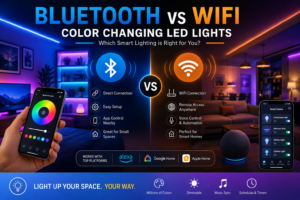
WiFi Connectivity
Wi-Fi lights are a strong choice when you want to control the system from anywhere in your home network or through cloud-based smart home features. They are useful for users who want more advanced control without relying on a simple local connection. In many cases, Wi-Fi products feel like the “full-fat” version of smart lighting because they are built for broader automation and remote access.
Bluetooth Connectivity
Bluetooth is ideal for smaller installations and simpler setups. Philips Hue says Bluetooth is enough to get started with small lighting setups, which makes it a friendly option for apartments, single rooms, or people who are testing smart lights for the first time. The upside is simplicity; the downside is range and fewer advanced features.
Voice Control
Voice control is one of the best convenience upgrades you can buy. LEDVANCE’s current guidance shows support for popular assistants such as Amazon Alexa, Google Home, and Apple Home, which means the lights can become part of a hands-free routine. That matters more than people expect, because once you get used to saying “dim the lights” or “set evening mode,” going back feels oddly primitive.
Mobile App Control
App control gives you the easiest way to manage scenes, brightness, and colors from your phone. It is especially useful when you want to save presets for bedtime, work, entertainment, or special events. A good app should feel intuitive rather than cluttered, and it should make scene changes fast enough that the system feels responsive instead of fussy.
Scheduling and Automation
Scheduling is where smart lighting starts paying you back in daily life. Instead of manually adjusting the lights every evening, you can automate them for wake-up routines, bedtime scenes, work hours, or security presence when you are away. Philips Hue notes that its Bridge adds automations and routines, which is exactly the kind of feature that makes a lighting setup feel polished rather than basic.
Music Sync Features
Music sync is mostly about entertainment, but it is a fun one. It is especially useful in gaming rooms, event spaces, and home theaters where the lighting is supposed to react with the mood. Philips Hue also notes that its Bridge unlocks entertainment sync for music, movies, and games, which is a good example of why advanced systems cost more.
Indoor vs Outdoor Color Changing LED Lights
Indoor and outdoor lights should never be treated as interchangeable. Outdoor products need protection against moisture and dust, and the IEC explains that IP ratings are the standard way to describe an enclosure’s resistance to ingress from solid objects and water. NEMA’s 2025 publication also explains that the IP code uses the first numeral for solid-particle protection and the second numeral for liquid ingress protection.
| Feature | Indoor LED Lights | Outdoor LED Lights |
| Weather Resistance | Usually not weatherproof | Built for rain, dust, and exposure |
| IP Rating Need | Often lower or none | Important for safety and durability |
| Installation | Easier, simpler | More careful sealing and mounting |
| Durability | Designed for protected spaces | Designed for tougher environments |
| Best Use Cases | Bedrooms, lounges, offices | Patios, facades, gardens, signage |
For outdoor installs, do not just chase the highest number on the box. Think about where water can collect, where sunlight will hit, and how the cable path will be protected. A good outdoor light that is installed badly can still fail early, while a modest product installed carefully can work beautifully for years.
Power Supply and Voltage Considerations
Power compatibility is not glamorous, but it is essential. Super Bright LEDs states that 12V LED strip lights require a 12V power supply and 24V strips require a 24V power supply, and that matching voltage is critical to avoid damage or underperformance. Their guidance also notes that 24V systems are generally better for longer runs because they reduce voltage drop and help maintain even brightness.
The practical rule is simple: match the strip voltage, check the total wattage, and make sure the supply can handle the run length. A power supply also converts household AC into the lower DC voltage the strip needs, which is why the right adapter matters so much. If you are planning a long installation, treat voltage drop like a silent thief that steals brightness the farther light has to travel.
Installation Requirements
Installation difficulty can make or break your buying decision. Some smart LED lights are truly DIY-friendly and can be set up in minutes, while others need careful wiring, mounting, controllers, and sometimes professional help. If you are using strip lights, think about surface prep, cable routing, and where the controller will live, because a tidy install looks better and is easier to maintain.
DIY-Friendly Options
Smart bulbs and plug-and-play LED strips are the easiest paths for beginners. They are ideal when you want a quick upgrade without modifying electrical infrastructure. These options are perfect for renters, small rooms, and first-time buyers who want a fast win rather than a weekend project.
Professional Installation Systems
Larger commercial setups, outdoor facades, and event lighting rigs often justify professional installation. The reason is simple: more power, more wiring, more control hardware, and more points of failure. A professional install tends to pay off when the system is permanent or when appearance and safety are critical.
Mounting Methods
Adhesive backing works well for clean indoor surfaces, but it is not magic. Outdoor and long-term installs usually benefit from clips, channels, or more secure mounting methods. The better the mounting, the less likely the system is to sag, peel, or fail at the edges.
Controller Placement
Controller placement matters because it affects access, maintenance, and signal reliability. Keep the controller where it is protected but still reachable. If the controller is buried behind furniture, inside a tight cavity, or exposed to weather when it should not be, you are creating avoidable problems.
Energy Efficiency and Lifespan
LED lighting is popular for a reason. ENERGY STAR says LED products can be up to 90% more efficient than incandescent bulbs, and its bulb guidance notes that shoppers should look at lumens, estimated operating cost, and how long the bulb should last. That combination of lower energy use and longer service life is why LEDs are so attractive for homes and businesses alike.
The environmental upside is just as important. Lower energy use means less wasted electricity, which supports lower operating costs and a lighter footprint over time. Maintenance also becomes simpler because quality LEDs usually need replacement less often than older lighting technologies. For busy households and commercial spaces, that reduced maintenance can be as valuable as the electricity savings.
Budget Considerations
Price matters, but value matters more. A budget-friendly light may work perfectly for accent color and casual use, while premium systems justify their cost with better app control, stronger build quality, and richer scene options. The best choice depends on whether you are lighting one room, one business area, or an entire property.
| Budget Tier | What to Expect | Best For |
| Budget-Friendly | Basic color effects, simpler controls, fewer extras | Dorms, casual accent lighting, starter setups |
| Mid-Range | Better brightness, more reliable apps, better white output | Homes, small businesses, better everyday use |
| Premium Smart Systems | Advanced automation, stronger ecosystem support, better control and sync | Whole-home smart lighting, commercial spaces, entertainment setups |
When you are comparing products, ask a simple question: does this light solve my actual problem, or is it just cheap? Sometimes spending a little more once is better than buying twice.
Common Mistakes to Avoid When Buying Color Changing LED Lights
The biggest mistake is assuming all color lights are equal. They are not. Many buyers ignore brightness, buy indoor products for outdoor spaces, choose the wrong voltage, or forget that one smart ecosystem may not play nicely with another. Another common error is focusing only on price and ignoring build quality, because a low-cost light that fails quickly is not a bargain.
A smarter approach is to read the specs like a detective. Check lumens, voltage, control method, IP rating, and supported features before you buy. If you do not know what the product is designed to do, that is usually a warning sign that the product may not be the right fit.
Buyer’s Checklist for Choosing the Best Color Changing LED Lights
Use this checklist before you make the purchase:
- Decide whether the light is for home, commercial, or event use.
- Confirm whether it will be used indoors or outdoors.
- Choose RGB if you mainly want effects, or RGBW if you want better white light too.
- Check lumens instead of relying on watts alone.
- Confirm the control method: Wi-Fi, Bluetooth, app, voice, or remote.
- Make sure the power supply matches the strip voltage.
- Check the IP rating for outdoor or damp environments.
- Review mounting and installation requirements.
- Compare warranty coverage and brand reputation.
- Decide your budget based on value, not just price.
If a product checks all ten boxes, you are probably close to the right choice.
Conclusion
The best color changing LED lights are the ones that match your purpose, brightness needs, control preferences, and installation environment. For simple room accents, a basic RGB strip or smart bulb may be all you need. For everyday lighting with better white performance, RGBW is often the stronger choice. For outdoor, commercial, or entertainment use, durability, power matching, and smart control become even more important. ENERGY STAR and the U.S. Department of Energy both make the core lesson clear: compare lumens, pay attention to color quality, and choose a system that fits the job instead of just the look.
The smartest purchase is the one that still feels right after the novelty wears off. Compare the specs, check the control options, and choose a light that makes your space easier to live in, not harder.
Frequently Asked Questions
1. What are the best color changing LED lights?
The best option depends on where you will use them. For simple accent lighting, LED strips are often the easiest choice. For everyday room lighting, smart RGBW bulbs or strips usually offer better flexibility.
2. Should I choose RGB or RGBW lights?
Choose RGB if you mainly want vivid colors and effects. Choose RGBW if you want better white light for daily use, because RGBW adds a dedicated white channel.
3. How bright should color changing LED lights be?
Brightness is measured in lumens, not watts. ENERGY STAR notes that a 60W incandescent replacement is generally around 800 lumens or more, which is a useful starting point for comparison.
4. Can color changing LED lights be used outdoors?
Yes, but only if the product is rated for outdoor use. The IP code is the standard way to show protection against dust and water, so check that rating before buying.
5. Are Bluetooth smart lights worth it?
Yes, especially for smaller spaces. Philips Hue says Bluetooth is enough for small setups, while a bridge becomes useful when you want more advanced control and automation.