Bedroom lighting does a lot more than help you see at night. It shapes how your room feels, how easily you relax, and even how smoothly you move from an active day into a calmer evening. That is why bedroom LED lights and mood lighting have become such a big part of modern home design. With the right color changing LED lights, you can turn a plain bedroom into a softer, more flexible space that works for reading, winding down, sleeping, or just creating a look you actually enjoy. Smart bedroom lighting is especially popular now because it lets people fine-tune color, brightness, schedules, and scenes from a phone or voice assistant.
The best part is that this is not just about style. Research on light and sleep consistently points toward the value of lower, warmer light in the evening, while brighter and cooler light is better for tasks that need focus. That means the right LED mood lights can support both comfort and function when you choose them wisely. In other words, bedroom lighting should not feel like a harsh overhead spotlight in a hotel hallway. It should feel more like a dimmer on a fireplace: adjustable, calming, and easy to live with.
Discover the full potential of intelligent lighting in our Color Changing LED Lights Guide, featuring everything from color-changing technology and WiFi controls to setup advice, automation features, and real-world use cases for residential and commercial spaces.
Why Color Changing LED Lights Are Perfect for Bedrooms
Color changing LEDs fit bedrooms so well because they give you control over atmosphere. You are not locked into one fixed look all day long. In the morning, a brighter white setting can help your room feel awake and functional. At night, the same lights can shift to a warm amber or soft red tone that feels more relaxed and intimate. That flexibility matters in bedrooms, where one space often has to serve as a sleep zone, a reading nook, a dressing area, and sometimes even a work corner. LED lighting products also produce light up to 90% more efficiently than incandescent bulbs, which makes them a practical choice for people who like to leave accent lighting on for longer periods.
They also help with design in a way that feels almost like changing the mood of a room with one simple switch. Put LED strips behind a headboard, add an RGB floor lamp in a corner, and suddenly the bedroom feels layered instead of flat. That layered look is what makes ambient lighting feel so inviting. And because LEDs typically last longer through gradual lumen depreciation rather than sudden burnout, they are a convenient option for bedroom fixtures that you do not want to keep replacing. If you want a room that feels calmer without constantly changing furniture or paint, light is the fastest design tool you have.
What to Look for in Bedroom LED Lights
Choosing the right bedroom lighting ideas starts with understanding how the light will actually behave in real life. The first thing to look at is brightness, usually measured in lumens. The U.S. Department of Energy recommends comparing lumens when shopping, because lumens tell you how bright a bulb really is rather than how much power it uses. For a bedroom, that matters a lot. Too much brightness can make the room feel alert when you want it calm, while too little brightness can make everyday tasks frustrating. A good bedroom setup usually combines softer ambient light with focused reading light instead of relying on one overly bright source.
Brightness Levels
Brightness should match the job, not just the room. A ceiling light might need enough output to clean or organize the room, while bedside lighting should feel much gentler. If your lights are too intense, the bedroom stops feeling restful and starts feeling like an office. For that reason, dimmable options are especially helpful. They let you keep one light source for multiple moods, which is exactly what you want in a room that changes from day mode to night mode.
Color Accuracy
Color accuracy matters more than people think. If a light renders colors poorly, your bedding, wall paint, and decor can look dull or strange. A light source with better color quality gives your room a cleaner, more natural look, especially if you use neutral white or decorative color scenes. In a bedroom, this is useful when you want your lighting to support both appearance and practical tasks like dressing or makeup. Good color rendering is one of those features you barely notice when it is excellent, but you notice it immediately when it is bad.
Dimming Features
Dimming is almost non-negotiable for relaxing bedroom lighting. A light that only has on and off feels too rigid for a bedroom, while a dimmable LED can shift with your routine. Many smart bulbs and tunable fixtures are designed for warm-to-cool control or dim-to-warm behavior, which makes them especially useful in spaces where you want softer light late at night. The general rule is simple: the closer you get to sleep time, the softer the light should become. That makes dimming one of the easiest ways to make cozy bedroom lighting feel intentional rather than accidental.
Smart Controls
Smart controls add convenience, but they also add consistency. Once you create a scene for reading, relaxing, or sleeping, you do not have to rebuild the setup every night. That is why app control, voice control, scheduling, and routines are so useful. Matter is now described by Google as the industry standard for smart homes because it simplifies setup and connectivity, while Apple and Amazon both support Matter-based lights in their ecosystems. In practical terms, that means your smart bedroom lighting can be easier to manage across devices and platforms than it used to be.
Installation Options
Installation is where many buyers either love their lights or regret the purchase. Strip lights are ideal if you want hidden glow behind a bed frame or along a ceiling edge, while bulbs are better when you already have a lamp or fixture you like. Most strip-light guides recommend measuring the installation area first and keeping the mounting surface clean and dry so the adhesive sticks properly. For longer or more customized installs, manufacturers also discuss joining sections with wires or soldering. That makes planning important, because the best light in the world still looks messy if the installation is rushed.
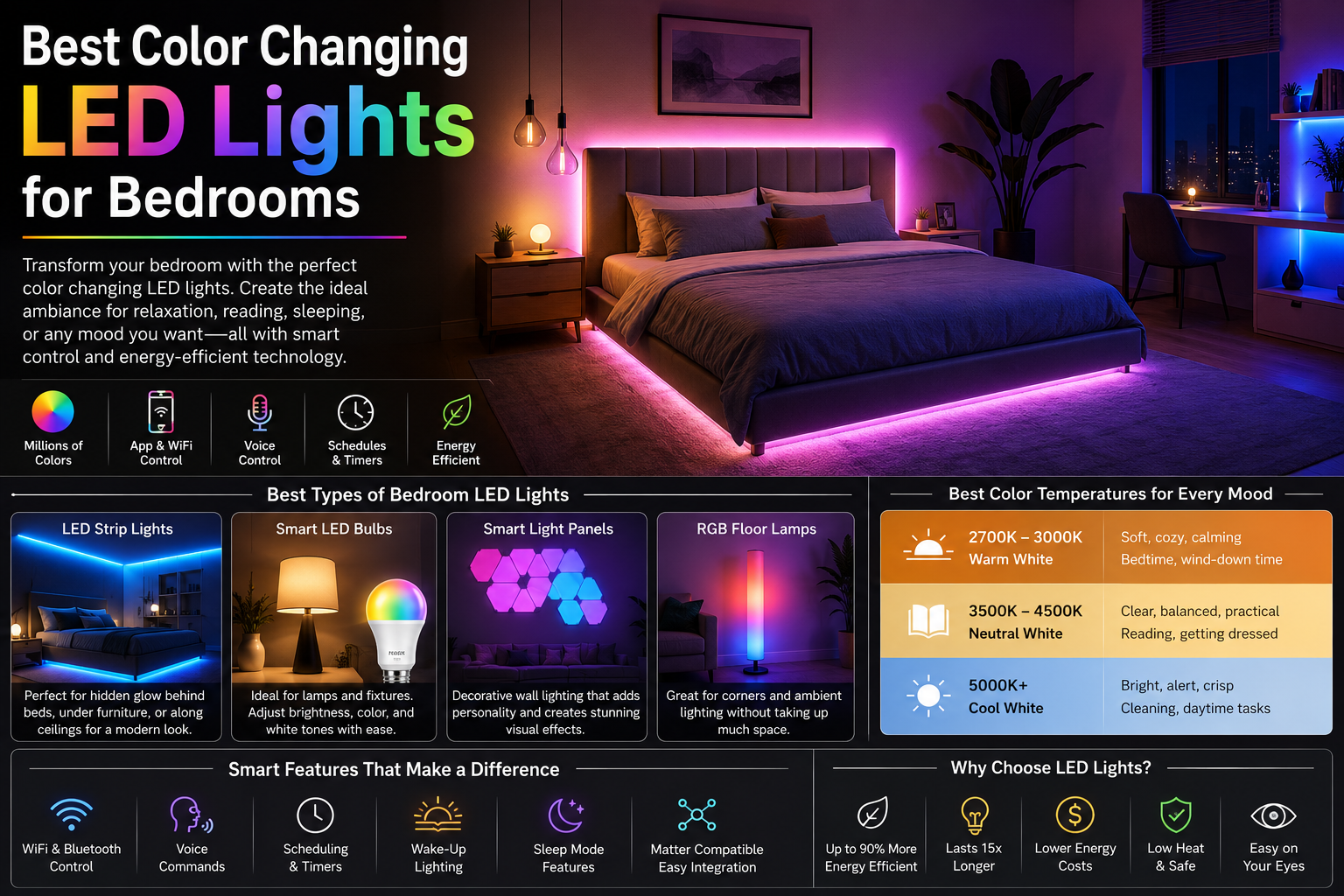
Best Types of Bedroom LED Lights
The best type of RGB LED lights for a bedroom depends on the mood you want and how much control you need. There is no single winner for every space. A small bedroom may benefit more from smart bulbs and a single LED strip, while a larger bedroom may need multiple layers of light to feel balanced. Think of the room like a stage set: the ceiling is the wash, the corners are the shadows, and the accent pieces are what make the scene feel finished. Once you understand that, choosing the right format gets much easier.
LED Strip Lights
LED strip lights for bedrooms are the most flexible choice for accent lighting. You can place them under the bed, behind the headboard, around the ceiling, or along shelves to create a soft halo effect. Their biggest strength is visual drama without visual clutter. Their downside is that they often need careful measuring and planning, especially if you want the glow to look even and clean. For people who want the room to feel modern, warm, and slightly cinematic, strip lights are hard to beat.
Smart LED Bulbs
Smart bulbs are the most practical all-round option for everyday bedroom use. They work well in bedside lamps, ceiling fixtures, and reading lights, and many models offer both white tuning and full color. They also make it easy to switch from task lighting to relaxed nighttime lighting without changing the fixture itself. Philips Hue, for example, positions its smart bulb ranges around different lighting needs, including warm white and white-and-color options, which shows how useful this format can be in a bedroom. If you want simple control and broad usefulness, smart bulbs are usually the safest place to start.
Smart Light Panels
Smart light panels are less about general illumination and more about visual personality. They work best as decorative wall lighting or accent lighting, especially if you want a room that feels expressive or futuristic. They are not always the best main light source, but they can be a strong design feature above a desk, around a mirror, or near a media wall. In a bedroom, panels are best used like artwork that also happens to glow. That makes them ideal for users who care as much about style as brightness.
RGB Floor Lamps
RGB floor lamps are a strong choice for corners that feel empty or dark. They create ambient effects without taking up much surface space, which is helpful in bedrooms that do not have room for lots of furniture or fixtures. They also work well when you want light that washes up a wall instead of shining directly into your eyes. A floor lamp is often the quiet hero of a room: not flashy, but surprisingly powerful when placed well. If you want atmosphere without adhesive strips or permanent installation, this is a great option.
Best Color Temperatures for Bedroom Mood Lighting
Color temperature changes how a room feels almost instantly. Lower Kelvin values usually feel warmer and more relaxing, while higher values feel cooler and more energizing. Energy.gov describes lower color temperatures such as 2700K to 3000K as warm and higher values like 3600K to 5500K as cool, which is a useful starting point when choosing bedroom LED lights. For bedroom use, warm light is usually the safest default, especially at night, while cooler light makes more sense for dressing, cleaning, or reading when you need more clarity.
| Color Temperature | Mood Effect | Best Use Case |
| Warm White (2700K–3000K) | Soft, cozy, calming | Bedtime, wind-down time, ambient lighting |
| Neutral White (3500K–4500K) | Clear, balanced, practical | Reading, getting dressed, everyday use |
| Cool White (5000K+) | Bright, alert, crisp | Cleaning, organizing, daytime tasks |
Warm white is usually the best fit for the end of the day. Research and lighting guidance both support the idea that warmer, dimmer evening light is friendlier to sleep routines than cooler, brighter light. Neutral white is a good middle ground when you want your bedroom to feel clean without becoming too sterile. Cool white should usually be used in short bursts, not as your default nighttime setting. Think of warm white as the soft blanket, neutral white as the everyday shirt, and cool white as the work light you bring out when you need focus.
Best Colors for Different Bedroom Moods
Color is where LED mood lights become fun. Different hues can make a bedroom feel romantic, playful, dreamy, or calm. The effect is partly emotional and partly visual, because the brain reacts to color cues even before you consciously think about them. Warm tones usually feel inviting, while cooler tones can feel more futuristic or crisp. Studies on light, mood, and circadian response suggest that the spectral content of light matters for how alert or relaxed people feel, so color is not just decoration; it is part of the experience.
| Color | Mood Effect | Best Use Case |
| Warm White | Cozy, gentle, restful | Nighttime wind-down |
| Blue | Cool, modern, calm for some users | Accent lighting, tech-style rooms |
| Purple | Dreamy, creative, dramatic | Relaxation scenes, entertainment |
| Red | Low-glare, intimate, softer on the eyes | Night lighting, romantic mood |
| Green | Fresh, balanced, natural | Calm ambient scenes |
| Orange | Warm, inviting, sunset-like | Evening relaxation |
| Pink | Soft, playful, romantic | Decorative accent lighting |
Use these colors with intention. Blue and purple are popular in RGB bedroom lights because they look great, but they are not always the best fit for bedtime if you want the room to feel sleepy. Red, orange, and warm white usually create the gentlest atmosphere because they feel less harsh. Green sits in the middle and can feel balanced when you want personality without too much intensity. The smartest way to use color is to treat it like seasoning: a little can transform the room, but too much can overwhelm it.
Smart Features That Improve Bedroom Lighting
Smart features are what turn a light from a product into a routine. WiFi LED lights, Bluetooth LED lights, voice control, timers, and scenes all help make a bedroom easier to live in. Google says Matter is designed to reduce compatibility issues, while Amazon explains that Matter devices can connect directly to Alexa without a separate hub or skill, improving reliability and reducing latency. Apple also supports Matter accessories in the Home app and lets users control lights through Siri. In real life, that means you can build a “good night” routine that lowers brightness, changes color, and turns off everything in one step.
WiFi Control
WiFi control is best when you want remote access and broader automation. You can manage lights away from home, place them into rooms or scenes, and combine them with other smart devices. That makes WiFi especially useful for larger bedrooms or homes where you already have a smart ecosystem. It is also ideal when you want schedules that work even if you are not standing near the switch. For bedroom use, the convenience is obvious: one app can handle the whole atmosphere.
Bluetooth Control
Bluetooth is often the faster, simpler choice for single-room control. Some smart bulbs advertise instant Bluetooth control right out of the box, which is handy if you only want to manage lights in one bedroom without installing a full hub. This is a good fit for renters or people who want easy setup without a more advanced network. It is not always as powerful as WiFi for home-wide automation, but for a bedroom it can be enough.
Voice Commands
Voice control makes lighting feel effortless. Apple says Siri can adjust lights, set scenes, and even handle room-based commands, while Alexa can locally control Matter devices. That means your lights can react without you reaching for your phone. A simple command like “good night” or “set reading scene” is the kind of convenience that sounds small until you use it every day. Bedrooms benefit a lot from this because voice control works well when you are already in bed and do not want to get up again.
Scheduling and Timers
Schedules and timers help your room match your body clock instead of fighting it. You can gradually dim lights before bed, switch to warmer tones at a set time, or make sure lights turn off after you fall asleep. That kind of routine reduces decision fatigue and keeps your bedroom lighting consistent. It also makes smart bedroom lighting feel like a sleep tool instead of just a gadget. If a room is supposed to help you rest, routine is one of the strongest design elements you can add.
Wake-Up Lighting
Wake-up lighting is one of the most underrated bedroom upgrades. Instead of being shocked awake by a bright overhead bulb, you can use gradual light that becomes brighter over several minutes. This creates a softer start to the day and can make early mornings feel less abrupt. Many smart systems let you build this kind of scene with a routine or automation. It is a simple feature, but it changes how the bedroom feels before breakfast has even started.
Sleep Mode Features
Sleep mode features usually dim the lights, shift them warmer, and sometimes turn them off gradually. That matters because the transition from wakefulness to sleep should feel smooth, not sudden. Research on evening ambient light and circadian rhythms supports the idea that reducing bright and blue-heavy light at night is helpful for sleep comfort. In practice, sleep mode turns your lighting into a cue: this is the part of the night when the room gets quieter, softer, and less demanding.
Bedroom LED Lighting Placement Ideas
Placement can make average lights look expensive or make great lights look awkward. Behind the headboard is one of the most popular spots because it creates a floating halo effect that feels warm without being direct. Under-bed strips are useful for low-level night lighting and can make the room feel larger by lifting the furniture visually. Around the ceiling, especially in coves or tray ceilings, the glow becomes more architectural and less obvious. The goal is to hide the source when possible and let the light do the talking.
Behind TVs and mirrors, accent lighting can create contrast and reduce the “flatness” that many bedrooms have at night. A glowing mirror frame works especially well in a dressing area, while shelves and bookshelves benefit from light that highlights objects instead of the whole room. Corners are another smart place for RGB floor lamps because they balance the room without taking up much space. Think about the bedroom in layers: low, medium, and high light. When those layers work together, the room feels designed instead of merely lit.
LED Strip Lights vs Smart Bulbs for Bedrooms
Both formats can be excellent, but they solve different problems. Strip lights are best for decorative ambience and hidden glow. Smart bulbs are best for practical lighting, especially when you want to keep your favorite lamp or fixture and simply make it smarter. If your bedroom is small, a bulb may be enough. If you want a dramatic ambient effect or a layered modern look, strips often create the bigger visual payoff.
| Feature | LED Strip Lights | Smart Bulbs |
| Installation | More planning, adhesive mounting | Easy screw-in replacement |
| Mood Lighting | Excellent for hidden glow | Good for lamps and fixtures |
| Brightness | Great for accents | Better for direct room lighting |
| Cost | Usually more variable | Often simpler to start with |
| Customization | Very high for placement | Very high for color and routines |
For bedroom size and design goals, the choice is straightforward. Use strips when the room needs atmosphere, edges, or a designer look. Use smart bulbs when you need flexibility, simple installation, and everyday function. Many people end up using both: bulbs for core lighting and strips for mood. That combination gives you the best of both worlds and keeps the room from feeling like a single point of light is doing all the work.
Common Bedroom Lighting Mistakes to Avoid
The most common mistake is making the room too bright for nighttime use. A bedroom should not feel like a supermarket aisle after dark. Another common problem is choosing the wrong color temperature, especially using cool white when the goal is relaxation. Poor placement can also ruin the effect, because even a great light looks wrong if it shines directly into your eyes from the wrong angle. A lot of people also skip dimming, which is like buying curtains you can never close.
The final mistake is overcomplicating the smart setup. More features do not always mean a better bedroom. In a sleep space, simplicity often wins because you want lighting that feels effortless at the end of a long day. That is where standards like Matter help by reducing compatibility headaches across ecosystems. If your system is so complicated that you avoid using it, then the lighting is not really improving the room.
How to Choose the Best Bedroom LED Lights
Start with room size, because that tells you how much light you actually need. A compact room may only need a few smart bulbs and one accent strip, while a larger bedroom may need a fuller layered setup. Then decide what the lighting should do. Do you need mostly relaxation, more reading light, or a decorative effect for a modern look? Your answer changes the best product type more than most people realize.
Next, choose between RGB and RGBW. RGB is great for color effects, but RGBW usually gives you a better white-light experience because it includes a dedicated white channel. After that, choose the smart features you will actually use, such as app control, voice commands, or schedules. Then set a budget and decide where everything will be installed before buying. A good buyer’s checklist is simple: room size, purpose, control method, color range, installation style, and future compatibility. If you get those six things right, you will usually get the bedroom lighting right too.
Energy Efficiency and Long-Term Savings
LEDs are one of the easiest upgrades if you care about electricity use. ENERGY STAR says LED lighting products can produce light up to 90% more efficiently than incandescent bulbs, and other ENERGY STAR guidance says certified bulbs can use 70% to 90% less energy while lasting at least 15 times longer. That combination matters in bedrooms because lights are often used every single day, sometimes for many hours. Lower energy use also means less heat, which is a nice bonus in a room that is supposed to feel comfortable.
The long-term savings are not just about the electricity bill. LEDs generally last much longer and dim gradually instead of failing all at once, which means fewer replacements and less hassle. They also produce very little heat compared with incandescent bulbs, so they are more comfortable in a small sleeping space. Over time, that adds up to a bedroom that is cheaper to run, easier to maintain, and more flexible to use. In plain English, the right LED setup pays you back in convenience every night.
Conclusion
The best color changing LED lights for bedrooms do more than decorate a room. They help you build a space that feels calmer at night, brighter when you need to get ready, and more personal all day long. Whether you choose LED strip lights for bedrooms, smart LED bulbs, a floor lamp, or a layered combination, the key is to match brightness, color temperature, and placement to your actual routine. Warm, dimmable lighting supports relaxation, while smart features like Matter, Siri, and Alexa make the whole setup easier to use.
If you want your bedroom to feel more comfortable, more stylish, and easier to live in, lighting is one of the smartest places to start. Explore related guides like Benefits of Color Changing LED Lights, Smart Color Changing LED Lights Explained, How to Choose the Right Color Changing LED Lights, and RGB vs RGBW LED Lights to keep building a better lighting plan for your home.
Frequently Asked Questions
1. What are the best bedroom LED lights?
The best bedroom LED lights are usually dimmable smart bulbs, LED strip lights, or a mix of both. Bulbs are best for functional lighting, while strips are best for ambience and hidden glow.
2. Are color changing LED lights good for bedrooms?
Yes. They let you adjust the room for reading, relaxing, or sleeping, which makes them much more useful than fixed lighting. Warm and dim settings are especially helpful at night.
3. What color LED lights are best for sleep?
Warm white, amber, red, and other low-intensity warm tones are usually the best choices for sleep-friendly lighting. Cooler and brighter light is better reserved for daytime tasks.
4. Are RGB lights safe to leave on overnight?
From a product standpoint, most quality LED lights are designed for normal home use, but from a sleep standpoint, very bright or blue-heavy light is not ideal overnight. For sleep comfort, use the lowest useful brightness and warmer tones.
5. Should I choose LED strips or smart bulbs?
Choose LED strips if you want hidden accent light and a modern glow. Choose smart bulbs if you want easy installation, everyday usefulness, and better lighting for lamps or ceiling fixtures.
6. How bright should bedroom LED lights be?
Use brightness based on the task. Bedside lamps should feel softer, while reading or cleaning may require more light. Lumens are the best comparison point when shopping.
7. Can smart LED lights improve sleep routines?
Yes. Schedules, dimming, and warm-toned scenes can create a smoother bedtime transition. That kind of consistency helps make the bedroom feel more sleep-focused.
8. Are bedroom LED lights energy efficient?
Yes. ENERGY STAR says LEDs can be up to 90% more efficient than incandescent bulbs and can use 70% to 90% less energy while lasting much longer.
9. What color lighting creates the most relaxing atmosphere?
Warm white and soft amber usually create the most relaxing atmosphere. These tones feel gentler and less alerting than bright cool white light.
10. How long do LED bedroom lights last?
LEDs generally last much longer than traditional incandescent bulbs. ENERGY STAR notes that certified bulbs can last at least 15 times longer, and LEDs fade gradually instead of burning out suddenly.