Introduction
Choosing the right beam light can significantly impact the success of an event. Whether you’re designing a concert stage, managing a wedding venue, operating a nightclub, or running a lighting rental business, selecting the correct fixture ensures better visibility, stronger visual effects, and a more immersive audience experience.
A beam light is a specialized lighting fixture designed to project narrow, concentrated shafts of light over long distances. These fixtures are widely used in stage production, concert lighting, event lighting, and professional entertainment venues because of their ability to create dramatic aerial effects.
Many buyers make the mistake of choosing fixtures solely based on wattage or price. However, factors such as beam angle, venue size, throw distance, DMX compatibility, weather protection, and movement capabilities are equally important.
For a deeper understanding of beam lighting technology, applications, and installation strategies, readers should also explore Beam Lights Complete Guide to Stage, DJ & Event Lighting.
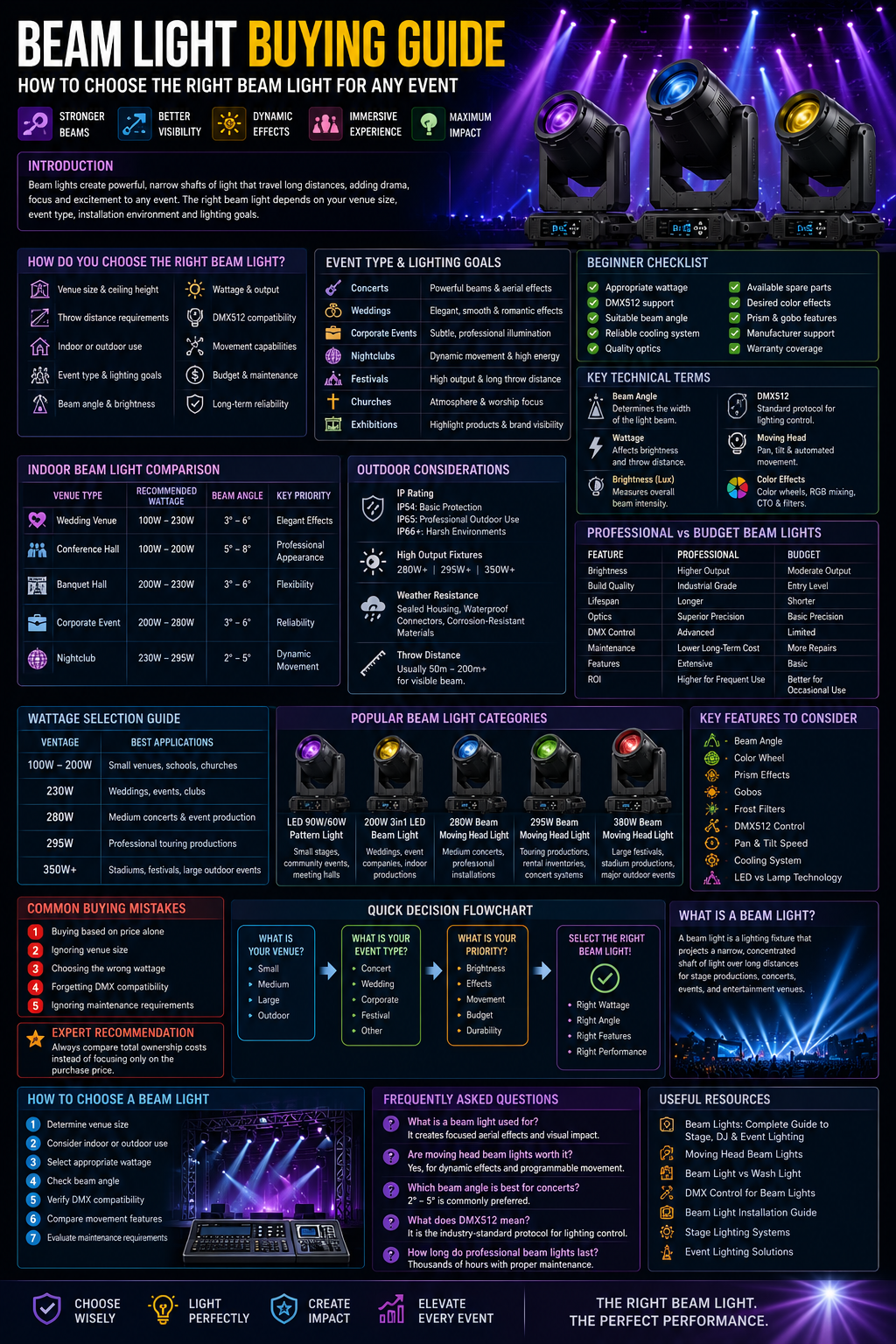
How Do You Choose the Right Beam Light?
When selecting a beam light, consider:
- Venue size
- Ceiling height
- Throw distance requirements
- Indoor or outdoor use
- Event type
- Beam angle
- Wattage and brightness
- DMX512 compatibility
- Movement capabilities
- Budget and long-term maintenance
The best fixture is the one that matches your lighting goals, not the one with the highest power rating.
How to Choose the Best Beam Light for Events
Every event environment has unique lighting requirements.
Venue Size
Large venues require higher-output fixtures capable of producing visible beams across greater distances. Smaller venues often benefit from lower-wattage units that prevent excessive brightness.
Ceiling Height
High ceilings require fixtures with stronger beam intensity and longer throw distances. Lower ceilings may require wider beam distribution to avoid overly concentrated effects.
Audience Distance
The farther the audience is from the stage, the greater the output required to maintain visual impact.
Indoor vs Outdoor Use
Indoor events generally prioritize flexibility and effects. Outdoor events require weather resistance, stronger output, and enhanced durability.
Event Type
Different events demand different lighting styles:
- Concerts require powerful moving head beam lights.
- Weddings prioritize elegant and controlled effects.
- Corporate events often need subtle, professional illumination.
- Nightclubs focus on dynamic movement and synchronized effects.
Lighting Goals
Ask yourself:
- Do you want aerial effects?
- Are you highlighting performers?
- Do you need audience engagement?
- Is atmospheric lighting the primary objective?
Answering these questions helps determine the ideal beam lighting system.
Buyer Recommendation
Before purchasing, evaluate:
- Venue dimensions
- Rigging limitations
- Existing truss system
- Available lighting console
- Power requirements
This assessment prevents costly purchasing mistakes.
Beam Light Buying Guide for Beginners
Understanding key technical terms makes the buying process easier.
Beam Angle
Beam angle determines how narrow or wide the projected light appears.
- 1°–3°: Ultra-narrow beams
- 3°–6°: Standard beam fixtures
- 7°–15°: Hybrid applications
Wattage
Wattage influences brightness, throw distance, and beam visibility.
Brightness
Brightness is typically measured through lux output and overall beam intensity.
Color Effects
Modern fixtures may include:
- Color wheels
- RGB mixing
- CTO correction
- Color temperature adjustment
DMX Compatibility
DMX512 compatibility enables centralized control using a lighting console and integration into larger lighting rigs.
Movement Capabilities
Moving head fixtures provide:
- Pan movement
- Tilt movement
- Automated programming
- Dynamic stage effects
Beginner Checklist
Before buying, verify:
✔ Appropriate wattage
✔ DMX512 support
✔ Suitable beam angle
✔ Reliable cooling system
✔ Quality optics
✔ Available spare parts
✔ Desired color effects
✔ Prism and gobo features
✔ Manufacturer support
✔ Warranty coverage
Best Beam Lights for Indoor Events
Indoor venues require a balance between brightness, control, and versatility.
Weddings
Ideal Features:
- Smooth movement
- Elegant prism effects
- Quiet operation
- Moderate brightness
Conferences
Ideal Features:
- Professional appearance
- Accurate positioning
- Consistent color temperature
Banquet Halls
Ideal Features:
- Compact fixtures
- Medium throw distance
- Flexible mounting options
Corporate Functions
Ideal Features:
- Clean beam effects
- Reliable DMX integration
- Fast setup
Nightclubs
Ideal Features:
- High-speed pan and tilt
- Multiple prism effects
- Dynamic beam movement
Indoor Beam Light Comparison
| Venue Type | Recommended Wattage | Beam Angle | Key Priority |
| Wedding Venue | 100W–230W | 3°–6° | Elegant Effects |
| Conference Hall | 100W–200W | 5°–8° | Professional Appearance |
| Banquet Hall | 200W–230W | 3°–6° | Flexibility |
| Corporate Event | 200W–280W | 3°–6° | Reliability |
| Nightclub | 230W–295W | 2°–5° | Dynamic Movement |
Best Outdoor Beam Lights for Large Venues
Outdoor productions create unique challenges.
Concerts
Concert lighting often requires powerful moving head fixtures capable of projecting visible beams over long distances.
Festivals
Festival stages need durable fixtures that can withstand varying weather conditions and extended operating hours.
Stadiums
Large venues require high-output beam lighting equipment with advanced optics and exceptional throw distances.
Outdoor Productions
Professional outdoor events often combine beam lights with wash lights and spot fixtures for layered lighting design.
Important Outdoor Considerations
IP Rating
An IP rating indicates protection against dust and water.
Recommended ratings:
- IP54: Basic protection
- IP65: Professional outdoor use
- IP66+: Harsh environments
High Output Fixtures
Outdoor applications typically benefit from:
- 280W+
- 295W+
- 350W+
Weather Resistance
Look for:
- Sealed housings
- Corrosion-resistant materials
- Waterproof connectors
Throw Distance
Outdoor beam lights often need to project visible beams across 50–200 meters or more.
Professional Beam Lights vs Budget Beam Lights
Not every project requires premium fixtures.
Comparison Table
| Feature | Professional Beam Lights | Budget Beam Lights |
| Brightness | Higher Output | Moderate Output |
| Build Quality | Industrial Grade | Entry Level |
| Lifespan | Longer | Shorter |
| Optics | Superior Precision | Basic Precision |
| DMX Control | Advanced | Limited |
| Maintenance | Lower Long-Term Cost | More Frequent Repairs |
| Features | Extensive | Basic |
| ROI | Higher for Frequent Use | Better for Occasional Use |
Which Is Better?
Professional fixtures are often the best choice for:
- Rental companies
- Concert organizers
- Production companies
- Permanent venues
Budget fixtures may suit:
- Schools
- Churches
- Small event companies
- Entry-level installations
The ideal choice depends on usage frequency and operational requirements.
What Wattage Beam Light Do You Need?
One of the most common questions buyers ask is:
How Many Watts Should a Beam Light Be?
The answer depends on venue size and application.
Wattage Selection Table
| Wattage | Best Applications |
| 100W–200W | Small venues, schools, churches |
| 230W | Weddings, banquet halls, clubs |
| 280W | Medium concerts and event production |
| 295W | Professional touring productions |
| 350W+ | Stadiums, festivals, large outdoor events |
General Guidelines
LED 90W/60W Pattern Light
Suitable for:
- Small stages
- Community events
- Meeting halls
200W 3in1 Led
Popular for:
- Wedding stage lighting
- Event companies
- Indoor productions
280W beam moving head light
Excellent for:
- Medium-sized concerts
- Professional installations
295w beam moving head light
Common in:
- Touring productions
- Rental inventories
- Concert lighting systems
380W Beam Moving Head Light
Recommended for:
- Large festivals
- Stadium productions
- Major outdoor events
Key Features to Consider Before Buying a Beam Light
Beam Angle
A narrower beam angle creates stronger aerial effects and longer throw distances.
Color Wheel
Provides multiple color options for dynamic event lighting.
Prism Effects
Prism effects multiply beams and enhance stage visuals.
Gobos
Gobos project patterns, logos, and textures onto stages and surfaces.
Frost Filters
Frost filters soften beam edges and expand fixture versatility.
DMX512
DMX512 remains the industry standard for controlling professional stage lighting systems.
Pan and Tilt Speed
Faster movement improves dynamic lighting design and audience engagement.
Cooling System
Effective cooling increases fixture lifespan and performance consistency.
LED vs Lamp Technology
LED Beam Lights
Advantages:
- Lower power consumption
- Longer lifespan
- Reduced maintenance
Lamp-Based Beam Lights
Advantages:
- Higher intensity
- Exceptional long-distance projection
Common Beam Light Buying Mistakes
Avoiding these mistakes can save money and improve event results.
1. Buying Based on Price Alone
Cheaper fixtures may increase maintenance costs over time.
2. Ignoring Venue Size
A fixture that works well in a ballroom may be ineffective in a stadium.
3. Choosing the Wrong Wattage
Excessive wattage wastes energy, while insufficient wattage limits visibility.
4. Forgetting DMX Compatibility
Poor integration can create operational challenges during live events.
5. Ignoring Maintenance Requirements
Evaluate:
- Lamp replacement costs
- Spare part availability
- Manufacturer support
- Service accessibility
Expert Recommendation
Always compare total ownership costs rather than focusing solely on purchase price.
What is the best beam light for events?
The best beam light depends on venue size, event type, and desired effects. Most professional event companies use 230W–295W moving head beam lights for versatility.
Are beam lights suitable for outdoor use?
Yes. Outdoor applications require fixtures with appropriate IP ratings and sufficient output for long-distance projection.
Which beam angle is best for stage lighting?
For dramatic aerial effects, beam angles between 2° and 5° are commonly preferred.
What is the difference between professional and budget beam lights?
Professional fixtures typically offer better optics, durability, DMX functionality, and longer service life.
Final Thoughts
Selecting the right beam light requires balancing performance, venue requirements, budget, and long-term reliability. Factors such as beam angle, wattage, DMX512 compatibility, movement capabilities, optics quality, and environmental protection all play critical roles in achieving successful lighting results.
Before making a purchase decision:
- Compare technical specifications carefully
- Request quotations from reputable suppliers
- Consult experienced lighting professionals
- Evaluate long-term operating costs
- Match fixture output to venue requirements
For a complete understanding of beam lighting technology and applications, explore the following resources:
- Beam Lights: Complete Guide to Stage, DJ & Event Lighting
- Moving Head Beam Lights
- Beam Light vs Wash Light
- DMX Control for Beam Lights
- Beam Light Installation Guide
- Stage Lighting Systems
- Event Lighting Solutions
Investing time in proper research today will help ensure better performance, greater reliability, and stronger return on investment for future events.
What Is a Beam Light?
A beam light is a lighting fixture that projects a narrow, concentrated shaft of light over long distances for stage productions, concerts, events, and entertainment venues.
How to Choose a Beam Light
- Determine venue size
- Consider indoor or outdoor use
- Select appropriate wattage
- Check beam angle
- Verify DMX compatibility
- Compare movement features
- Evaluate maintenance requirements
Best Wattage for Beam Lights
- 100W–200W: Small venues
- 230W: Weddings and events
- 280W: Medium productions
- 295W: Professional touring
- 350W+: Stadiums and festivals
FAQs
1. What is a beam light used for?
Beam lights create focused aerial effects and visual impact in stage and event environments.
2. Are moving head beam lights worth it?
Yes, especially for venues requiring dynamic lighting effects and programmable movement.
3. Which beam angle is best for concerts?
A beam angle between 2° and 5° is commonly used for concert lighting.
4. What does DMX512 mean?
DMX512 is the industry-standard communication protocol for controlling lighting fixtures.
5. How long do professional beam lights last?
High-quality fixtures can last thousands of operating hours with proper maintenance.
6. Are LED beam lights better than lamp fixtures?
LED fixtures offer efficiency and longevity, while lamp fixtures often provide greater intensity.
7. What IP rating is recommended for outdoor events?
IP65 is generally recommended for professional outdoor applications.
8. Can beam lights be used in weddings?
Yes, beam lights are widely used for wedding stage lighting and reception effects.
9. How many beam lights does a stage need?
The number depends on stage size, lighting design goals, and event requirements.
10. What should I compare before buying?
Compare wattage, beam angle, optics, DMX support, build quality, maintenance costs, and warranty coverage.