Introduction
Choosing among the top beam light brands has become more complex than ever in 2026. Professional event production companies, rental houses, concert organizers, venue operators, and distributors now have access to hundreds of fixture options from global manufacturers. At first glance, many products appear similar. They may share comparable wattage ratings, beam angles, DMX features, and marketing claims. Yet experienced buyers know that long-term performance often depends less on specifications and more on the manufacturer behind the fixture.
In professional environments, lighting failures can have significant consequences. A moving head beam fixture that overheats during a concert, loses DMX communication during a corporate event, or suffers from inconsistent output across multiple units can create operational challenges and increase maintenance costs. This is why evaluating beam light manufacturers carefully has become a critical procurement task.
Readers looking for a broader understanding of fixture technologies should also explore the pillar resource, Beam Lights: Complete Guide to Stage, DJ & Event Lighting, which provides foundational knowledge on beam lighting systems and applications.
Industry sourcing trends show growing demand for manufacturers that provide reliable support, strong warranties, consistent performance, and future-ready technologies rather than simply competing on price alone. Buyers increasingly prioritize serviceability, software support, and long-term ROI when selecting professional lighting systems.
What Makes a Beam Light Brand Reliable?
A reliable beam light brand consistently delivers high-quality fixtures, dependable technical support, spare parts availability, safety-certified products, firmware updates, and proven performance across professional event environments.
Product Quality
Quality begins with engineering consistency. Reliable manufacturers invest heavily in optical systems, cooling architecture, LED technology, motor precision, and component selection. Whether a fixture is a beam spotlight, moving head fixture, or hybrid unit, consistency between production batches is essential.
Professional event companies often deploy dozens or even hundreds of fixtures within a single lighting rig. Uniform color temperature, beam consistency, gobo alignment, and movement accuracy directly impact the quality of the overall lighting design.
Consistent Performance
The best manufacturers understand that performance must remain stable throughout long events. Concert lighting equipment frequently operates for many hours under demanding conditions. Consistent lux output, stable beam angles, and reliable movement systems are often considered more important than maximum brightness specifications alone.
Technical Support, Warranty, and Spare Parts
Many buyers focus heavily on fixture specifications while overlooking support infrastructure. Yet support often determines the actual ownership experience.
Reliable brands typically provide:
- Comprehensive warranty coverage
- Readily available spare parts
- Technical documentation
- Firmware updates
- Service networks
- Product training resources
Industry professionals consistently identify support and reliability as major differentiators between premium and budget lighting brands.
Product Innovation and Safety Certifications
Professional manufacturers continue investing in:
- Advanced optics
- Improved LED engines
- Intelligent lighting systems
- Wireless control integration
- Enhanced energy efficiency
Buyers should also verify compliance with relevant safety certifications and international standards before purchasing equipment.
Key Factors to Evaluate Before Choosing a Beam Light Brand
Build Quality
The fixture housing, internal structure, connectors, and movement mechanisms reveal a great deal about manufacturing quality. Touring-grade fixtures are designed to withstand frequent transportation, vibration, and repeated setup cycles.
A durable fixture often costs more initially but significantly reduces long-term maintenance expenses.
Optical Performance
Optical quality remains one of the most important evaluation criteria.
Buyers should assess:
- Beam sharpness
- Beam angle consistency
- Focus quality
- Gobos performance
- Prism effects
- Light output uniformity
Premium optics often create more noticeable differences than raw wattage figures.
DMX Compatibility
Professional stage lighting depends heavily on the DMX512 protocol. Fixtures must communicate reliably with lighting consoles and intelligent lighting systems.
Compatibility testing should include:
- DMX512 functionality
- RDM support
- Wireless DMX integration
- Network compatibility
Cooling Systems
Heat management directly impacts fixture lifespan. Efficient cooling systems help maintain consistent output while protecting internal components.
Product Lifespan and Firmware Support
Many manufacturers now provide firmware updates that improve performance, add features, and address compatibility issues. This ongoing support can significantly extend the usable life of a fixture.
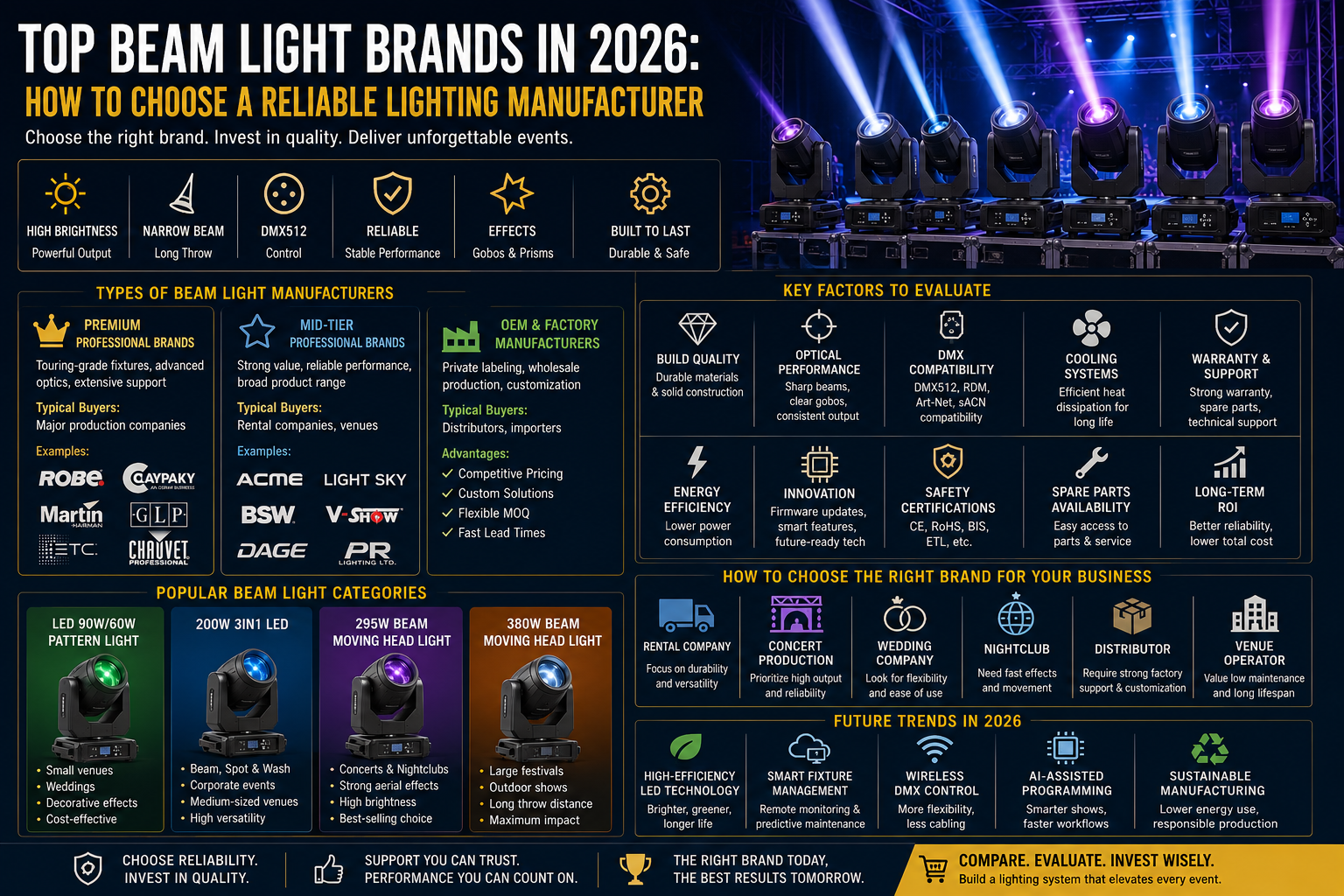
Types of Beam Light Manufacturers in 2026
| Manufacturer Type | Characteristics | Typical Buyers |
| Premium Professional Brands | Touring-grade equipment, advanced optics, extensive support | Major production companies |
| Mid-Tier Professional Brands | Strong value, reliable performance, broad product range | Rental companies, venues |
| OEM & Factory Manufacturers | Private labeling, wholesale production, customization | Distributors, importers |
Premium Professional Brands
Premium manufacturers focus on high-performance fixtures designed for demanding environments such as international tours, broadcast productions, and large festivals.
Brands frequently referenced in professional touring and event production markets include manufacturers such as Robe, Clay Paky, Martin Professional, GLP, ETC, and Chauvet Professional. These companies are known for extensive R&D, global service networks, and proven deployment in major productions.
Mid-Tier Professional Brands
Mid-tier brands balance performance and affordability. They often provide excellent value for rental companies and venue operators that need dependable fixtures without premium pricing.
OEM and Factory Manufacturers
OEM stage lighting manufacturers play a significant role in today’s market. Many distributors and importers work directly with factories to develop private-label product lines and customized solutions.
China’s lighting manufacturing ecosystem continues to dominate global supply chains for professional lighting products, providing substantial OEM opportunities.
What Product Range Should a Good Beam Light Brand Offer?
A manufacturer’s product portfolio often reflects its ability to serve different market segments and customer needs.
LED 90W/60W Pattern Light
Suitable for:
- Small venues
- Decorative installations
- Wedding productions
- Hospitality applications
These fixtures provide economical visual effects while remaining easy to deploy.
200W 3in1 LED
Suitable for:
- Multi-purpose event production
- Corporate events
- Houses of worship
- Medium-sized venues
The versatility of hybrid functionality makes these fixtures attractive for organizations seeking flexibility.
295W Beam Moving Head Light
Suitable for:
- Concert productions
- Nightclubs
- Rental inventories
- Touring applications
These fixtures commonly deliver strong aerial beam effects and robust programming capabilities.
380W Beam Moving Head Light
Suitable for:
- Large festivals
- Stadium productions
- Outdoor events
- High-impact lighting rigs
Manufacturers offering a complete range of products typically provide better upgrade paths and fleet compatibility for growing businesses.
Top Features Buyers Look for in Beam Light Brands
Beam Light Evaluation Checklist
| Feature | Why It Matters |
| Brightness & Lux Output | Determines visibility over long distances |
| Beam Quality | Creates cleaner aerial effects |
| Gobos & Prism Effects | Expands creative possibilities |
| DMX512 Support | Ensures control compatibility |
| Intelligent Functions | Simplifies programming |
| Power Efficiency | Reduces operating costs |
| Durability | Improves ROI |
| Weather Resistance | Supports outdoor events |
Modern buyers increasingly prioritize system integration rather than isolated fixture performance. The ability to integrate seamlessly with lighting consoles, truss systems, networking infrastructure, and event production workflows often influences purchasing decisions as much as fixture specifications themselves.
How Event Companies Evaluate Lighting Brands
Professional event companies rarely evaluate fixtures based solely on marketing materials.
Their assessment often includes:
Reliability During Live Events
Can the fixture operate consistently throughout a demanding show schedule?
Ease of Programming
How easily can lighting designers integrate fixtures into existing workflows?
Maintenance Costs
What is the expected service frequency?
How available are replacement parts?
Return on Investment
Will the fixture generate revenue opportunities for rental businesses?
Equipment Longevity
Can the product remain competitive for several years?
These practical considerations frequently outweigh headline specifications during procurement decisions.
Common Mistakes When Choosing a Beam Light Brand
Several mistakes repeatedly appear in procurement projects.
Choosing Solely on Price
Low acquisition costs can sometimes result in higher maintenance expenses and reduced reliability.
Ignoring Service Support
Without proper support infrastructure, even technically capable fixtures can become operational liabilities.
Overlooking Spare Parts Availability
Parts shortages can significantly increase downtime.
Buying Incompatible Fixtures
DMX profiles, networking protocols, and software ecosystems should be evaluated before purchase.
Focusing Only on Wattage
Higher wattage does not automatically translate into superior beam quality, optics, or real-world performance.
How to Choose the Right Brand for Your Business
| Business Type | Recommended Brand Characteristics |
| Rental Company | Durability and versatility |
| Concert Production | High output and reliability |
| Wedding Company | Flexible fixture options |
| Nightclub | Fast effects and movement |
| Distributor | Strong factory support |
| Venue Operator | Low maintenance requirements |
The best beam light company for one organization may not be ideal for another. Buyers should evaluate manufacturers according to operational requirements, budget expectations, service infrastructure, and long-term growth plans.
Future Trends in Beam Light Manufacturing
The professional lighting industry continues evolving rapidly.
Several trends are shaping 2026:
LED Advancements
Manufacturers are increasingly replacing traditional discharge lamps with high-efficiency LED technology. This shift improves energy efficiency while reducing maintenance requirements.
Smart Fixture Management
Remote monitoring, diagnostics, and predictive maintenance capabilities are becoming more common.
Wireless DMX Integration
Wireless control solutions continue gaining acceptance in professional event environments.
Improved Energy Efficiency
Sustainability initiatives are encouraging manufacturers to develop fixtures with lower power consumption and higher performance ratios.
AI-Assisted Lighting Programming
AI-assisted tools are beginning to support automated tracking, fixture management, and programming workflows in advanced production environments.
Final Thoughts
Selecting among the top beam light brands requires far more than comparing wattage specifications or pricing sheets. Professional buyers must evaluate reliability, support infrastructure, optical quality, product range, firmware support, spare parts availability, and long-term ownership costs.
The most successful procurement strategies focus on total value rather than initial purchase price. Reliable manufacturers often deliver stronger ROI through reduced downtime, longer service life, and greater operational flexibility.
Before making a purchasing decision, compare technical specifications carefully, request product demonstrations, review support policies, and consult experienced lighting professionals. These steps can help ensure that your investment in professional stage lighting delivers dependable performance for years to come.
Featured Snippet Opportunities
What makes a beam light brand reliable?
A reliable beam light brand offers consistent performance, strong technical support, available spare parts, safety-certified products, firmware updates, and proven durability in professional event environments.
How do I choose a beam light manufacturer?
Evaluate product quality, optical performance, support services, warranty coverage, DMX compatibility, spare parts availability, and long-term operating costs.
Are expensive beam lights worth it?
Higher-priced fixtures often provide better reliability, support, optics, and longevity, which may reduce total ownership costs over time.
10 FAQs
1. What are the best beam light brands?
The best brands vary by application, but buyers typically prioritize reliability, support, and performance rather than rankings.
2. What is DMX512?
DMX512 is the industry-standard communication protocol used to control professional lighting fixtures.
3. Why are moving head beam lights popular?
They provide dynamic movement, aerial effects, and flexible programming capabilities.
4. How important is warranty coverage?
Warranty support can significantly reduce long-term maintenance expenses.
5. Should I buy directly from a factory?
Factory sourcing may offer cost advantages for distributors and wholesale buyers.
6. What beam light wattage is suitable for concerts?
Requirements vary by venue size, throw distance, and lighting design objectives.
7. Are LED beam lights replacing discharge lamps?
Yes, many manufacturers are transitioning toward high-output LED technology.
8. How long do professional beam lights last?
Lifespan depends on usage, maintenance, and manufacturing quality.
9. What should distributors prioritize?
Support infrastructure, customization capabilities, certifications, and spare parts availability.
10. How do rental companies evaluate fixtures?
Reliability, maintenance requirements, programming flexibility, and ROI are common evaluation criteria.