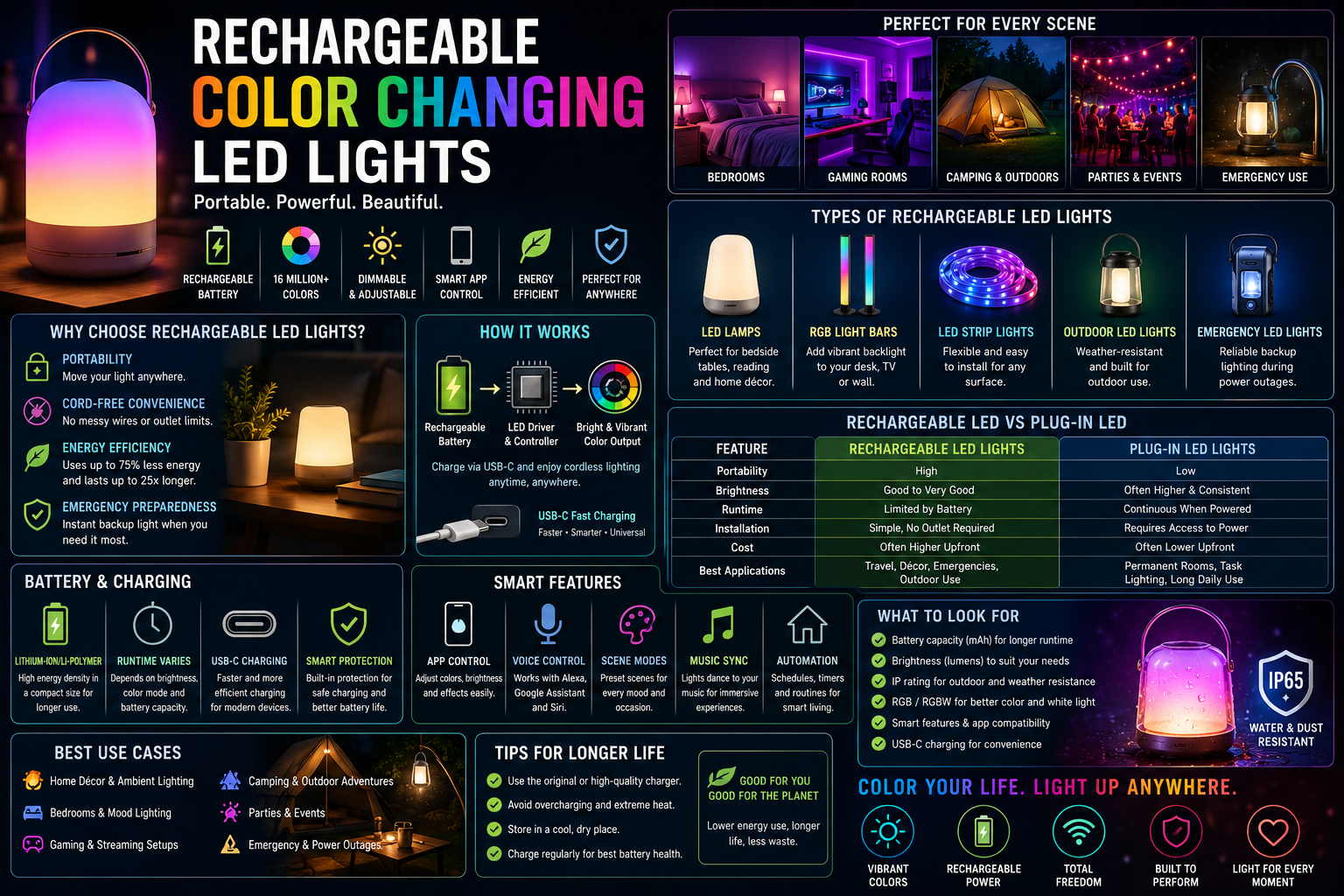
Rechargeable color changing LED lights have become one of the easiest ways to add flexible lighting to modern life. They give you the freedom to light a room, a patio, a campsite, or an emergency corner without relying on a wall socket the whole time. For people who want style and practicality in one product, rechargeable LED lights are a smart middle ground between fixed lighting and disposable battery lamps. They are also useful for home décor, camping, parties, and backup lighting when the power goes out. In a world where convenience matters, cordless lighting feels less like a luxury and more like a daily essential.
What makes them especially attractive is the mix of portability and color control. You can soften a bedroom with warm tones, turn a gaming setup into a neon-style zone, or create a calm ambient glow for a dinner table. Because many current LED products are also far more efficient than older bulbs, they are not just stylish; they are practical too. The U.S. Department of Energy says residential LEDs use at least 75% less energy and can last up to 25 times longer than incandescent lighting, which is a big reason these products keep gaining popularity. From homes and events to commercial spaces and stage productions, Color Changing LED Lights: The Complete Guide covers everything you need to know to make the right choice.
What Are Rechargeable Color Changing LED Lights?
Rechargeable color changing LED lights are lighting products with a built-in battery and light-emitting diodes that can shift between different colors or color temperatures. Instead of staying tied to a fixed outlet, they can run on stored power and be moved wherever you need them. Many of the latest smart lighting systems are built around LED bulbs and fixtures that communicate with apps, hubs, or voice assistants, which makes the category feel more connected and more user-friendly than old-fashioned portable lamps. That is why people now use them for both decoration and daily utility.
How Rechargeable LED Lights Work
The basic idea is simple: power is stored in a battery, and that battery feeds an LED driver that controls the light output. When the battery is charged, the light can run cord-free until the charge is depleted. In practical terms, this means you can move the same light from a bedside table to a balcony to a camping tent without changing the setup. Many current portable lights charge through USB ports, and the USB Type-C standard supports higher charging current levels, which is one reason USB-C has become a popular choice in modern portable electronics and lighting accessories.
Battery Technologies Used
Most modern rechargeable lighting products use lithium-ion or lithium-polymer battery packs because those chemistries offer strong energy density and power density in compact formats. That matters in a portable light, where size and weight have to stay manageable while still delivering usable runtime. Research reviews on lithium-ion batteries also point to ongoing work aimed at improving safety, size, and performance, which helps explain why this battery family keeps dominating rechargeable consumer devices. The big takeaway is that battery quality affects not only runtime, but also weight, charging speed, and long-term reliability.
RGB and RGBW Lighting Capabilities
RGB lighting combines red, green, and blue LEDs to create a wide range of colors. RGBW takes it one step further by adding a dedicated white channel, which usually helps produce cleaner whites and more natural everyday lighting. That matters because not every lighting moment should look like a nightclub scene; sometimes you just want a soft white glow for reading or relaxing. Manufacturers of current smart lights often highlight this color flexibility as a major selling point, especially for mood lighting, entertainment spaces, and décor-heavy rooms.
Smart Control Features
Many rechargeable color changing LED lights now offer app control, automation, voice commands, scene presets, and even entertainment sync features. Current smart lighting ecosystems from major brands support control through Amazon Alexa, Google Assistant, Apple Home/Siri, Bluetooth, Wi-Fi, and sometimes Matter. Some systems also let you sync lighting with music or TV content, which makes them especially appealing for gaming rooms and living rooms. In other words, the light is no longer just a bulb; it becomes part of the room’s digital environment.
Benefits of Rechargeable LED Lights
The biggest advantage of rechargeable lighting is freedom. You are no longer forced to place a lamp where the socket happens to be. That matters in rented homes, temporary setups, outdoor spaces, and emergency situations where the power may be unreliable. Rechargeable color changing LED lights also reduce cable clutter, which instantly makes a space look cleaner and less crowded. For people who enjoy flexible décor, that convenience feels like opening a window in a room that used to feel boxed in.
Portability
Portability is the reason many people buy battery powered LED lights in the first place. A good rechargeable lamp can move from shelf to desk to patio without any tools or rewiring. That makes it ideal for travelers, students, remote workers, and anyone who likes rearranging a room often. Portable lighting solutions are also helpful in shared spaces where running new cables is inconvenient or impossible.
Cord-Free Convenience
Cord-free lighting removes one of the biggest frustrations in home setup: placement limits. You can put a light where it looks best instead of where the outlet is hidden behind furniture. This is especially useful for shelves, accent corners, headboards, closets, and temporary event décor. It also cuts the visual mess that often comes with extension cords, adapters, and tangled charging cables.
Energy Efficiency
LED technology is already efficient, and rechargeable designs make that efficiency more useful in mobile settings. The Department of Energy says LEDs use at least 75% less energy and last up to 25 times longer than incandescent bulbs; another DOE resource notes they can use up to 90% less energy. That means less wasted electricity over time and less frequent replacement. For households trying to lower utility costs, that is a practical advantage that adds up quietly, month after month.
Emergency Preparedness
When the power goes out, rechargeable LED lights can be a lifesaver. They provide immediate backup lighting without hunting for candles, flashlights, or disposable batteries. Because many models are compact and easy to recharge, they are worth keeping in bedrooms, hallways, and emergency kits. For families, this makes rechargeable lights more than décor; they become part of a real backup plan.
Types of Rechargeable Color Changing LED Lights
Different spaces need different lighting tools. A bedside lamp and a garden light may both be rechargeable, but they solve completely different problems. The best choice depends on where the light will live, how often you will move it, and how much brightness or color control you need. Think of it like choosing shoes: the best pair is the one that fits the job, not the one with the most features on paper.
Rechargeable LED Lamps
Rechargeable LED lamps are perfect for bedrooms, living rooms, and reading nooks. They usually provide softer, more localized light and often include dimming or color temperature control. Because they sit close to people, they work best when the glow is comfortable and not harsh. These lamps are especially useful for bedside tables, guest rooms, and cozy corners where ambiance matters as much as brightness.
Portable RGB Light Bars
Portable RGB light bars are popular in gaming setups, streaming rooms, and event booths. They usually throw colored light onto walls, desks, or display areas to create atmosphere instead of broad task lighting. Many current smart lighting products aimed at entertainment spaces include scene control, app automation, and music or screen sync features. If you want a room to feel dynamic and visually alive, light bars are one of the easiest ways to get that effect.
Rechargeable LED Strip Lights
Rechargeable LED strip lights are useful when you need temporary lighting or a decorative effect without a permanent install. They are often used for shelves, displays, camping setups, DIY projects, and seasonal décor. The advantage is obvious: they can bend around surfaces, hide in edges, and disappear into the background while still changing the mood of a space. Their limitation is also obvious: they are not always the brightest choice for full-room illumination.
Rechargeable Outdoor LED Lights
Rechargeable outdoor LED lights are built for patios, gardens, balconies, and outdoor gatherings. Here, durability matters as much as color quality, and that is where weather resistance becomes important. The IEC explains that IP ratings, defined in IEC 60529, grade how well enclosures resist dust and liquid intrusion. For outdoor use, that rating matters a lot more than it does on a shelf in a living room.
Emergency Rechargeable LED Lights
Emergency rechargeable LED lights are designed for blackouts, severe weather, and disaster preparedness. They often prioritize runtime, easy charging, and reliable white light over fancy color effects. The best models are simple, quick to access, and easy to store in a hallway, utility room, or car trunk. Their limitation is that they may not look as stylish as decorative lights, but when the lights go out, style takes a back seat to usefulness.
Best Uses for Rechargeable Color Changing LED Lights
Rechargeable color changing LED lights work so well because they adapt to the setting instead of forcing the setting to adapt to them. A single product can shift roles from decoration to task light to emergency backup depending on how you use it. That flexibility is one of the strongest reasons they continue to grow in popularity.
Home Décor
In home décor, rechargeable LED lights help you add accent lighting without committing to permanent wiring. You can place them behind furniture, inside shelves, near mirrors, or around artwork to create depth and warmth. This layered effect makes a room feel more thoughtful and finished, almost like adding music to silence. Smart lighting systems are especially good at this because they let you change the mood without changing the physical setup.
Bedrooms and Mood Lighting
Bedrooms benefit from soft, adjustable light because the room serves so many purposes. You may want bright light in the morning, warm light at night, and a gentle ambient glow in between. Rechargeable RGB or RGBW lights are ideal here because they can adapt without extra installation work. The right light in a bedroom should feel like a calm voice, not a spotlight.
Gaming Rooms
Gaming rooms love color, and color changing LED lights can make a setup feel more immersive instantly. Light bars, panels, and strips work well because they frame the screen and reduce the feeling of staring into a dark box. Many smart lighting ecosystems now support TV sync, entertainment zones, and music-reactive effects, which makes the whole room feel connected. If your setup is meant to impress, these lights do a lot of the heavy lifting.
Take your setup beyond a desk and monitor with immersive RGB effects that transform the entire atmosphere. Explore Gaming Room Setup ideas to discover smart LED placement, ambient lighting zones, and color themes designed for gaming, streaming, and entertainment.
Camping and Outdoor Adventures
Camping is one of the best use cases for rechargeable cordless LED lighting. You do not always have a plug, and you do not want extra clutter around sleeping areas or cooking spaces. A rechargeable lantern, strip light, or small portable lamp can make a campsite safer and easier to live in after sunset. Just keep in mind that outdoor use demands better battery planning and better weather resistance than indoor use.
Parties and Events
Parties and events benefit from portable RGB lights because the lighting can shift with the atmosphere. A warm welcome, a colorful party scene, and a calm wind-down phase can all happen with the same set of lights. That is one reason event planners and home hosts often prefer cordless lighting: it makes last-minute setup much easier. The room can feel polished without requiring a lighting crew.
Emergency Lighting
For emergency lighting, the best rechargeable LED lights are the ones you can trust without thinking. They should be easy to find, easy to charge, and bright enough to guide you safely through a dark hallway or stairwell. Because battery devices can be sensitive to heat and charging habits, storing them properly matters. NREL notes that battery lifespan can drop by roughly 50% for every 13°C increase in operating temperature, which is a strong reminder to keep emergency lights out of hot cars and direct sunlight.Create a safer and longer-lasting outdoor setup with waterproof RGB lighting designed for gardens, patios, and open-air spaces. Explore Best Waterproof Color Changing LED Lights to compare weather-resistant options, smart controls, and outdoor-ready features.
Rechargeable LED Lights vs Plug-In LED Lights
Both types have a place, but they solve different problems. Rechargeable models win when flexibility matters. Plug-in models win when you want uninterrupted operation and do not want to think about battery management. That is why the best choice depends less on the light itself and more on how you actually live.
| Feature | Rechargeable LED Lights | Plug-In LED Lights |
| Portability | High | Low |
| Brightness | Good to very good | Often higher and more consistent |
| Runtime | Limited by battery | Continuous when powered |
| Installation | Simple, no outlet required | Requires access to power |
| Cost | Often higher upfront | Often lower upfront |
| Best Applications | Travel, décor, emergencies, outdoor use | Permanent rooms, task lighting, long daily use |
For a bedroom, desk corner, patio, or campsite, rechargeable lights usually make more sense because they give you placement freedom. For a kitchen, office, or workshop where the light needs to stay on for hours, plug-in lights are usually the safer bet. That is a practical inference from how portable battery-powered products and fixed smart lighting systems are built and used.
Battery Life and Charging Considerations
Battery life is the part of rechargeable lighting that buyers often underestimate. A light may look fantastic in photos, but if the battery dies too quickly, the excitement fades fast. Runtime depends on brightness level, color mode, battery capacity, and how efficiently the LEDs and control electronics are designed. In other words, the battery is not just a spec; it is the engine that decides whether the light is truly portable or only portable in theory.
Battery Capacity, Charging Speed, and Runtime
Battery capacity is usually measured in mAh, but the number alone does not tell the whole story. A larger battery often means longer runtime, but also a heavier product and a longer recharge time. High-brightness white light usually drains faster than low-brightness ambient color modes, so a “10-hour light” may not last 10 hours in every setting. The most useful buying habit is to compare capacity with the brightness level you actually plan to use.
USB-C vs Micro USB Charging
USB-C is the more future-friendly choice for portable lights because it is easier to plug in and supports higher charging current levels under the USB Type-C specification. That does not magically make every light charge fast, but it does give manufacturers a better platform for convenience and power delivery. Micro USB still exists, but it is old enough to feel awkward in a modern device. For a new rechargeable light, USB-C usually signals a more current design.
Smart Features to Look For
Smart features are where rechargeable lights stop being “just a lamp” and start behaving like part of a connected home. The best systems let you control brightness, color, schedules, and scenes from your phone, and some allow voice commands through Alexa, Google Assistant, or Siri. Philips Hue’s current ecosystem, for example, highlights voice control, automation, TV and music sync, and Matter compatibility across its smart lighting range. That is a good snapshot of what modern buyers now expect from premium wireless LED lighting.
When comparing smart rechargeable lights, look for app reliability, easy pairing, and scene presets that are actually useful in daily life. Music sync is fun, but a gentle wake-up scene or a low-glare bedtime mode may be more valuable over time. Voice control also matters more than people think, especially when your hands are full or your phone is across the room. The best smart features are the ones you keep using after the novelty wears off.
How to Choose the Best Rechargeable LED Lights
The smartest purchase starts with the space, not the product page. Ask yourself where the light will sit, how often it will move, and whether you care more about color effects, brightness, or battery life. If the answer changes depending on the room, that is normal. A good portable lighting solution should fit your lifestyle like a well-cut jacket: useful, comfortable, and not trying too hard.
A Practical Buyer’s Checklist
First, match the light to the task. Reading lights need clean white output and good direction, while mood lights need color flexibility and dimming. Second, check battery capacity and runtime so you are not stuck charging every few hours. Third, make sure the charging method is convenient, ideally USB-C. Fourth, look for a suitable IP rating if the light will live outdoors, because IEC 60529 exists specifically to rate dust and liquid resistance. Finally, decide whether smart control is a nice bonus or something you will actually use every day.
Rechargeable LED Lights for Travel and Outdoor Activities
Travel exposes the weakness of fixed lighting very quickly. In hotels, RVs, campsites, beach gatherings, and temporary rentals, rechargeable lights solve a basic problem: they create light where infrastructure is limited. That is why portable lighting for travel has become such a strong niche. The best setups are light enough to carry, simple enough to charge, and durable enough to survive being tossed into a bag.
Camping, RVs, and Outdoor Events
For camping and RV travel, a layered lighting setup works best. Use one light for general area glow, another for task lighting near cooking or gear, and a small backup light for emergencies. If you are at the beach or an outdoor event, weather resistance matters even more, so check the IP rating before you buy. Bright color modes are fun, but reliable white light and solid runtime usually matter more after dark.
Energy Efficiency and Sustainability
Rechargeable LED lights are a good example of convenience and sustainability working together. LEDs already reduce power use compared with older incandescent options, and rechargeability reduces the need for disposable batteries in many use cases. That means fewer replacements, less waste, and lower long-term running costs. In everyday life, the green choice is often also the cheaper choice, which is rare and welcome.
The long-term savings add up in two ways. First, LEDs draw less electricity. Second, battery-powered designs can reduce cable dependency and battery waste when used wisely. If you keep brightness at the level you actually need, store lights properly, and charge them with the correct cable, you get a better lifespan and better value. Good habits matter here, because heat and charging mistakes can shorten battery life and create avoidable safety problems.
Common Mistakes to Avoid
One of the biggest mistakes is buying a light for the colors and forgetting about runtime. A beautiful RGB lamp that dies too quickly is more frustration than feature. Another common mistake is choosing an indoor-only product for outdoor use, then being surprised by moisture or dust damage. A third mistake is ignoring charging compatibility and using the wrong adapter or cable. Those errors sound small, but they are exactly the kind that turn a good purchase into a regret.
Another mistake is assuming brighter is always better. In a bedroom or lounge, too much brightness can feel harsh instead of helpful. Some buyers also forget that operating temperature affects battery health, and heat can reduce lifespan significantly. If a product will live in a hot car, a direct-sun window, or a cramped outdoor enclosure, battery quality and thermal management matter far more than a flashy feature list.
Conclusion
Rechargeable color changing LED lights are popular because they solve several problems at once. They give you portable lighting, colorful mood control, lower power use, and a cleaner setup with fewer cords. They also work in a surprisingly wide range of situations, from bedrooms and gaming rooms to camping trips and emergency kits. The strongest products are the ones that balance battery life, brightness, smart controls, and durability without overcomplicating the experience.
If you are choosing between styles, think about your actual routine before you think about the product photos. A lamp for reading, a bar for gaming, a strip for décor, or a weather-resistant light for outdoor use can all be the right answer depending on the job. Rechargeable lighting works best when it fits your lifestyle, not when it tries to impress you with features you will never touch.
Frequently Asked Questions
1) What are rechargeable LED lights?
Rechargeable LED lights are battery-powered lights that can be charged and used without staying plugged into a wall outlet. They are useful for portable lighting, décor, travel, and emergencies.
2) How long do rechargeable LED lights last?
Runtime depends on battery size, brightness, and color mode. Lower brightness and warm white settings usually last longer than high-brightness or color-changing modes.
3) Are rechargeable RGB lights worth it?
Yes, if you want both portability and color flexibility. They are especially useful for bedrooms, gaming rooms, parties, and places where running wires is inconvenient.
4) Can rechargeable LED lights be used outdoors?
Yes, but only if the product is designed for outdoor use and has an appropriate IP rating. The IEC’s IP system is used to rate resistance against dust and liquids, which is important outdoors.
5) What battery capacity is best?
The best capacity depends on how bright the light needs to be and how long you want it to run. A bigger battery usually gives longer runtime, but it can also mean more weight and longer charging time.