Introduction
Large-scale events don’t forgive weak lighting. When you’re dealing with thousands of people in a stadium or an open-air festival ground, basic fixtures simply disappear into the distance. That’s exactly why high-power beam lights for large productions have become a core part of modern stage design. They deliver the punch, throw distance, and visual impact needed to cut through ambient light and atmosphere effects like haze or fog.
In concert environments, low-output fixtures often fail to reach the back rows or create defined aerial effects. This leads to flat visuals and a disconnected audience experience. High-output beam systems, however, solve this by producing tight, focused beams that remain visible even over long distances. These fixtures are now essential in professional concert lighting equipment and touring setups.
If you’re exploring deeper fundamentals of beam technology, check the guide: Beam Lights: Complete Guide to Stage, DJ & Event Lighting for foundational knowledge before selecting advanced fixtures.
What Are High-Power Beam Lights?
High-power beam lights are advanced moving head beam fixtures designed to produce extremely intense, narrow light beams for long-distance projection. Unlike wash or spot lights, beam fixtures focus on creating sharp aerial effects with minimal beam spread.
High-power beam lights are professional long-throw lighting systems that use high-intensity lamps or LEDs to project concentrated beams across large venues such as concerts, festivals, and stadiums.
These fixtures are typically used in lighting rigs where precision and visibility matter more than wide coverage. Their optical systems are designed for maximum lux output, allowing them to remain visible even in outdoor daylight conditions when combined with atmospheric effects.
They differ from entry-level beam lights mainly in brightness, optical clarity, and mechanical speed. High-end models also integrate advanced DMX512 control systems for seamless synchronization in complex stage programming.
Why Large Productions Need High-Power Beam Lights
Large productions operate under extreme visual demands. The lighting must be powerful enough to reach distant audience sections while still maintaining clarity and artistic flexibility.
Large Audience Coverage
In stadiums or festival grounds, audience members can be hundreds of meters away. Only high-output beams ensure visibility across the entire space.
Long Throw Distance
A standard fixture cannot maintain intensity over long distances. High-power beams maintain tight focus even at extended ranges.
Outdoor Visibility
Outdoor event production lighting must compete with ambient daylight, smoke, and environmental brightness.
Dynamic Stage Effects
Fast-moving beams synchronized with music create immersive experiences that define modern concerts.
Professional Production Requirements
Touring shows and international festivals rely on consistent performance, durability, and control precision.
Key Features to Look for in High-Power Beam Lights
When selecting fixtures for professional use, evaluating technical specifications is critical.
Brightness Output
Measured in lux or lumen intensity, brightness determines how far your beam can travel.
Beam Angle
A tighter beam angle creates sharper aerial effects and better long-distance projection.
Long-Distance Projection
Essential for stadium-scale lighting where fixtures must reach extreme distances.
Prism Effects
Multi-facet prisms multiply beams for dramatic aerial patterns.
Gobo Effects
Gobos allow custom patterns for branding or visual storytelling.
Fast Pan & Tilt Movement
High-speed motors ensure synchronization with music and cues.
DMX512 Compatibility
Modern systems rely on DMX512 for precise control.
Cooling Systems
Efficient thermal design ensures reliability during long festival runs.
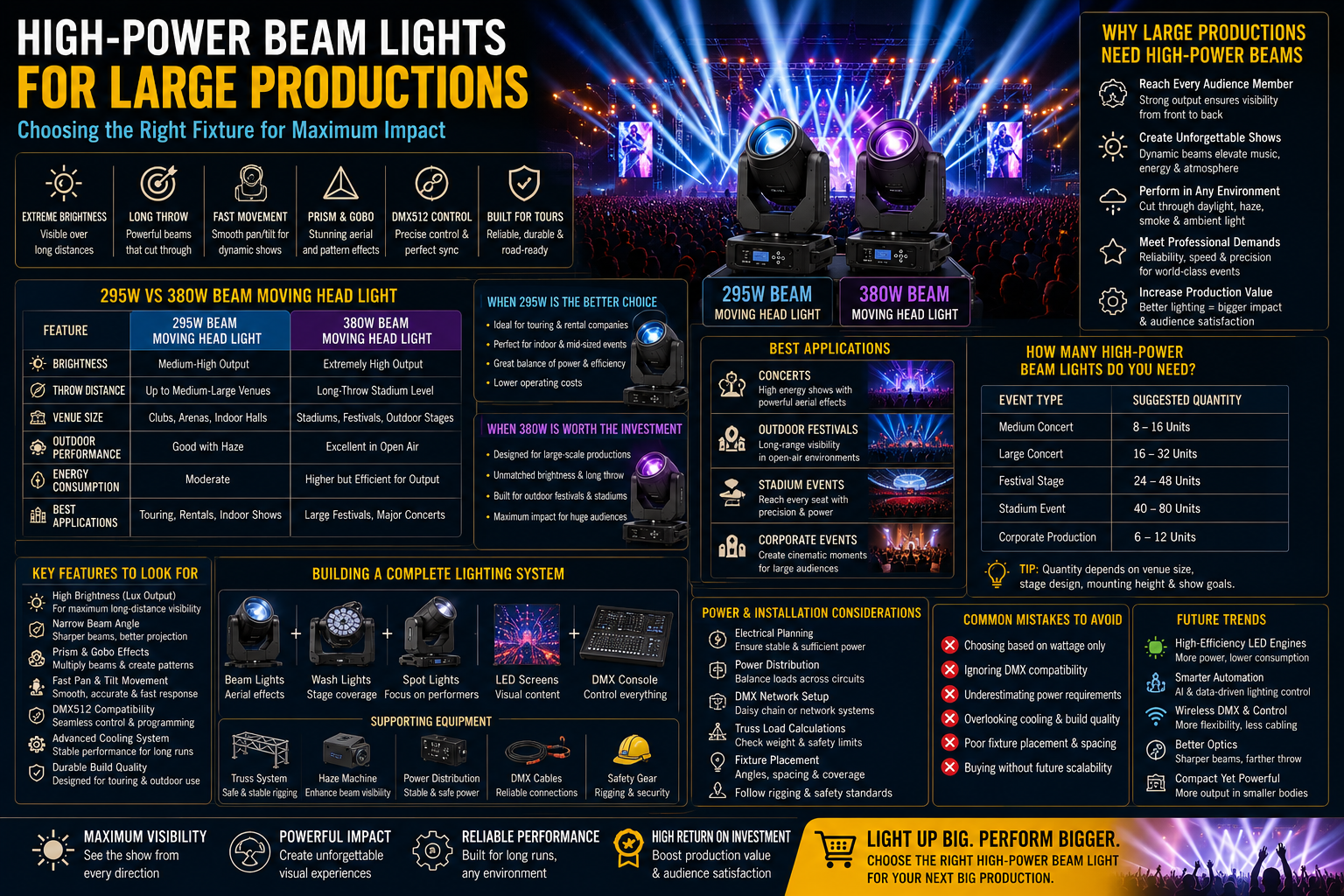
295W Beam Moving Head Light vs 380W Beam Moving Head Light
| Feature | 295W Beam Moving Head Light | 380W Beam Moving Head Light |
| Brightness | Medium-high output | Extremely high output |
| Throw Distance | Up to medium-large venues | Long-throw stadium level |
| Venue Size | Clubs, arenas, indoor halls | Stadiums, festivals, outdoor stages |
| Outdoor Performance | Good with haze | Excellent in open air |
| Energy Consumption | Moderate | Higher but efficient for output |
| Best Applications | Touring, rentals, indoor shows | Large festivals, major concerts |
When 295W Is the Better Choice
The 295W beam moving head light is ideal for rental companies and touring productions that require flexibility. It performs well in indoor arenas, clubs, and mid-sized concerts where extreme throw distance is not necessary. It also offers a strong balance between power consumption and performance, making it cost-effective for frequent use.
When 380W Is Worth the Investment
The 380W beam moving head light is designed for large-scale productions. In outdoor festivals, stadium shows, and massive stage setups, it delivers unmatched brightness and projection distance. If your production regularly involves open-air environments or large crowds, this fixture ensures consistent visibility.
Best Applications for High-Power Beam Lights
Concerts
In modern concerts, beam lights define the energy of the show. They are used for audience scanning, drop effects, and synchronized movement with music.
Outdoor Festivals
Festival stages rely heavily on beam systems for long-range visibility and aerial effects. Weather conditions like haze actually enhance beam visibility.
Stadium Events
High mounting positions require powerful fixtures that can still reach audience zones clearly.
Large Corporate Events
Brand launches and award ceremonies use beam systems to create cinematic environments and highlight key moments.
How Many High-Power Beam Lights Do You Need?
| Event Type | Suggested Quantity |
| Medium Concert | 8–16 units |
| Large Concert | 16–32 units |
| Festival Stage | 24–48 units |
| Stadium Event | 40–80 units |
| Corporate Production | 6–12 units |
Key factors influencing quantity include venue size, stage layout, and lighting design goals. Larger lighting rigs require more fixtures to maintain visual balance and symmetry.
Power Requirements and Installation Considerations
Electrical Planning
High-power systems require stable and distributed power sources.
Power Distribution
Proper load balancing prevents system overloads in large setups.
DMX Network Setup
Modern shows rely on daisy-chained or network-based lighting consoles.
Truss Load Calculations
Structural safety is critical when mounting heavy fixtures on a truss system.
Fixture Placement
Angles and spacing affect beam overlap and visual impact.
Safety Procedures
Always follow rigging safety standards in professional installations.
Common Mistakes When Buying High-Power Beam Lights
Many buyers focus only on wattage without considering real-world usage. Another common mistake is ignoring DMX compatibility or maintenance requirements. Some also underestimate how important optical quality is compared to raw brightness.
How Rental Companies Evaluate High-Power Beam Lights
Rental companies prioritize ROI, durability, and versatility. Fixtures like the 295W beam moving head light are popular due to their balanced performance. Meanwhile, the 380W beam moving head light is favored for high-demand festival circuits.
Reliability and low maintenance costs are just as important as brightness when evaluating equipment for commercial use.
Building a Complete Large-Production Lighting System
A professional setup combines multiple fixture types:
- Beam lights for aerial effects
- Wash lights for stage coverage
- Spot lights for focused performers
- LED walls for visual content
- Controllers integrated via DMX512 systems
Supporting fixtures like 200W 3in1 LED lights are often used for secondary stage lighting and color layering.
Future Trends in High-Power Beam Lighting
The industry is shifting toward energy-efficient LED systems, smarter automation, and wireless control. Improved optics are increasing beam precision while reducing power consumption. Touring productions are also adopting more compact fixtures with higher output efficiency.
Final Thoughts
Choosing the right high-power beam lights for large productions is about matching performance to venue scale. A well-designed lighting system transforms an ordinary event into a visual experience that audiences remember.
Whether you’re building a touring rig or planning a festival stage, always evaluate beam power, control systems, and fixture reliability. For deeper learning, explore internal resources like:
- Beam Lights: Complete Guide to Stage, DJ & Event Lighting
- Moving Head Beam Lights
- Beam Light Buying Guide
- Technical Guides
- Beam Light Comparisons
FAQs
1. What is considered a high-power beam light?
A fixture with strong long-throw output designed for concerts, festivals, and stadium events.
2. Is a 295W beam light enough for concerts?
Yes, for indoor and medium-sized venues it performs very well.
3. When should I use a 380W beam light?
For outdoor festivals, stadiums, and large-scale touring productions.
4. How many beam lights are needed for a festival?
Typically 24–48 units depending on stage size and design.
5. What beam light is best for large productions?
High-output 380W beam fixtures are ideal for maximum coverage.
6. What is a moving head beam light?
A motorized fixture that projects a concentrated beam with pan and tilt movement.
7. What is DMX512 in lighting?
A control protocol used to manage stage lighting systems digitally.
8. Why is beam angle important?
It determines how focused or wide the light projection appears.
9. Can beam lights be used outdoors?
Yes, especially high-power models designed for long-distance projection.
10. What equipment works with beam lights?
Lighting consoles, truss systems, haze machines, and stage controllers.