Introduction
Choosing the right LED power supply guide is one of the most important steps when designing or upgrading an RGB LED lighting system. Whether you are installing decorative LED strips in a bedroom, adding under-cabinet lighting in a kitchen, creating an immersive gaming room, or planning a large commercial lighting project, the power supply determines how safely and efficiently your LEDs will perform. Many lighting problems that people blame on poor-quality LED strips are actually caused by using the wrong power supply. Flickering lights, inconsistent colors, overheating, reduced brightness, and premature component failure often result from incorrect voltage, insufficient wattage, or poor-quality electrical components.
Think of your LED power supply as the heart of your lighting system. Just as a healthy heart keeps blood flowing throughout the body, a properly selected power supply delivers stable electrical power to every LED. If that heart struggles, every connected component suffers. Selecting the correct RGB LED power supply ensures consistent brightness, longer equipment life, better energy efficiency, and improved electrical safety. Modern LED systems are designed to operate within strict electrical specifications, making power supply selection far more important than many first-time installers realize.
This comprehensive guide explains everything you need to know about selecting the ideal LED strip power supply. You’ll learn how LED power supplies work, understand the differences between power supplies and LED drivers, compare voltage options such as 5V, 12V, and 24V systems, calculate wattage requirements, avoid voltage drop, troubleshoot common issues, and follow proven electrical safety practices. Whether you’re a homeowner, electrician, lighting designer, or DIY enthusiast, this guide will help you make confident purchasing and installation decisions.
Choosing between Bluetooth vs WiFi Color Changing LED Lights depends on how you plan to control and automate your lighting. Bluetooth offers simple direct control for smaller spaces, while WiFi enables remote access, smart home integration, and advanced automation features. Understanding the differences helps you select the best lighting setup for your needs.
What Is an LED Power Supply?
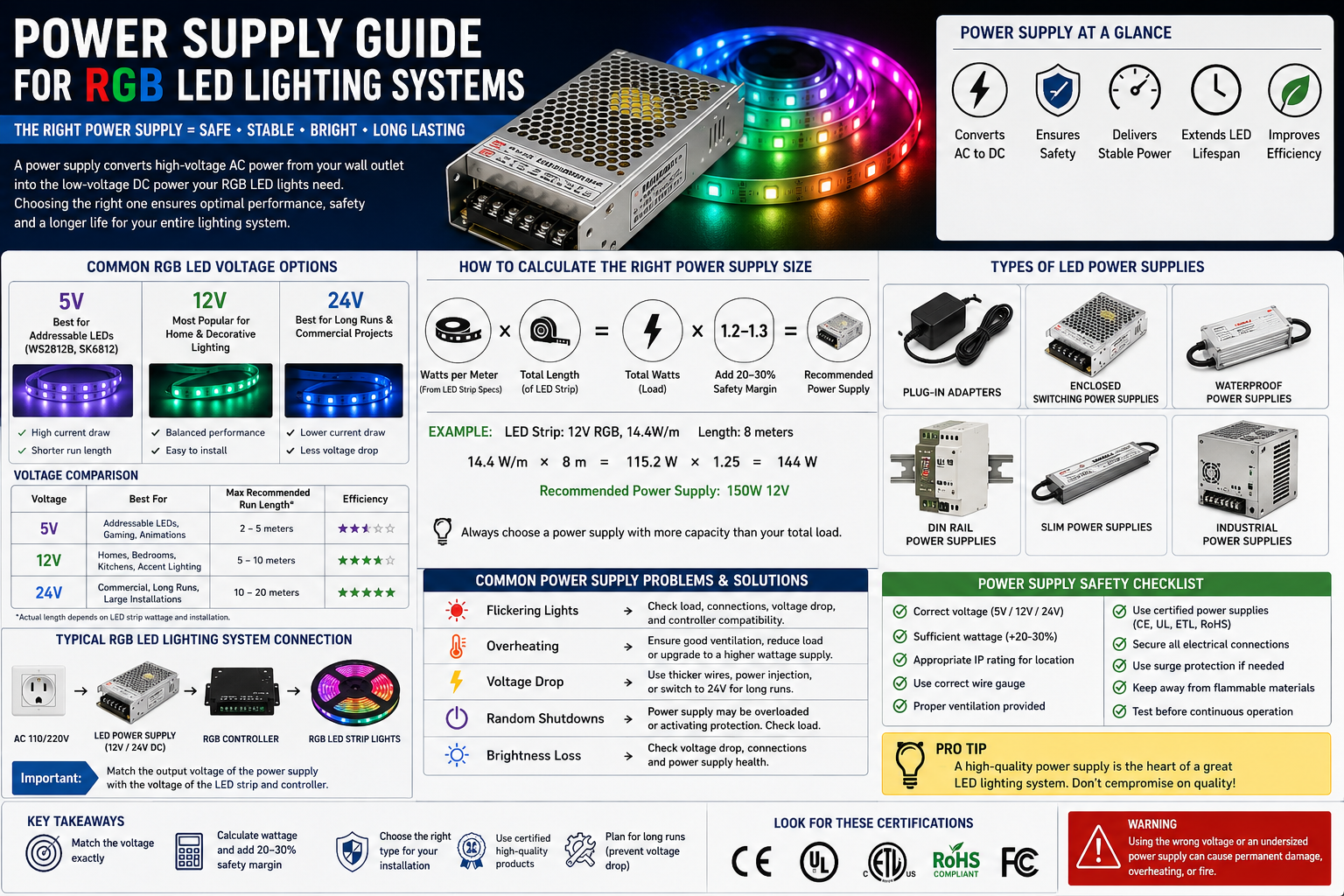
An LED power supply is an electrical device that converts high-voltage alternating current (AC) from your wall outlet into the low-voltage direct current (DC) required by LED lighting systems. Household electricity typically operates at either 120V or 230V AC depending on your country, while most RGB LED strip lights require a stable 5V, 12V, or 24V DC supply. Without this conversion process, LED strips would be damaged almost instantly.
Unlike traditional incandescent lighting, LEDs are semiconductor devices that require carefully regulated electrical power. Even small fluctuations in voltage can affect brightness, color consistency, and lifespan. That is why manufacturers design LED power supplies to provide a stable output regardless of small changes in the incoming electrical supply. High-quality power supplies also include built-in safety features such as overload protection, over-voltage protection, short-circuit protection, and thermal shutdown to protect both the lighting system and the user.
For RGB LED installations, the power supply works together with the LED controller. While the controller changes colors, brightness, and lighting effects, the power supply simply provides clean and reliable electrical energy. Both components are essential, but they perform very different functions within the overall lighting system.
Definition
An LED power supply is a constant voltage electrical converter that transforms AC mains electricity into low-voltage DC power suitable for LED lighting equipment. It ensures the connected LEDs receive the correct voltage and enough current to operate safely and efficiently. Modern switching power supplies are compact, highly efficient, and capable of powering everything from small decorative strips to large architectural lighting systems.
The power supply’s main purpose is to maintain stable voltage output even when electrical demand changes. This stability is critical because LEDs are sensitive electronic devices. A properly designed unit minimizes voltage fluctuations, reduces electrical noise, and supports consistent illumination across the entire installation.
How an LED Power Supply Works
Inside a modern switching power supply, several electronic stages work together to convert and regulate electricity. First, incoming AC power is filtered to reduce electrical interference. Next, the alternating current is rectified into direct current. High-frequency switching components then regulate the output voltage with remarkable efficiency, often exceeding 90%.
This electronic conversion process produces far less heat than older transformer-based power supplies while delivering precise voltage regulation. The result is a compact, lightweight device capable of supplying stable power for extended periods. Many premium models also include active cooling, intelligent thermal management, and automatic protection systems that prevent damage during overloads or electrical faults.
AC to DC Conversion
Wall outlets provide alternating current because it is efficient for long-distance power transmission. LED lighting, however, requires direct current because semiconductor components operate using one-directional electrical flow. The power supply bridges this gap by converting AC into regulated DC.
During this conversion, capacitors smooth out voltage fluctuations while voltage regulators maintain a constant output level. This process ensures the connected RGB LED lighting system receives clean electrical power, reducing flickering, minimizing color shifts, and extending component lifespan. Efficient AC-to-DC conversion also reduces wasted energy, lowering electricity costs over the lifetime of the installation.
Why LED Lighting Requires Low Voltage
Most RGB LED strip lights are engineered to operate at low voltages such as 5V, 12V, or 24V. Low-voltage operation improves electrical safety, reduces the risk of electric shock, simplifies installation, and allows flexible placement in homes, offices, retail spaces, and entertainment venues.
Low-voltage systems are also better suited for electronic controllers that manage color changes, dimming, and programmable lighting effects. Stable low-voltage power enables precise control over every LED segment, ensuring smooth transitions and accurate color reproduction. For homeowners and installers alike, this combination of safety, efficiency, and performance makes low-voltage LED systems the preferred choice for modern RGB lighting projects.
LED Power Supply vs LED Driver
One of the most common sources of confusion in LED lighting is the difference between an LED power supply and an LED driver guide. Although these terms are often used interchangeably, they refer to different types of electrical equipment designed for different lighting applications.
A power supply delivers a fixed voltage, such as 12V or 24V DC, while allowing the connected devices to draw the current they require. An LED driver, by contrast, delivers a constant current and adjusts voltage automatically to match the electrical characteristics of the connected LED module. Understanding this distinction is essential when selecting components for an RGB LED lighting system.
Constant Voltage Power Supplies
Constant voltage power supplies maintain a fixed output voltage regardless of changing load conditions. This design makes them ideal for RGB LED strip lights because the strips contain built-in current-limiting resistors or electronic circuitry that regulates individual LED segments.
The installer simply matches the power supply voltage to the LED strip voltage and ensures sufficient wattage capacity. Constant voltage systems are easy to expand, making them popular for residential lighting, retail displays, signage, and architectural accent lighting.
Constant Current LED Drivers
Constant current LED drivers are commonly used for high-power LEDs, COB modules, industrial lighting fixtures, and commercial luminaires. Instead of maintaining a fixed voltage, they maintain a precise electrical current while adjusting voltage automatically.
These drivers are not typically used with RGB LED strips because strip lights are already designed for constant voltage operation. Using the wrong driver can result in poor performance or permanent damage to the lighting equipment.
Which One RGB LED Strip Lights Use
Nearly all RGB LED strip lights require a constant voltage power supply, typically rated at 5V, 12V, or 24V DC. The LED controller then distributes power across the red, green, and blue channels to create millions of color combinations.
This configuration simplifies installation and allows multiple strip sections to operate consistently from the same power source. As long as the voltage matches and the wattage is sufficient, the lighting system will operate safely and reliably.
Common Misconceptions
Many beginners believe every LED requires a driver. While that is true for certain high-power lighting modules, it is not true for most RGB strip lighting systems. Another misconception is that a higher-voltage power supply automatically provides brighter light. In reality, supplying a 24V power supply to a 12V LED strip can permanently damage the LEDs almost immediately.
Another frequent mistake is assuming that a larger wattage power supply forces additional power into the LEDs. In fact, LEDs only draw the current they require, provided the voltage is correct. Choosing a power supply with extra wattage capacity is actually recommended because it reduces operating stress, improves efficiency, and extends service life.
LED Power Supply vs LED Driver Comparison
| Feature | LED Power Supply | LED Driver |
| Output Type | Constant Voltage | Constant Current |
| Typical Voltage | 5V, 12V, 24V DC | Variable |
| Current | Drawn by LEDs | Regulated by Driver |
| Applications | RGB LED Strip Lights | High-Power LEDs |
| Compatible Products | LED strips, controllers, RGB systems | COB LEDs, commercial fixtures |
| Best For | Decorative and architectural lighting | Professional LED luminaires |
Understanding Voltage Requirements
Selecting the correct voltage is one of the most critical decisions when choosing an LED power supply. Every RGB LED strip is designed to operate at a specific voltage, and using the wrong one can lead to poor performance or permanent damage. Common RGB LED systems are available in 5V, 12V, and 24V, while higher-voltage systems are mainly used in commercial and industrial applications. Each option has its own strengths, limitations, and ideal use cases.
Voltage affects much more than whether your LEDs turn on. It influences the maximum strip length, brightness consistency, cable size, energy efficiency, and installation cost. Lower-voltage systems are excellent for compact projects and individually addressable LEDs, while higher-voltage systems are better suited for long runs because they experience less voltage drop. Understanding these differences helps you select a power supply that delivers reliable performance without unnecessary complexity.
5V RGB LED Systems
A 5V RGB LED lighting system is commonly used with individually addressable LED strips such as WS2812B, SK6812, and similar digital LEDs. These strips allow each LED to display a different color, making them ideal for animated effects, gaming setups, decorative displays, and smart home projects.
The biggest advantage of a 5V system is its flexibility in creating dynamic lighting effects. Each LED contains its own integrated controller, enabling stunning animations that are impossible with standard analog RGB strips. However, the lower operating voltage also means higher current consumption for the same amount of power. As current increases, voltage drop becomes more noticeable, limiting the maximum strip length before additional power injection is required.
For example, a 5-meter addressable LED strip may require power injection every few meters to maintain consistent brightness. Installers must also use thicker wires because higher current generates more heat and greater electrical losses. Although 5V systems demand more careful planning, they remain the preferred choice for projects requiring advanced lighting effects.
Advantages
- Perfect for individually addressable LEDs
- Supports advanced animations and pixel control
- Ideal for gaming rooms and decorative lighting
- Compatible with many smart lighting controllers
Limitations
- Higher current draw
- Increased voltage drop
- Shorter recommended cable lengths
- More frequent power injection required
12V RGB LED Systems
The 12V LED power supply is the most popular choice for residential RGB LED strip installations. It offers an excellent balance between performance, affordability, and installation simplicity. Most analog RGB LED strips found in homes operate on 12 volts, making compatible power supplies widely available and relatively inexpensive.
Compared to 5V systems, a 12V installation carries less current for the same power level. Lower current reduces voltage drop, allowing slightly longer cable runs before brightness begins to decrease. This makes 12V systems ideal for bedrooms, kitchens, living rooms, shelving, TV backlighting, and accent lighting.
Another advantage is the vast availability of accessories, including RGB controllers, dimmers, connectors, and waterproof power supplies. Homeowners and DIY installers often choose 12V because replacement components are easy to source and installation instructions are widely available.
Despite these benefits, very long strip runs still require careful planning. If a single strip exceeds the manufacturer’s recommended maximum length, additional power injection or multiple power supplies may be necessary to maintain uniform brightness.
Best Applications
- Bedroom lighting
- Kitchen cabinet lighting
- TV backlighting
- Shelving illumination
- Home theaters
- Decorative accent lighting
24V RGB LED Systems
A 24V LED power supply is becoming increasingly popular for larger residential projects and commercial lighting installations. By doubling the voltage compared to a 12V system, the current required to deliver the same power is cut approximately in half. Lower current means reduced cable losses, less heat generation, and significantly lower voltage drop.
These characteristics make 24V systems ideal for long LED strip runs. Installers can often power longer sections from a single supply without noticeable brightness differences between the beginning and end of the strip. This simplifies wiring while improving overall efficiency.
Commercial environments such as offices, hotels, restaurants, shopping centers, and exhibition spaces frequently use 24V systems because they reduce installation complexity and maintenance costs. Although 24V components may cost slightly more initially, the improved efficiency often offsets the higher purchase price over time.
Advantages
- Longer continuous strip lengths
- Reduced voltage drop
- Lower current draw
- Improved efficiency
- Less cable heating
Limitations
- Slightly higher equipment cost
- Not compatible with 12V LED strips
- Requires matching 24V controllers and accessories
Higher Voltage Commercial Systems
Large commercial buildings, warehouses, outdoor architectural lighting, and industrial facilities sometimes utilize higher-voltage lighting solutions that incorporate specialized drivers and distribution equipment. These systems are engineered for large-scale installations where efficiency, reliability, and maintenance accessibility are priorities.
Unlike residential RGB strip lighting, commercial systems often integrate advanced lighting controls, centralized monitoring, emergency backup systems, and programmable automation. They may also include multiple power supplies connected through intelligent control networks to manage thousands of LEDs simultaneously.
Professional electrical design is generally recommended for these installations because power distribution, circuit protection, and load balancing become increasingly important as system size grows.
Voltage Comparison Table
| Voltage | Best Applications | Maximum Recommended Run Length* | Efficiency |
| 5V | Addressable RGB LEDs, gaming setups | 2–5 meters | Moderate |
| 12V | Homes, kitchens, bedrooms, accent lighting | 5–10 meters | High |
| 24V | Commercial projects, long strip runs | 10–20 meters | Very High |
*Actual maximum length depends on LED strip wattage and manufacturer specifications.
How to Calculate the Correct Power Supply Size
Choosing the correct LED strip power supply involves more than matching voltage. The power supply must also provide enough wattage to operate the entire lighting system without being overloaded. A properly sized power supply runs cooler, lasts longer, and provides stable brightness even during continuous operation.
Many beginners simply estimate the required wattage, but professional installers always perform a power calculation before purchasing equipment. The process is straightforward and only requires three pieces of information:
- LED strip wattage per meter
- Total strip length
- Recommended safety margin
Once these values are known, selecting the correct power supply becomes easy.
Determine LED Strip Wattage per Meter
Manufacturers specify the power consumption of LED strips in watts per meter (W/m) or watts per foot. This value indicates how much electrical power each section of the strip requires when operating at full brightness.
Typical examples include:
| LED Strip Type | Power Consumption |
| Basic RGB | 7.2 W/m |
| High Brightness RGB | 14.4 W/m |
| Premium RGBW | 19.2 W/m |
| High Density RGB | 24 W/m |
Always check the manufacturer’s specifications rather than guessing. Two strips that look nearly identical may consume significantly different amounts of power.
Measure Total Strip Length
Next, calculate the total length of LED strip that will be connected to the same power supply. Include every section powered by that supply, even if multiple strips are connected in parallel.
For example:
- Bedroom ceiling: 8 meters
- TV backlight: 3 meters
- Shelving: 4 meters
Total strip length:
8 + 3 + 4 = 15 meters
This total length will be used in the power calculation.
Calculate Total Power Consumption
Multiply the strip wattage by the total installation length.
Formula:
Total Watts = Watts per Meter × Total Length
Example 1 – Bedroom LED Installation
LED Strip:
- 12V RGB
- 14.4 W/m
Length:
- 8 meters
Calculation:
14.4 × 8 = 115.2 Watts
The LEDs require approximately 115 Watts under full load.
Example 2 – Kitchen Cabinet Lighting
LED Strip:
- 9.6 W/m
Length:
- 5 meters
Calculation:
9.6 × 5 = 48 Watts
Required output:
48W
Example 3 – Gaming Room Setup
LED Strip:
- 18 W/m
Length:
- 10 meters
Calculation:
18 × 10 = 180 Watts
The lighting system consumes 180W at maximum brightness.
Example 4 – Commercial Display Lighting
LED Strip:
- 24 W/m
Length:
- 20 meters
Calculation:
24 × 20 = 480 Watts
For larger projects like this, installers often divide the load between multiple power supplies to improve reliability and simplify maintenance.
Add a 20–30% Safety Margin
Professional electricians never size a power supply exactly equal to the calculated load. Operating continuously at 100% capacity increases heat generation and shortens the life of electronic components.
Instead, add 20–30% spare capacity.
Example:
Calculated load:
180W
20% Safety Margin:
180 × 1.20 = 216W
Recommended power supply:
240W 12V LED Power Supply
This additional capacity keeps the power supply running cooler, improves efficiency, and provides room for future expansion.
LED Wattage Calculation Table
| Project | Strip Length | Wattage per Meter | Total Load | Recommended Power Supply |
| Bedroom | 8 m | 14.4 W/m | 115 W | 150 W |
| Kitchen | 5 m | 9.6 W/m | 48 W | 60 W |
| Gaming Room | 10 m | 18 W/m | 180 W | 240 W |
| Commercial Display | 20 m | 24 W/m | 480 W | 600 W |
How to Choose the Right LED Power Supply
Selecting the correct LED power supply is about much more than simply matching the voltage listed on your LED strip. A quality power supply directly impacts brightness consistency, color accuracy, energy efficiency, and the overall lifespan of your RGB LED lighting system. Even the highest-quality LED strips can perform poorly if they are paired with an undersized or low-quality power supply.
Professional lighting designers evaluate several factors before choosing a power supply, including voltage compatibility, wattage capacity, installation environment, cooling method, enclosure type, safety certifications, and future expansion needs. Spending a little extra time during the planning stage helps prevent costly troubleshooting later. Whether you’re installing decorative lighting in a home or powering a commercial display, following these guidelines will help you choose a reliable solution.
Voltage Compatibility
The first and most important rule is to match the output voltage of the power supply with the voltage rating of the LED strip. If your LED strip is designed for 12V, it must be connected to a 12V power supply. The same rule applies to 5V and 24V systems.
Using a lower voltage than required usually results in dim lighting or the LEDs failing to turn on. Using a higher voltage is far more serious because it can permanently damage the LEDs, controllers, and other connected components within seconds.
Before purchasing a power supply, always verify:
- LED strip operating voltage
- RGB controller voltage rating
- Power supply output voltage
All three must be compatible.
Wattage Capacity
After confirming voltage compatibility, calculate the required wattage using the method described earlier. Always include a 20–30% safety margin to prevent the power supply from operating continuously at maximum capacity.
For example:
- LED Load: 120W
- Safety Margin: 30%
- Recommended Power Supply: 160W
An oversized power supply does not force extra power into the LEDs. Instead, it simply provides additional capacity that the LEDs may use if needed. Operating below maximum capacity reduces heat generation and often extends the lifespan of the power supply.
Indoor vs Outdoor Use
Installation location significantly affects the type of power supply you should choose.
Indoor power supplies are designed for dry environments where they are protected from moisture, dust, and direct weather exposure. They are commonly installed inside cabinets, ceilings, entertainment units, and equipment enclosures.
Outdoor installations require waterproof LED power supplies with weather-resistant housings that protect internal electronics from rain, humidity, snow, and dust. Outdoor models are ideal for garden lighting, landscape illumination, architectural façades, and signage.
Never use an indoor-rated power supply in an outdoor location, even if it is placed under a roof or awning. Moisture can still enter the enclosure over time and cause corrosion, electrical faults, or complete failure.
IP Ratings
The Ingress Protection (IP) rating indicates how well a power supply is protected against dust and water.
| IP Rating | Protection Level | Recommended Use |
| IP20 | Dust protection only | Indoor dry areas |
| IP44 | Splash resistant | Covered outdoor spaces |
| IP65 | Water-resistant | Outdoor walls and patios |
| IP67 | Waterproof | Wet environments |
| IP68 | Continuous water exposure | Specialized outdoor projects |
For most residential indoor RGB lighting projects, an IP20 power supply is sufficient. Outdoor installations generally require at least IP65 or higher.
Cooling Method
Every power supply generates heat while operating. Efficient cooling helps maintain stable performance and extends component life.
Fan-Cooled Power Supplies
These models use internal fans to improve airflow. They are commonly found in high-wattage commercial installations where maximum power output is required. Although effective, they can produce noticeable noise, making them less suitable for bedrooms or quiet living spaces.
Passive Cooling
Passive power supplies rely on aluminum housings and natural airflow to dissipate heat. They operate silently and are ideal for homes, offices, retail displays, and entertainment systems.
When installing any power supply, ensure there is adequate ventilation around the unit. Blocking airflow can cause overheating and activate thermal protection circuits.
Safety Certifications
Reliable manufacturers test their power supplies against internationally recognized electrical safety standards. Choosing certified products provides greater confidence in long-term reliability and user safety.
Look for certifications such as:
- CE
- UL
- ETL
- RoHS
- FCC (where applicable)
Certified power supplies are more likely to include built-in protections against:
- Short circuits
- Over-voltage
- Over-current
- Over-temperature
- Electrical overload
Although certified units may cost slightly more, they often provide better performance and durability than low-cost, uncertified alternatives.
Build Quality
The quality of internal components greatly affects the reliability of an LED power supply. Premium models typically include:
- High-quality capacitors
- Efficient transformers
- Better heat sinks
- Improved voltage regulation
- Enhanced electrical protection
Well-built power supplies maintain stable output even during extended operation, reducing flicker and improving LED lifespan. Cheap units may initially appear similar but often suffer from voltage fluctuations, excessive heat, or premature failure.
Understanding LED Controllers and Accessories Explained helps you build a more reliable and flexible lighting system. Controllers manage colors, brightness, and effects, while accessories like power supplies, connectors, and amplifiers improve performance and installation quality. Learning how these components work together ensures a smoother and smarter LED lighting experience.
Power Supply Selection Checklist
Before purchasing an LED power supply, confirm the following:
✔ Voltage matches the LED strip (5V, 12V, or 24V)
✔ Wattage exceeds calculated load by at least 20%
✔ Suitable IP rating for the installation environment
✔ Certified by recognized safety organizations
✔ Adequate ventilation available
✔ Compatible with RGB controllers
✔ High-quality construction
✔ Future expansion considered
Types of LED Power Supplies
Modern LED lighting systems use several different styles of power supplies. Choosing the right type depends on the installation environment, available space, and total power requirements.
Plug-In Power Adapters
Plug-in adapters are the simplest option for small residential lighting projects. They connect directly to a wall outlet and provide low-voltage DC power through a barrel connector or screw terminals.
These adapters are ideal for:
- TV backlighting
- Small shelving installations
- Bedroom lighting
- Gaming desks
- Decorative displays
Advantages include easy installation, compact size, and minimal wiring.
Limitations include relatively low wattage and limited expandability.
Enclosed Switching Power Supplies
Enclosed switching power supplies are among the most popular options for medium and large RGB LED installations. They feature a metal housing with ventilation openings and screw terminals for secure electrical connections.
Common applications include:
- Retail displays
- Kitchen lighting
- Commercial signage
- Home automation
- Architectural lighting
These units offer excellent efficiency, stable voltage regulation, and wide power ranges.
Waterproof Power Supplies
Outdoor lighting projects require waterproof power supplies specifically designed to withstand environmental conditions.
Typical applications include:
- Landscape lighting
- Garden paths
- Swimming pool surroundings
- Outdoor entertainment areas
- Building façades
Waterproof models use sealed housings that protect electronic components from moisture and dust while maintaining reliable operation throughout the year.
DIN Rail Power Supplies
DIN rail power supplies are designed for professional electrical control panels and industrial automation systems. They snap directly onto standardized DIN rails, making installation neat and organized.
These units are commonly used in:
- Smart buildings
- Industrial control systems
- Commercial automation
- Security systems
- Intelligent lighting networks
They offer excellent reliability and simplify maintenance within electrical cabinets.
Slim LED Power Supplies
Slim power supplies are engineered for installations with limited available space.
Common examples include:
- Cabinet lighting
- Furniture lighting
- Display shelves
- Ceiling coves
- Mirror lighting
Despite their compact dimensions, many slim models provide impressive efficiency and dependable voltage regulation.
Industrial Power Supplies
Industrial-grade power supplies are designed for demanding environments requiring continuous operation under heavy loads.
They typically feature:
- Higher power capacity
- Enhanced cooling
- Rugged construction
- Superior electrical protection
- Long service life
These units are frequently used in warehouses, factories, transportation facilities, stadiums, and large commercial installations where reliability is critical.
Common Power Supply Problems
Even a high-quality LED power supply can experience issues if it is installed incorrectly, overloaded, or paired with incompatible components. Fortunately, most problems have clear causes and practical solutions. Understanding these common issues can save time, reduce maintenance costs, and extend the lifespan of your RGB LED lighting system.
Flickering LEDs
Flickering is one of the most frequently reported problems in LED lighting installations. It can range from subtle brightness fluctuations to rapid flashing that makes the lighting unusable.
Common Causes
- Undersized power supply
- Loose electrical connections
- Voltage fluctuations
- Faulty RGB controller
- Damaged LED strip
- Low-quality power supply
Solutions
Start by verifying that the power supply has sufficient wattage for the connected load. Tighten all wiring connections, inspect connectors for corrosion, and confirm that the output voltage matches the LED strip specifications. If the issue persists, test the system with another certified power supply to determine whether the original unit is faulty.
Voltage Drop
Voltage drop occurs when electrical resistance causes the voltage to decrease as electricity travels through the wiring or along a long LED strip.
Typical symptoms include:
- Bright LEDs near the power supply
- Dim LEDs at the far end
- Color inconsistency
- Uneven brightness
Longer installations and higher current draw increase the severity of voltage drop.
Solutions
- Use shorter strip runs.
- Inject power at multiple points.
- Upgrade to a 24V LED power supply for long installations.
- Use thicker power cables.
- Divide large projects across multiple power supplies.
Overheating
Heat is one of the biggest enemies of electronic equipment. A power supply that consistently operates above its rated capacity will generate excessive heat, reducing efficiency and shortening its lifespan.
Causes
- Continuous overload
- Poor ventilation
- High ambient temperature
- Dust accumulation
- Low-quality internal components
Solutions
Ensure the power supply operates at no more than 80% of its rated capacity whenever possible. Install it in a well-ventilated location, keep cooling vents clear, and periodically remove dust from the enclosure. For high-power commercial systems, consider fan-cooled models or additional ventilation.
Power Supply Noise
Some switching power supplies produce a faint humming or buzzing sound. While a slight noise can be normal, loud or increasing noise may indicate a problem.
Possible Causes
- Coil vibration
- Loose internal components
- Electrical overload
- Aging capacitors
Solutions
If the noise becomes excessive, inspect the installation for overload conditions and verify that the unit is securely mounted. Persistent buzzing from an older power supply often indicates that replacement is the safest option.
Random Shutdowns
A power supply that turns off unexpectedly is usually activating its built-in protection circuits.
Common Reasons
- Overload protection
- Thermal protection
- Short circuit
- Internal failure
Solutions
Disconnect the load and reconnect individual LED sections one at a time. This process helps identify faulty strips or wiring issues. Also verify that the total wattage remains below the rated capacity of the power supply.
Brightness Loss
If LED strips gradually become dimmer over time, the problem may not be the LEDs themselves.
Possible causes include:
- Voltage drop
- Aging power supply
- Loose wiring
- Oxidized connectors
- Excessive cable length
Replacing worn connectors and ensuring stable voltage often restores normal brightness.
Voltage Drop in Long LED Strip Installations
Voltage drop is one of the most misunderstood concepts in LED lighting. Even experienced DIY installers sometimes assume that using a larger power supply alone will solve brightness issues. In reality, voltage drop is primarily caused by resistance in the wiring and the copper traces inside the LED strip itself.
As electricity travels through the strip, small amounts of energy are lost as heat. The farther the electricity must travel, the greater the loss. This is why LEDs closest to the power supply often appear brighter than those at the opposite end.
What Causes Voltage Drop?
Several factors contribute to voltage drop:
- Long LED strip runs
- Thin wiring
- High current
- Poor-quality copper traces
- Loose electrical connections
Lower-voltage systems such as 5V RGB LED strips experience voltage drop much sooner than 24V systems because they require significantly higher current to deliver the same amount of power.
Signs of Voltage Drop
Watch for these common symptoms:
- LEDs become dimmer toward the end of the strip.
- White light develops a yellow or reddish tint.
- Colors appear inconsistent.
- Brightness changes during animations.
- End sections fail to illuminate fully.
Recognizing these signs early helps prevent unnecessary replacement of perfectly good LED strips.
How to Prevent Voltage Drop
Professional installers use several techniques to minimize voltage drop:
- Select 24V LED strips for long runs.
- Keep cable lengths as short as possible.
- Use thicker wire gauges.
- Feed power from both ends of the strip.
- Divide very large installations into multiple circuits.
- Use multiple power supplies where appropriate.
Proper planning during installation is much easier than correcting voltage drop after the project is complete.
Power Injection Techniques
Power injection simply means supplying power to additional points along the LED strip rather than only at the beginning.
Example:
Power Supply
│
▼
==========================
LED STRIP
==========================
▲
│
Second Power Injection
For example, imagine installing a 15-meter 12V RGB LED strip around a room. Instead of powering all 15 meters from one end, you could connect the power supply at the beginning and inject additional power near the middle or end. This keeps voltage more consistent across the entire installation, resulting in uniform brightness and color.
Safety Tips for LED Power Supplies
Electrical safety should always be a priority when installing any RGB LED lighting system. While low-voltage LED systems are generally safer than mains-voltage lighting, improper installation can still create risks such as overheating, equipment damage, or fire.
Follow these best practices:
- Provide adequate ventilation around the power supply.
- Never exceed the rated wattage.
- Match voltage exactly.
- Use the correct wire gauge.
- Install surge protection where appropriate.
- Properly ground metal enclosures when required.
- Use waterproof power supplies outdoors.
- Keep flammable materials away from power supplies.
- Inspect wiring regularly for signs of wear or damage.
- Disconnect power before servicing the system.
Electrical Safety Checklist
✔ Correct voltage selected
✔ Wattage includes a 20–30% safety margin
✔ Wire gauge sized correctly
✔ Ventilation openings remain unobstructed
✔ Outdoor installations use waterproof power supplies
✔ Surge protection installed where needed
✔ Secure electrical connections
✔ Proper grounding completed
✔ Certified power supply used
✔ Installation tested before continuous operation
Common Mistakes to Avoid
Even experienced installers occasionally make avoidable mistakes. Preventing these common errors will improve system reliability and reduce future maintenance.
Buying an Undersized Power Supply
A power supply operating continuously at full capacity generates more heat and has a shorter lifespan. Always include spare capacity.
Mixing Voltages
Never connect:
- 24V power supply to 12V LEDs
- 12V power supply to 5V LEDs
- Different voltage strips on the same circuit
Voltage mismatch is one of the fastest ways to destroy LED equipment.
Ignoring Wattage Calculations
Guessing instead of calculating often results in overload problems. Always calculate total power consumption before purchasing equipment.
Using Indoor Power Supplies Outdoors
Rain, humidity, and condensation can quickly damage indoor power supplies. Always select an IP-rated enclosure for outdoor installations.
Poor Cable Management
Messy wiring increases the risk of loose connections, accidental damage, and difficult maintenance. Use cable clips, conduits, or cable trays where appropriate.
Blocking Ventilation
Do not install enclosed switching power supplies inside sealed boxes without airflow. Excessive heat significantly reduces lifespan.
Choosing Low-Quality Power Supplies
Very inexpensive, uncertified power supplies may lack essential safety protections and often fail much sooner than reputable products. Investing in a trusted brand usually saves money over the long term.
Conclusion
Choosing the right LED power supply guide is essential for building a safe, efficient, and reliable RGB LED lighting system. Matching the correct voltage, accurately calculating total wattage, and adding a 20–30% safety margin will help prevent flickering, overheating, voltage drop, and premature equipment failure. Selecting a high-quality, certified power supply with the appropriate IP rating and cooling method further improves long-term performance and peace of mind.
Before purchasing any LED power supply, take the time to calculate your lighting requirements carefully and consider future expansion. A properly planned installation not only delivers brighter and more consistent lighting but also reduces maintenance costs and extends the lifespan of your entire LED system.
Frequently Asked Questions
1. What size power supply do I need for RGB LED strip lights?
Calculate the total wattage of your LED strips and add a 20–30% safety margin. For example, a 100W load should use at least a 120–130W power supply.
2. How do I calculate LED power requirements?
Multiply the strip’s wattage per meter by its total length, then add a safety margin.
3. Is a 12V or 24V power supply better?
For shorter residential installations, 12V is usually sufficient. For longer runs with less voltage drop, 24V is generally the better choice.
4. What happens if the power supply is too small?
It may overheat, flicker, shut down, or fail prematurely.
5. Can one power supply run multiple LED strips?
Yes, provided the combined wattage stays within the power supply’s rated capacity.
6. What is voltage drop?
Voltage drop is the reduction in electrical voltage caused by resistance in wires or LED strips over long distances.
7. Do LED strips need a driver or a power supply?
Most RGB LED strip lights use a constant-voltage power supply, not a constant-current LED driver.
8. Can I use a larger wattage power supply?
Yes. LEDs only draw the power they need, provided the voltage is correct.
9. How long do LED power supplies last?
A quality power supply typically lasts 30,000–50,000 hours, depending on operating conditions and load.
10. Are waterproof power supplies necessary outdoors?
Yes. Outdoor installations should use a power supply with a suitable IP rating, typically IP65 or higher.
11. What certifications should I look for?
Look for CE, UL, ETL, RoHS, or equivalent certifications from recognized testing organizations.
12. Can an overloaded power supply damage LED lights?
Yes. Continuous overload can cause voltage instability, overheating, and premature failure of both the power supply and connected LEDs.