Introduction
Modern events rely heavily on lighting to create memorable experiences. Whether it is a live concert, wedding reception, fashion show, conference, or nightclub performance, lighting has the power to transform ordinary spaces into immersive environments.
Among all stage lighting equipment available today, beam lights for stage lighting remain one of the most popular solutions. Their sharp beams, long throw distances, fast movement, and dynamic effects make them ideal for professional event production.
From audience engagement to enhancing stage design, beam lights help bring performances to life. They create movement, depth, and atmosphere while supporting performers and strengthening the overall visual impact.
Complete Guide to Stage, DJ & Event Lighting covers everything you need to know about professional lighting setups, including equipment types, applications, and installation tips. Explore expert insights to choose the right lighting solutions for concerts, DJs, weddings, and live events.
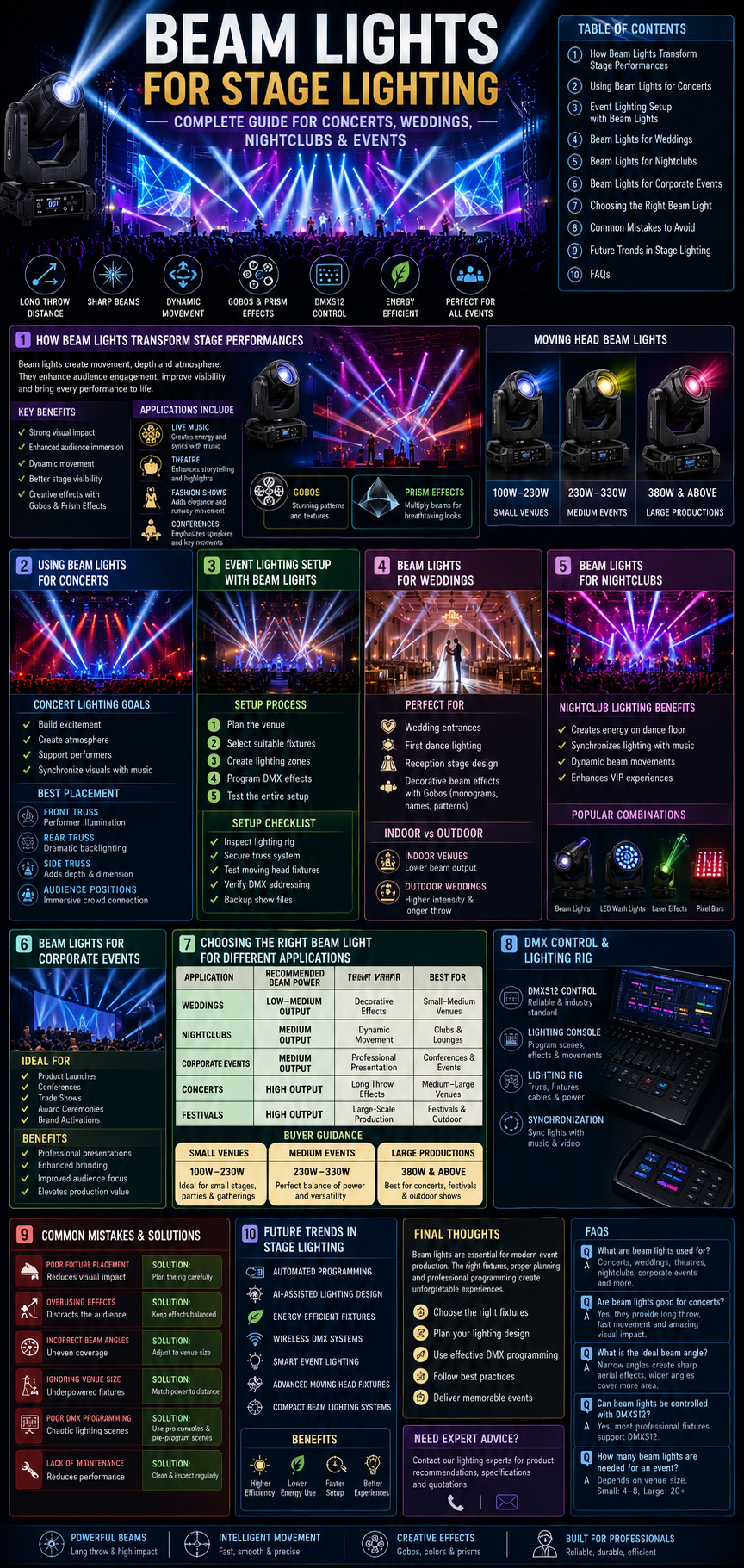
How Beam Lights Transform Stage Performances
How do beam lights improve stage performances?
Beam lights improve stage performances by creating dynamic visual effects, enhancing audience engagement, increasing performer visibility, and adding depth and movement to productions. Their concentrated beams and intelligent movement capabilities make them essential tools for concerts, theatres, conferences, and live events.
Professional stage designers use moving head fixtures and beam spotlight effects to create dramatic moments that capture attention.
Key Benefits
- Strong visual impact
- Enhanced audience immersion
- Dynamic movement
- Better stage visibility
- Creative effects using Gobos and Prism Effects
Applications Include
Live Music
Concert production teams use beam lighting systems to synchronize effects with music and create energetic atmospheres.
Theatre Productions
Beam lights highlight actors and enhance storytelling.
Fashion Shows
Moving head lighting adds elegance and movement to runway presentations.
Conferences
Corporate productions use beam effects to emphasize speakers and product reveals.
Using Beam Lights for Concerts
Concert lighting aims to create energy and immerse audiences in the performance.
Concert Lighting Goals
- Build excitement
- Create atmosphere
- Support performers
- Synchronize visuals with music
Why Concerts Use Beam Lights
Professional beam lights are favored because they provide:
- Long throw distance
- Sharp beam effects
- Fast pan and tilt movement
- DMX512 synchronization
- Multiple Gobos and Prism Effects
Modern lighting consoles allow lighting programming to follow the rhythm of the music and create spectacular scenes.
Beam Light Placement for Concert Stages
Front Truss
Provides performer illumination.
Rear Truss
Creates silhouettes and dramatic backlighting.
Side Truss
Adds depth and dimension.
Audience Lighting Positions
Produces immersive effects that connect performers with the crowd.
Practical Recommendation
Large concert stage lighting systems often combine moving head beam lights with wash fixtures and LED technology to achieve maximum versatility.
Event Lighting Setup with Beam Lights
Successful event lighting starts with proper planning.
How to set up beam lights for an event?
- Plan the venue.
- Select suitable fixtures.
- Create lighting zones.
- Program DMX effects.
- Test the entire lighting design.
Step 1: Planning the Venue
Evaluate:
- Venue dimensions
- Ceiling height
- Truss system placement
- Audience areas
Proper production management ensures the lighting rig supports the event goals.
Step 2: Selecting Fixtures
Choose beam lights based on:
- Throw distance
- Beam angle
- Power output
- Event size
Step 3: Creating Lighting Zones
Professional event lighting generally includes:
- Stage area
- Audience lighting
- Decorative effects
- Accent lighting
Step 4: Programming DMX Effects
DMX512 technology allows:
- Scene changes
- Movement synchronization
- Color transitions
- Beam patterns
Step 5: Testing the Lighting Design
Before every event:
- Verify fixture positioning.
- Test DMX controllers.
- Check safety connections.
- Confirm lighting programming.
Setup Checklist
✓ Inspect lighting rig
✓ Secure truss system
✓ Test moving head fixtures
✓ Verify DMX addressing
✓ Backup show files
Beam Lights for Wedding Stages
Wedding stage lighting requires elegance and subtlety.
Wedding Entrance Effects
Moving head beam lights create dramatic entrances for couples without overwhelming guests.
First Dance Lighting
Soft beam movements add romance while maintaining visibility for photography and video production.
Reception Stage Design
Beam lights enhance:
- Floral arrangements
- Backdrops
- Dance floors
- Cake presentation areas
Decorative Beam Effects
Gobos can project:
- Monograms
- Names
- Custom patterns
Indoor vs Outdoor Wedding Lighting
Indoor Venues
Require lower beam output.
Outdoor Weddings
Need higher intensity fixtures and longer throw distances.
Practical Example
Most wedding stage lighting systems combine beam lights with warm LED wash fixtures to create balanced visual experiences.
Beam Lights for Nightclubs
Nightclub lighting focuses on energy and excitement.
Creating Energy on the Dance Floor
Dynamic beam movements encourage audience participation and increase immersion.
Synchronizing Lighting with Music
Modern lighting consoles integrate with sound systems to deliver synchronized effects.
Dynamic Beam Movements
Moving head lighting allows:
- Fast sweeps
- Circle effects
- Crossing beams
- Aerial effects
Combining Beam Lights with LED Effects
Popular nightclub combinations include:
- Beam lights
- LED wash lights
- Laser effects
- Pixel bars
Creating VIP Experiences
Focused beam spotlight effects help highlight VIP areas and performers.
Real-World Recommendation
Nightclubs benefit from medium-output beam lighting systems capable of continuous operation and rapid movement.
Beam Lights for Corporate Events
Professional lighting plays a crucial role in branding and audience engagement.
Product Launches
Beam lights create dramatic reveals.
Conferences
Controlled lighting improves speaker visibility.
Trade Shows
Professional event lighting attracts attention to booths and displays.
Award Ceremonies
Moving beam effects elevate production value.
Brand Activations
Creative lighting design strengthens brand experiences.
Professional Example
Corporate event lighting often combines beam lights with intelligent lighting systems and LED screens to create premium presentations.
Choosing the Right Beam Light for Different Applications
| Application | Recommended Beam Power | Typical Setup |
| Weddings | Low-Medium Output | Decorative Effects |
| Nightclubs | Medium Output | Dynamic Movement |
| Corporate Events | Medium Output | Professional Presentation |
| Concerts | High Output | Long Throw Effects |
| Festivals | High Output | Large-Scale Production |
Buyer Guidance
Small Venues
100W–230W fixtures are usually sufficient.
Medium Events
230W–330W moving head beam lights provide excellent versatility.
Large Productions
380W and above are commonly used in concert production and outdoor festivals.
Beam Light Buying Guide helps you understand key factors like brightness, beam angle, features, and performance before purchasing a stage lighting solution. Explore expert tips and recommendations to choose the right beam light for events, concerts, and professional applications.
Common Mistakes When Using Beam Lights for Events
Poor Fixture Placement
Incorrect positioning reduces visual impact.
Solution
Plan the lighting rig carefully.
Overusing Effects
Too many beam effects can distract audiences.
Solution
Maintain balance within the lighting design.
Incorrect Beam Angles
Improper beam angle selection causes uneven coverage.
Solution
Adjust fixtures according to venue dimensions.
Ignoring Venue Size
Underpowered fixtures struggle in large venues.
Solution
Match fixture power to throw distance requirements.
Poor DMX Programming
Weak programming results in chaotic lighting scenes.
Solution
Use professional lighting consoles and pre-program scenes.
Lack of Maintenance
Dirty lenses and worn components reduce performance.
Solution
Perform routine inspections and maintenance.
Future Trends in Stage Lighting Applications
The industry continues evolving through innovations in LED technology and intelligent lighting systems.
Major trends include:
- Automated programming
- AI-assisted lighting design
- Energy-efficient fixtures
- Wireless DMX systems
- Smart event lighting
- Advanced moving head fixtures
- Compact beam lighting systems
These developments are improving efficiency while reducing energy consumption and setup time.
Final Thoughts
Beam lights for stage lighting remain among the most versatile tools available for modern event production. From concerts and weddings to corporate events and nightclubs, they help create memorable experiences while enhancing audience engagement.
Successful lighting design depends on selecting the right fixtures, implementing effective DMX programming, and following industry best practices.
Consult experienced lighting professionals or request product specifications and quotations to identify the best solution for your next project.
How are beam lights used on stage?
Beam lights are used to create movement, improve visibility, and add dynamic effects that enhance audience experiences during performances and events.
Are beam lights good for concerts?
Yes. Beam lights are ideal for concerts because they offer long throw distances, fast movement, and synchronization with music.
What lights are best for wedding stages?
Beam lights combined with LED wash fixtures create elegant and visually appealing wedding environments.
How many beam lights are needed for an event?
The number depends on venue size and production requirements. Small events may use 4–8 fixtures, while large concerts can require dozens.
FAQs
What are beam lights used for?
Beam lights are used for concerts, theatres, weddings, corporate events, and nightclub lighting.
Are moving head beam lights suitable for outdoor events?
Yes. High-power fixtures are commonly used for festivals and outdoor productions.
Can beam lights be controlled with DMX512?
Yes. Most professional beam lights support DMX512 protocols.
What is the ideal beam angle?
Narrow beam angles provide sharp aerial effects, while wider angles offer broader coverage.
Do beam lights consume a lot of electricity?
Modern LED technology has significantly improved energy efficiency.
Are beam lights suitable for churches?
Yes. Churches and auditoriums frequently use professional beam lights.
How many fixtures are needed for weddings?
Most wedding stages use between four and twelve beam lights.
Can beam lights synchronize with music?
Yes. DMX programming and lighting consoles allow synchronized effects.
What is a lighting rig?
A lighting rig consists of fixtures, truss systems, controllers, and support equipment.
Are Gobos and Prism Effects important?
Yes. They enhance creativity and add texture to lighting designs.