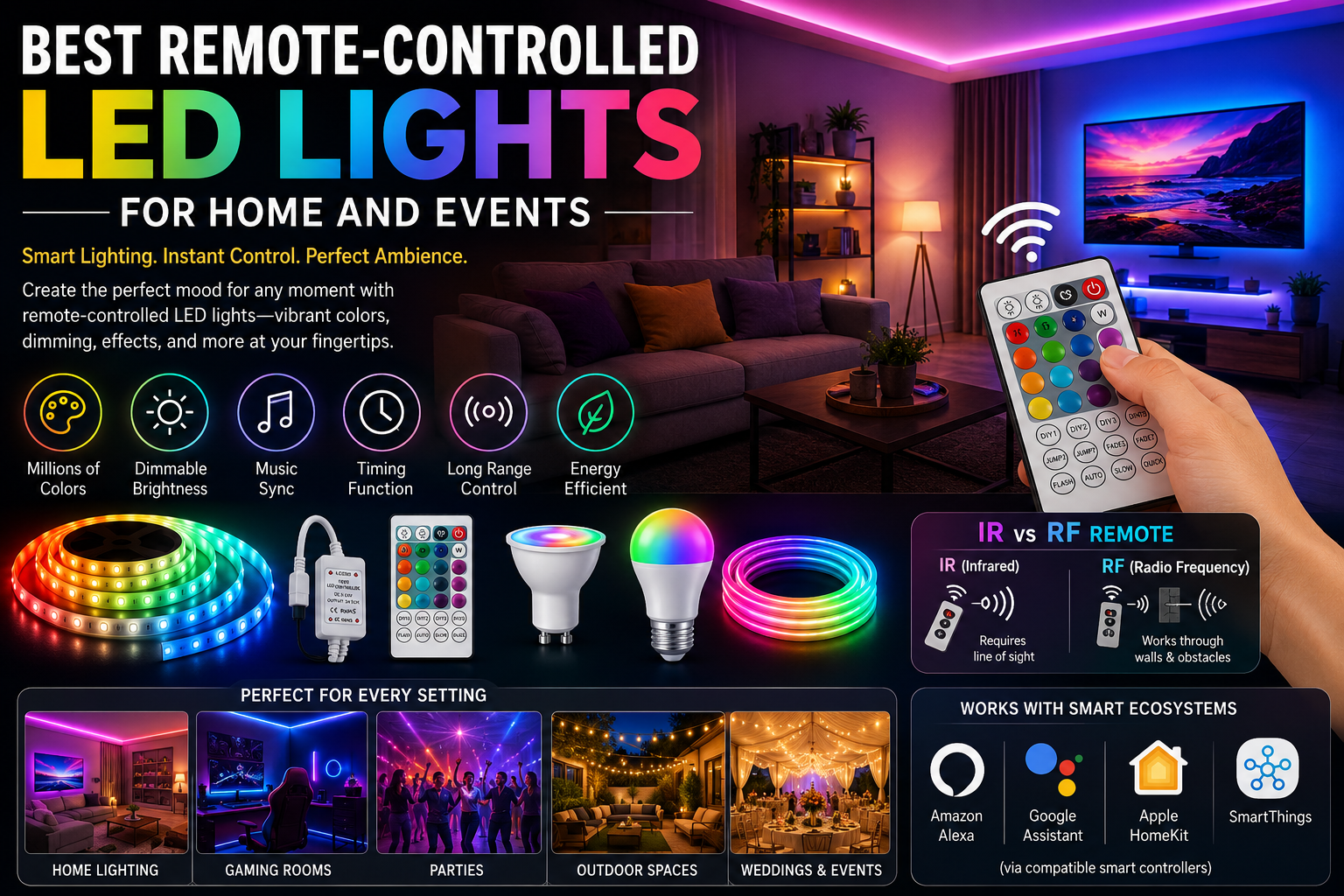
Remote control LED lights have become one of the easiest ways to make a room feel polished, flexible, and fun without turning lighting into a complicated project. Because LEDs are semiconductor light sources that can emit visible or infrared light, they fit neatly into everything from simple bedroom accents to full event displays. That versatility is exactly why remote control LED lights keep showing up in homes, weddings, parties, gaming setups, and commercial spaces. They give you fast control, better mood-setting, and a much cleaner user experience than walking around flipping switches all night.
If you have ever tried to change the vibe of a room right before guests arrive, you already know the appeal. A soft warm glow for dinner, bright white light for cleanup, colorful effects for a birthday, and subtle accent lighting for a movie night can all come from the same lighting setup. That is the real magic of wireless control: your lights stop being fixed hardware and start acting like part of the experience. In this guide, you will see how remote controlled LED lights, wireless LED lights, RGB LED lights with remote, and smart LED lights differ, and how to choose the right one for your home or event.
Want to understand smart lighting before choosing your setup? Explore Color Changing LED Lights: The Complete Guide to learn how RGB lighting works, compare different LED types, and discover the best options for homes, gaming rooms, events, and smart lighting projects. Find practical tips on features, installation, and selecting the right lighting for your space.
What Are Remote Control LED Lights?
Remote control LED lights are lighting products that let you change power, brightness, color, or effects without walking up to the fixture. They are built around LED technology, which is widely valued because LED lamps are far more energy efficient than older incandescent and fluorescent lighting, and they last much longer in real-world use. In practical terms, that means you are not just buying a color-changing gadget; you are buying a more flexible lighting system that can save effort and reduce maintenance over time. For homes and event spaces, that combination of control and efficiency is what makes the category so popular.
How Remote-Controlled LED Lights Work
Most remote-controlled lighting systems send a command from a handheld remote to the light receiver. In infrared systems, the remote sends invisible light signals, and the receiver must “see” the signal directly, which is why line of sight matters. In radio frequency systems, the remote sends radio signals instead, and those signals do not need a direct visual path to the fixture. That basic difference affects everything from range to convenience, and it is one of the first things a buyer should understand before choosing a system.
Types of Wireless Control Systems
The two big control styles are IR remote LED lights and RF remote LED lights. IR remotes are usually cheaper and simple to use, but they can be blocked by furniture, cabinet doors, or the wrong angle. RF remotes are more forgiving because they do not depend on direct line of sight, which makes them a stronger choice for larger rooms, mounted strips, hidden fixtures, or event setups where people are moving around constantly. If you want the least amount of fuss, RF is usually the more practical long-term pick.
RGB and RGBW Color Technology
Color-changing LED lights typically use red, green, and blue channels to create a wide range of colors. In LED systems, different semiconductor materials and phosphor approaches can produce visible light in different colors, and white light can be created in more than one way. In buyer terms, RGB lighting systems are best when you want dramatic color effects, while RGBW models add a dedicated white channel that usually gives cleaner everyday white light for normal room use.
That is why RGB lights feel playful and event-ready, while RGBW lights often feel more balanced for daily living spaces.Still deciding between RGB and RGBW lighting? Understanding the difference can make a big impact on brightness, color quality, and overall ambiance. Explore RGBW vs RGB LED Strips to learn how dedicated white LEDs improve lighting performance and which option works best for smart homes, gaming rooms, and decorative setups.
Smart vs Traditional Remote Control Lighting
Traditional remote lights are usually easier to set up and easier to explain to guests. Smart lights, by contrast, are built to connect into broader smart-home ecosystems, and the Matter standard is designed to help compatible smart home devices work across brands, mobile apps, and cloud services with more reliable local connectivity. That makes smart lighting more flexible for automations and cross-device control, while standard remote-controlled lighting keeps the experience simple and self-contained. A good rule of thumb is this: choose traditional remote control if you want simplicity, and choose smart lighting if you want app-based control and broader automation.
Benefits of Using Remote Control LED Lights
The biggest benefit is convenience, but that is only the start. Remote control LED lights let you change a room without getting up, which sounds small until you use them every day. They also make a space feel more polished because the lighting can shift with the moment instead of staying locked in one setting. For homes, that means less friction. For events, that means faster changes and better atmosphere. For decorators, that means more creative control with less visible hardware clutter.
Convenient Operation
Convenience is the reason many people buy remote-controlled LED lighting in the first place. You can turn lights on from the couch, dim them from bed, or switch everything off after guests leave without crossing the room. In a party setting, convenience becomes even more valuable because lighting changes happen quickly and often. The less time you spend reaching for switches, the more time you spend actually enjoying the room. That is what makes these lights feel like a small upgrade that becomes a daily habit.
Instant Color Changes
Color control is where remote LED lights really come alive. A bedroom can move from calm white to warm amber in seconds, and a party can jump from soft purple to energetic blue without changing hardware. That quick change is one reason color changing LED lights are so useful for mood lighting and event ambiance lighting. Instead of relying on separate fixtures, you can treat one set of lights like multiple looks in one product.
Adjustable Brightness
Brightness control matters because not every moment needs full output. A strip under a cabinet may need only a low glow, while a living room during a cleanup session may need maximum brightness. Dimming also helps a space feel less harsh and more layered, which is especially important in bedrooms, media rooms, and event lounges. The right dimming range makes a light much more useful than a single on-off switch ever could.
Custom Lighting Scenes
Custom scenes are the difference between plain lighting and purposeful lighting. You might keep one scene for reading, one for movies, one for guests, and one for cleaning. Event planners use the same idea on a bigger scale: cocktail hour, dinner, speeches, and dance time can each have a different look. When a light remembers your preferred setting, it stops being a tool and starts acting like part of the room’s personality.
Energy Efficiency
LEDs are widely used because they are efficient and long-lasting compared with older lighting technologies. Britannica notes that LED lamps are significantly more energy efficient than equivalent incandescent and fluorescent lamps, and it also highlights their long lifespan. That matters when you are lighting a home every evening or powering event décor for several hours at a time. Lower energy use is good for the bill, and the longer lifespan reduces how often you replace fixtures or bulbs.
Types of Remote Control LED Lights
Not every remote LED light is built for the same job. Some are made for accent lighting, some for general lighting, and some are clearly designed for party effects or temporary event use. When you match the product type to the space, you get better results and spend less money fixing a mismatch later. That is why the “best” light is rarely the fanciest one; it is the one that fits the job.
LED Strip Lights with Remote
LED strip lights with remote are one of the most popular choices for bedrooms, gaming setups, under-cabinet edges, shelves, and entertainment furniture. They are flexible, easy to hide, and excellent for accent lighting because they create a smooth wash of color instead of a single bright hotspot. Their main strength is atmosphere, not full-room illumination, so they work best when they support other lighting rather than replace it. If you want a room to feel modern and layered, strips are often the easiest win.
Remote-Controlled LED Bulbs
Remote-controlled bulbs are the most straightforward option for living rooms, table lamps, and general household lighting. They are useful when you want color or dimming control without changing the fixture itself. The main advantage is simplicity: screw them in, pair the remote, and start using them. The downside is that they usually offer less dramatic visual effect than strip lights or party fixtures, so they are better for everyday comfort than for high-impact décor.
LED Party Lights
LED party lights are built to look lively. They often include strong color shifts, flashing modes, music-style effects, or preset scenes that help a room feel festive right away. These are ideal for birthdays, weddings, holiday events, and any space where the lighting is part of the entertainment. The trade-off is that they are usually less subtle, so they work best when you want energy instead of calm.
Outdoor Remote-Controlled LED Lights
Outdoor remote-controlled lights are useful for patios, gardens, decks, and temporary event structures. The main thing to watch is weather resistance, because outdoor use needs protection against moisture, dust, and exposure. These lights can transform a plain yard into a welcoming gathering space, especially when used for pathways, borders, or architectural accents. For outdoor events, remote control also helps because you can adjust the mood without running back and forth to wall switches.
Rechargeable LED Lights with Remote
Rechargeable lights are a smart option when cords would be a problem. They work well for portable event décor, temporary displays, camping, vendor booths, or places where you want wireless placement freedom. Their strength is flexibility, but their weakness is battery management, since you need to remember charging cycles and runtime. When portability matters more than all-night continuous use, rechargeable models can be the perfect fit.
IR vs RF Remote Control LED Lights
This is one of the most important buying decisions in the whole category. IR and RF both look “wireless” to the shopper, but they behave very differently in daily use. IR is the older, simpler option, while RF is usually the more flexible one. If your lights will sit in plain view and only need basic control, IR can work well. If the setup is larger, hidden, or event-based, RF is usually easier to live with.
| Feature | IR Remote | RF Remote |
| Range | Short to moderate | Usually longer |
| Line-of-Sight Requirement | Yes | No |
| Reliability | Good in simple setups | Better in busy spaces |
| Interference Resistance | More sensitive | Usually better |
| Cost | Lower | Higher |
| Best Applications | Small rooms, simple bulbs | Strips, hidden fixtures, events |
IR remotes are often best when you want low cost and a very simple setup. RF remotes are better when the light is mounted out of sight, when furniture blocks the receiver, or when you are controlling multiple fixtures across a room. For event lighting, RF is usually the better choice because people move around, sight lines change, and convenience matters more than saving a small amount on hardware. The short version is simple: IR is fine for basic use, but RF is the safer bet when you want fewer control headaches.
Remote Control LED Lights vs Smart LED Lights
A lot of buyers compare these two categories because they overlap, but they are not the same thing. Remote-controlled lights focus on direct hardware control, while smart lights are designed to fit into connected-home systems with app, ecosystem, and automation features. Matter’s official material describes smart home devices as secure, reliable, and seamless to use, with compatibility across mobile app and cloud services and interoperability across brands. That is the big difference: remote lights are usually simpler; smart lights are usually more connected.
| Feature | Remote-Controlled LEDs | Smart LEDs |
| Setup Complexity | Usually simpler | Usually more involved |
| Internet Requirement | Not usually needed | Often helpful for full features |
| Mobile App Control | Rare | Common |
| Voice Control | Rare | Common on compatible ecosystems |
| Automation Features | Basic presets | Broad automation options |
| Cost | Usually lower | Often higher |
The practical recommendation is easy to remember. Choose remote-controlled LEDs when you want fast setup, straightforward operation, and a lower price point. Choose smart LEDs when you want app control, scheduling, voice assistants, and broader ecosystem support. If you are lighting a rental property, guest room, or event space, a plain remote often makes more sense. If you are building a long-term smart home, smart LEDs can be worth the extra complexity.
Best Applications for Remote Control LED Lights
Remote control lighting works best when you want fast mood shifts and easy access. Bedrooms benefit because you can dim or switch colors without getting out of bed. Living rooms benefit because you can keep the room soft for movies and bright for cleaning or reading. Gaming setups, home theaters, weddings, and commercial displays all benefit for the same reason: lighting becomes part of the experience instead of just background utility.
Bedrooms and Mood Lighting
Bedrooms are one of the easiest places to appreciate LED mood lighting. A remote lets you move from warm and relaxed to brighter and more functional without changing bulbs or touching wall switches. Soft color control can make a room feel calmer at night, while dimming keeps the space comfortable in the morning. This is one of those simple upgrades that feels surprisingly luxurious once you use it every day.
Living Room Accent Lighting
Living rooms often need more than one atmosphere. A remote-controlled strip behind a TV, along a shelf, or under a console can make the room feel polished without overpowering the main lighting. It also helps the space adapt to different activities, from hosting friends to watching a film. Accent lighting works best when it adds depth, and remote control makes that depth easy to manage.
Gaming Setups
Gaming rooms love remote-controlled LEDs because the lighting can match the energy of the setup. Color changes behind a monitor, under a desk, or around a wall panel can make the whole area feel more immersive. It is not about brightness alone; it is about making the room feel like it belongs to the experience. A good lighting setup can turn a desk into a stage.
Home Theater Rooms
In home theater spaces, remote control is almost a necessity. You want to dim the room for the movie, brighten it slightly during breaks, and maybe add subtle accent light without washing out the screen. Remote lights help you do all of that in seconds. The best theater lighting is supportive, not distracting, and that is where remote control really earns its keep.
Weddings and Events
For weddings and events, remote control LED lights are valuable because timing matters. A planner may need soft lighting during dinner, a brighter setting for speeches, and a colorful scene for dancing. Wireless control makes those transitions smoother and helps staff react quickly when the room changes. In event work, lighting is like music: if the pacing is right, the whole atmosphere feels better.
Commercial Displays
Retail displays, booth setups, and branded environments benefit from remote-controlled lighting because the appearance can be adjusted quickly for different traffic patterns or promotions. A display that looks subtle in daylight might need stronger color or brightness later in the evening. Remote control keeps those changes easy without forcing the staff to rework the setup every time. That kind of flexibility is a real advantage in commercial spaces.
Features to Look for When Buying Remote Control LED Lights
When you shop for remote control LED lights, think beyond color and price. The best product is one that behaves well in the space where it will actually live. A flashy effect means very little if the remote barely works or the brightness is too weak. On the other hand, a simple product with strong range, reliable memory, and the right waterproof rating can outperform a more expensive one that is poorly matched to the job.
Brightness Levels
Brightness should match the purpose of the room. Accent strips need enough output to glow without overpowering a space, while general lighting bulbs should be bright enough to stand in for daily use. If a seller only focuses on effects and ignores lumens, that is a red flag. Brightness is not a bonus feature; it is part of whether the light will actually work for you.
Color Options
Color count matters, but more is not always better. A wide color range is great for parties, décor, and gaming rooms, but daily living spaces often benefit more from reliable warm and cool white tones. RGB lights are fun, yet they are not always the best for reading, working, or watching TV. Think about how often you want mood lighting versus practical lighting.
Remote Range
Remote range is one of the most overlooked specs. A remote that works only when pointed directly at a fixture is fine for a nightstand, but not for a long room, a hidden strip, or an event installation. RF systems generally give more freedom because they do not require a direct visual path. If convenience matters, range deserves real attention.
Lighting Effects
Preset effects can be fun, but they should not feel gimmicky. A good product may offer fade, jump, pulse, or static modes, yet the transitions should still look smooth and intentional. For home use, subtle effects usually age better than aggressive flashing patterns. For events, stronger effects can be useful, but they should still be easy to control.
Timer Functions
Timers are excellent for bedrooms, outdoor setups, and rental spaces. They help save energy, improve convenience, and reduce the chance that lights stay on all night by mistake. A timer can also make a room feel more polished because the lighting follows a routine rather than depending on memory. That small detail can make a big difference in everyday use.
Memory Settings
Memory settings are worth caring about because they save your last scene, brightness, or color choice. Without memory, you may have to rebuild the look every time you turn the lights back on. With memory, the light behaves more like part of the room and less like a disposable accessory. That is a small feature that can save a lot of annoyance.
Waterproof Ratings
If you plan to use the lights outside, waterproof or weather-resistant ratings are essential. Outdoor products need more protection than indoor ones because moisture and dust can shorten life or cause failure. Never assume an LED strip is safe outdoors just because it is LED-based. Always match the rating to the environment, especially for patios, decks, and event installations.
Practical buyer checklist: choose the right brightness, confirm remote range, check whether the system is IR or RF, verify indoor versus outdoor suitability, look for memory settings, and make sure any battery or charging requirements fit your routine. That simple checklist prevents most bad purchases before they happen.
Event Lighting Ideas Using Remote-Controlled LEDs
Remote-controlled lighting is especially useful for events because a space can change mood in minutes. The same product can support a soft reception, a lively dance floor, or a branded presentation, depending on the scene you choose. That flexibility is what makes event LED lighting feel more professional without requiring a complicated rig. For planners, decorators, and hosts, it is one of the easiest ways to get a more intentional look.
Wedding Receptions
Wedding receptions usually need multiple lighting phases. Warm, flattering light works beautifully during dinner, while gentle accent colors can frame the dance floor or photo backdrop later in the evening. Remote-controlled LEDs help you change those scenes without bringing in a lot of extra equipment. The result feels coordinated and polished instead of improvised.
Birthday Parties
Birthday parties are a perfect match for LED party lights because the room can shift from family-friendly to high-energy in seconds. Color presets, animated effects, and simple brightness changes make the space feel celebratory without much effort. If there are kids involved, remote control also helps adults keep everything easy to manage. That blend of fun and control is exactly what the category does well.
Corporate Events
Corporate events usually need cleaner, more restrained lighting than birthdays or weddings. Remote-controlled LED strips and uplights can help reinforce branding colors, highlight stage edges, or define seating zones. The beauty of remote control here is precision: you can go from presentation mode to networking mode with one change. That makes the room feel more intentional and less static.
DJ Performances
DJ setups often benefit from lighting that reacts to the energy of the room. Strong color changes, faster transitions, and more dramatic scenes can help the performance feel bigger. A remote makes it easy to shift the atmosphere as the set evolves. Even a modest lighting kit can feel much more dynamic when you can steer it in real time.
Outdoor Gatherings
Outdoor gatherings need lighting that feels inviting but not overpowering. Remote-controlled patio and garden lights can define a seating area, highlight pathways, or create a soft perimeter glow. Because outdoor spaces change quickly with weather and crowd size, a remote helps you adapt without interrupting the flow of the event. That kind of flexibility is hard to beat.
Planning an outdoor gathering? The right lighting can completely transform patios and gardens into warm, inviting spaces for guests. Explore Outdoor Event Lighting Ideas for Patios and Gardens to discover creative ways to use LED lights, string lights, uplighting, and ambient effects for unforgettable outdoor events.
Installation and Setup Guide
A good setup does not have to be difficult. In fact, the best installations are usually the ones that are planned before the lights ever go up. If you know where the power will come from, how the remote communicates, and what scene you want to create, the whole process becomes much easier.
- Select the installation location and decide whether the lights are for accent, task, or event use.
- Mount or position the lights so the receiver can work properly and the light output lands where you want it.
- Connect the power source carefully and make sure cords are hidden or safely routed.
- Pair the remote control following the product instructions, especially if it is an RF system.
- Configure lighting scenes by testing brightness, colors, and any preset effects.
- Test all functions before finalizing the setup so you can correct problems early.
If something does not work, start with the basics. Check the batteries, confirm that the receiver has power, and make sure an IR remote has a clear line of sight if the product uses infrared. For RF systems, check for interference, pairing issues, or distance problems. Most failures are simple setup mistakes, not product defects.
Common Mistakes to Avoid
One common mistake is choosing lights that are not bright enough for the job. Another is buying an IR system when the receiver will be hidden behind furniture or mounted out of reach. People also sometimes use indoor-rated lights outdoors, which is a fast way to shorten the life of the product. You can avoid most problems by matching the product to the environment before you buy.
Another mistake is ignoring battery or charging needs. A rechargeable light that looks great on paper can become annoying if it needs charging at the worst possible time. Buyers also sometimes overlook compatibility with accessories, dimmers, or controllers, which can create frustration later. The safer approach is simple: buy for the actual use case, not just for the demo video.
Energy Efficiency and Cost Savings
LEDs are popular partly because they use less energy and last longer than older bulbs. Britannica notes that LED lamps are significantly more energy efficient than equivalent incandescent and fluorescent lamps, and that they have a much longer lifespan. That combination can lower electricity use and reduce replacement frequency, which matters in both homes and commercial spaces. If you use lighting every day, those savings stack up quietly over time.
A practical way to think about it is this: one light may not change your budget dramatically, but a whole room or event venue absolutely can. Accent strips, bulbs, and party lights all add up, especially when they are used for long hours. Because LEDs also produce relatively little heat compared with older technologies, they can help reduce cooling load in some spaces as well. That makes them a smarter fit for modern home and event lighting than traditional wasteful options.
Conclusion
Remote control LED lights are a smart choice when you want flexible lighting without complexity. They make bedrooms easier to relax in, living rooms easier to style, parties easier to energize, and events easier to run. The best part is how adaptable they are: one setup can deliver mood lighting, practical lighting, or decorative lighting depending on the scene you choose. That is why they remain such a strong option for homeowners, decorators, and event planners alike.
Frequently Asked Questions
1) What are remote control LED lights?
They are LED lighting products that let you adjust power, brightness, color, or effects from a handheld remote instead of a wall switch. LED lamps are efficient, long-lasting, and available in many indoor and outdoor styles.
2) How do remote-controlled LED lights work?
IR models send invisible light signals that need line of sight, while RF models use radio signals and do not need a direct visual path. That is why RF usually feels easier in real rooms and event spaces.
3) Are RF remotes better than IR remotes?
For most modern home and event setups, yes. RF is usually more reliable because it does not require direct line of sight, though IR can still be fine for simple, low-cost installations.
4) Can remote control LED lights change colors?
Yes. Many color-changing LED lights use RGB or RGBW technology, which can create a wide range of colors and lighting moods. White light can also be produced in different ways depending on the LED design.
5) Do remote-controlled LED lights require WiFi?
Not usually. Traditional remote-controlled LEDs often work without internet, while smart lighting systems may use app, network, and cloud-based connectivity as part of a larger smart-home setup.